From Basic Loans to Regional Relocation... Controversy Over Financial Pledges of Lee Jae-myung and Yoon Seok-yeol
Rising Tensions in the Financial Sector Ahead of the Presidential Election
Lee Jae-myung's Basic Loan... "A Policy Ignoring the Essence of Finance"
Yoon Seok-youl's Loan Regulation Easing... "Concerns Over Household Debt Defaults"

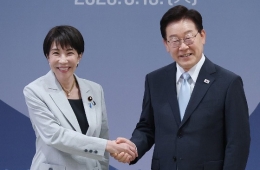
Lee Jae-myung, the Democratic Party presidential candidate, and Yoon Seok-youl, the People Power Party presidential candidate, are attending an event held on the 22nd at Grand Walkerhill Seoul in Gwangjin-gu, Seoul, and exchanging greetings. Photo by the National Assembly Press Photographers Group
View original image[Asia Economy Reporter Kim Jin-ho] With the 20th presidential election scheduled for March next year, tension is rising in the financial sector. This is because unexpected ‘pledge controversies’ have erupted, ranging from basic loans that ignore the essence of finance to the relocation of outdated financial public institutions to provinces and the full-scale easing of loan regulations. Depending on who is elected, the fortunes of financial authorities and financial companies are expected to diverge.
According to political and financial circles on the 16th, the most controversial financial pledge is Lee Jae-myung, the Democratic Party candidate’s basic finance policy. The basic finance pledge centers on providing all citizens with loans of up to 10 million won at low interest rates over a long period (10 to 20 years), regardless of credit rating. It is similar to a kind of overdraft account that can be freely used at any time during the maturity period.
Candidate Lee’s financial philosophy is to guarantee basic loan rights to low-credit borrowers to alleviate financial inequality in our society. At an invited lecture on the 7th, he criticized the financial sector, saying, "It is not fair that poor people pay high interest while the rich can borrow at low interest rates for a long time."
However, the financial sector has expressed concerns about Lee’s flagship pledge. The basic principle of finance is to lend money based on creditworthiness and charge differentiated interest rates as compensation for taking on more risk, but the concept of basic loans thoroughly overturns this. A financial sector official said, "I think this is a financial policy that ignores the essence of finance," adding, "Lending money at low interest rates for a long time to those who may have difficulty repaying is close to a populist pledge."
Professor Seo Ji-yong of Sangmyung University’s Department of Business Administration also pointed out, "If loans are given at low interest rates for a long time to borrowers with relatively high risk, there are concerns about insolvency from the perspective of bank soundness."
Yoon Seok-youl, the People Power Party candidate, has consistently called for easing loan regulations, but there are concerns that this could undermine financial market stability next year. Yoon proposed a dramatic financial support measure, such as easing the Loan-to-Value ratio (LTV) to a maximum of 80% when announcing his real estate policy.
Yoon believes that the sudden and excessive regulations of the Moon Jae-in administration caused side effects, but the financial sector expects Yoon’s pledge to also have a significant impact on the market. In particular, if the LTV is eased to 80%, there is a high possibility of a surge in housing prices and loans. Another financial sector official predicted, "If the loan regulations that were tightened this year are eased next year, it could become much more difficult for financial authorities to manage soaring household debt."
Financial public institutions such as policy banks are trembling at the talk of ‘relocation to provinces.’ Candidate Lee pledged to relocate all 200 or so public institutions in the metropolitan area to provinces if elected. This includes KDB Industrial Bank, Korea Eximbank, and IBK Industrial Bank among others. However, considering the special nature and operational efficiency of financial public institutions, relocation to provinces raises concerns about ‘weakening competitiveness.’ It is analyzed that the disadvantages outweigh the benefits of balanced development.
Professor Lee Min-hwan of Inha University’s Department of Global Finance said, "If institutions with central functions such as the Financial Services Commission or the Financial Supervisory Service do not move together, the effect will be extremely limited," adding, "In places without established financial infrastructure, there is a high risk of a direct hit to competitiveness."
Hot Picks Today
!["Rather Than Endure a 1.5 Million KRW Stipend, I'd Rather Earn 500 Million in the U.S." Top Talent from SNU and KAIST Are Leaving [Scientists Are Disappearing] ①](https://cwcontent.asiae.co.kr/asiaresize/93/2026051914165468840_1779167814.png) "Rather Than Endure a 1.5 Million KRW Stipend, I'd Rather Earn 500 Million in the U.S." Top Talent from SNU and KAIST Are Leaving [Scientists Are Disappearing] ①
"Rather Than Endure a 1.5 Million KRW Stipend, I'd Rather Earn 500 Million in the U.S." Top Talent from SNU and KAIST Are Leaving [Scientists Are Disappearing] ①
- "No Cure Available, Spread Accelerates... Already 105 Dead, American Infected"
- "If That's the Case, Why Not Just Buy Stocks?" ETFs in Name Only, Now 'Semiconductor-Heavy' and a Playground for Short-Term Traders
- "Reporters Who First Revealed Jo Jinwoong's Juvenile Offense History Cleared of Juvenile Act Violation"
- "How Did an Employee Who Loved Samsung End Up Like This?"... Past Video of Samsung Electronics Union Chairman Resurfaces
Meanwhile, financial authorities are also paying close attention to the election results. The direction of reform in the financial supervisory system could subtly differ depending on who becomes president. Both candidates Lee and Yoon agree that the current financial supervisory system, maintained for 13 years since 2008, needs change. Lee’s side advocates dismantling the Financial Services Commission, while Yoon’s side proposes unifying the Financial Supervisory Service’s policy and enforcement functions.
© The Asia Business Daily(www.asiae.co.kr). All rights reserved.