KOSPI Starts Up, Then Turns Down... Only Individuals Buy Alone Amid 'Volatility Watch'
![[Image source=Yonhap News]](http://www.asiae.co.kr/news/img_view.htm?img=2021101801265969695_1634488019.jpg)
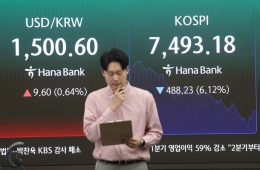
[Asia Economy Reporter Lee Seon-ae] The KOSPI index showed a slight decline after starting with an upward trend. The mixed positive and negative factors in various indicators are interpreted as causing volatility and cautious trading.
On the 18th, the KOSPI index opened at 3,017.48, up 2.42 points (0.08%). The KOSDAQ index started at 992.57, up 2.03 points (0.20%).
Both indices started higher but soon turned downward, showing a slight decline. The KOSPI fell below the 3,000 mark during the session and is currently around 2,990. The KOSDAQ is also below the 990 level.
Individual investors are the only net buyers, while foreigners and institutions are selling simultaneously. Individuals are net buying 209.5 billion KRW and 82.8 billion KRW in the KOSPI and KOSDAQ markets, respectively. On the other hand, foreigners are net sellers with 50.7 billion KRW and 59.6 billion KRW in the two markets. Institutions are also net sellers with 166.3 billion KRW and 16.3 billion KRW in the respective markets.
Seo Sang-young, a researcher at Mirae Asset Securities, said, "The U.S. stock market’s rise due to solid retail sales, favorable earnings reports, and expanded efforts to pass infrastructure investment legislation is positive for the Korean stock market. However, retail sales excluding the energy sector have not shown clear growth, and economic indicators such as consumer sentiment are weak, which is a burden." He added, "In particular, the Atlanta Federal Reserve Bank president’s continuous downward revisions of the U.S. GDP growth forecast for the third quarter to 1.2% and ongoing concerns about economic slowdown are also burdensome factors."
He continued, "Considering this, the Korean stock market is expected to start slightly higher but with a high possibility of profit-taking. If China’s real economy indicators released during the trading session show significant slowdown, it could further stimulate expectations for a rate cut by the People’s Bank of China, and the Korean stock market will be influenced by changes in the Chinese stock market based on these indicators." He emphasized the need to pay attention to the expected slowdown in China’s third-quarter GDP growth, industrial production, and fixed asset investment compared to the previous month.
Hot Picks Today
 "Samsung and Hynix Were Once for the Underachievers"... Hyundai Motor Employee's Lament
- "Sold Everything Fearing Bankruptcy, Then It Soared 3,900 Times: How a Stock Once Feared for Delisting Became an AI Powerhouse"
- Court Partially Grants Samsung Electronics' Injunction to Prohibit Industrial Action... 100 Million Won Penalty Per Day for Violations
- President Lee Attends Gwangju May 18 Ceremony... Declares 'A Nation Where the People Are the True Owners' at Democratic Cemetery
- "That? It's Already Stashed" Nightlife Scene Crosses the Line [ChwiYak Nation] ③
Meanwhile, on the 15th (local time) at the New York Stock Exchange (NYSE), the Dow Jones Industrial Average closed at 35,294.76, up 382.20 points (1.09%) from the previous session. The Standard & Poor’s (S&P) 500 index rose 33.11 points (0.75%) to 4,471.37, and the tech-heavy Nasdaq index ended at 14,897.34, up 73.91 points (0.5%).
© The Asia Business Daily(www.asiae.co.kr). All rights reserved.