Assemblyman Kim Seung-nam Ignores Distribution of 'Climate-Adapted New Variety Development' Funded with 92.2 Billion Won Budget
99 Varieties with Poor Distribution Management, Development Budget Reaches 32.75 Billion KRW
Low Distribution of 289 Climate-Adapted Varieties Developed by NACF... Need for Farmer-Customized Development

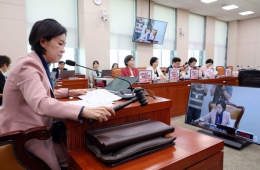
[Goheung=Asia Economy Honam Reporting Headquarters Reporter Lee Hyung-kwon] Congressman Kim Seung-nam urged at the Rural Development Administration's national audit on the 8th that the damages in the agricultural sector caused by abnormal climate such as global warming should be represented, and that the Rural Development Administration must take responsibility for identifying farmers' demands and developing and distributing climate-adaptive new varieties.
Last year, the longest rainy season in history lasted 54 days, resulting in 36 deaths and property damage worth 1 trillion won due to road damage, fruit drop, and crop flooding.
In April last year, abnormal low temperatures caused frost damage to crops, and in May and June, hail damaged fruit trees and open-field crops. From August to September, three typhoons occurred consecutively, causing continuous damage such as crop flooding, lodging, fruit drop, and loss and burial of farmland.
The Rural Development Administration is developing and distributing climate change-adaptive new varieties to respond to warming and abnormal weather on the Korean Peninsula.
From 2009 to last year, 35 crops and 289 varieties were developed with a budget of 92.2 billion won.
Among them, post-management has not been conducted for 99 varieties developed with about 32.75 billion won, and the distribution performance of 190 varieties managed by the Rural Development Administration is also poor, requiring special attention from the administration.
Among 49 rice varieties developed with 17.15 billion won by the Rural Development Administration, 29 varieties are currently cultivated on 113,141 hectares, accounting for only 15.5% of the total rice cultivation area.
For horticultural and special crops, which have high dependence on farm income, 32.4 billion won was invested to develop 99 varieties, but 45.5% (45 varieties) have unmonitored distribution performance, and the remaining 54 varieties are all cultivated on a small scale.
Congressman Kim Seung-nam said, "Despite the acceleration of subtropical phenomena due to global warming, reducing the cultivable areas for apples, grapes, peaches, etc., the number of farmers cultivating fruit trees with varieties developed by the Rural Development Administration is not increasing," and added, "For the climate-adaptive variety development project to succeed, it is essential to confirm farmers' preferred crops and varieties through prior demand surveys."
Hot Picks Today
 "Now Our Salaries Are 10 Million Won a Month" Record High... Semiconductor Boom Drives Performance Bonuses at Major Electronic Component Firms
- Wallets Open Wide on Big News...300 Trillion Won Heads to the U.S., "Tax Breaks" Fail to Keep Funds at Home
- "Realizing How Fast Money Disappears: Should You Try Only the Essentials for 5,000 Won? [The Basics of Benefits]"
- "Heading for 2 Million Won": The Company the Securities Industry Says Not to Doubt [Weekend Money]
- Experts Already Watching Closely..."Target Price Set at 970,000 Won" Only Upward Momentum Remains [Weekend Money]
He also stated, "The Rural Development Administration should conduct follow-up management on the distribution status of the 289 varieties previously developed, increase the cultivation area of new varieties, create stable income sources for farmers, and lead agricultural competitiveness."
© The Asia Business Daily(www.asiae.co.kr). All rights reserved.