Medical Expenses for Those Aged 65 and Over Surge from 14 to 37 Trillion Won... "'Moon Care' Requires Improvement in Health Insurance Premium Standards"
Korean Tripartite Commission for Social Affairs 'Public Forum on Health Insurance System Development Plan'

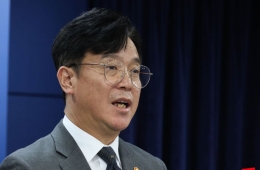
Moon Sung-hyun, Chairman of the Economic, Social and Labor Council. (Photo by Yonhap News)
View original image[Sejong=Asia Economy Reporter Moon Chaeseok] At the tripartite discussion involving labor, management, and government, who are the direct payers of health insurance premiums, opinions were raised that the criteria for imposing health insurance premiums should be improved amid a surge of over 23 trillion won in medical expenses for those aged 65 and older over the past decade due to policies strengthening coverage such as 'Moon Jae-in Care.'
Shin Youngseok, a senior research fellow at the Korea Institute for Health and Social Affairs, who presented at the "Public Forum for Exploring Development Plans for the Health Insurance System" held on the 29th by the Economic, Social and Labor Council, a social dialogue body under the president, argued this for financial expansion. According to Researcher Shin, medical expenses for those aged 65 and older skyrocketed from 1.4058 trillion won in 2010 to 3.7474 trillion won last year. Since the government has set a goal of 70% coverage rate by next year, the financial status of health insurance premiums is expected to worsen further.

Researcher Shin argued that the criteria for imposing premiums on income other than wages among workplace subscribers should be lowered to increase the number of subjects. This aims to prevent the omission of premium imposition on high-income individuals. He also suggested expanding government subsidies and raising premium rates.
Professor Kim Jinhyun of Seoul National University’s Department of Nursing, who gave the keynote presentation, announced the main opinions of labor, management, and government focusing on five areas: coverage, financial expenditure management, resource mobilization, governance reform, and linkage and cooperation. While labor, management, and government agreed on the need to expand health insurance coverage and establish a management system for medical expenses, they reportedly showed differences in detailed implementation plans for reaching a consensus statement. Regarding finances, they agreed on promoting rationalization of expenditures but had differing views on specific wording for re-evaluating the list of drug and treatment material costs and improving the total medical expense payment system.
Hot Picks Today
 "Stocks Are Not Taxed, but Annual Crypto Gains Over 2.5 Million Won to Be Taxed Next Year... Investors Push Back"
- "Don't Throw Away Coffee Grounds" Transformed into 'High-Grade Fuel' in Just 90 Seconds [Reading Science]
- Signed Without Viewing for 1.6 Billion Won... Jamsil and Seongbuk Jeonse Prices Jump 200 Million Won in a Month [Real Estate AtoZ]
- "Groups of 5 or More Now Restricted"... Unrelenting Running Craze Leaves Citizens and Police Exhausted
- "Even With a 90 Million Won Salary and Bonuses, It Doesn’t Feel Like Much"... A Latecomer Rookie Who Beat 70 to 1 Odds [Scientists Are Disappearing] ③
Moon Sunghyun, chairman of the Economic, Social and Labor Council, emphasized, "Health insurance is the most fundamental social safety net necessary for a healthy society," adding, "In light of the growing national demand for securing health rights, efforts to improve related systems have very important significance." He said, "It is a distinctive achievement to establish a dialogue framework involving labor and management, who are the direct parties bearing the burden of health insurance premiums, beyond the existing discussions centered on the medical industry," and added, "It will be an important starting point for preparing future system improvement measures."
© The Asia Business Daily(www.asiae.co.kr). All rights reserved.