Gyeonggi-do Partners with KAIST to Operate 'Mobile Negative Pressure Ward' Starting from the 13th

[Asia Economy (Suwon) = Reporter Lee Young-gyu] Gyeonggi Province is partnering with KAIST to operate a special living treatment center applying a 'Mobile Negative Pressure Ward (MCM)'.
On the 8th, Gyeonggi Province announced that starting from the 13th, it will operate the indoor gymnasium of the Gyeonggi Human Resources Development Institute located in Pajang-dong, Suwon, as Gyeonggi Province's second special living treatment center.
The province will operate this facility as a short-term treatment center linked to self-treatment for mild patients who require medical services. In particular, a mobile negative pressure ward developed by KAIST will be deployed here.
The short-term treatment center linked to self-treatment using the mobile negative pressure ward is attracting attention as a new quarantine system because it can not only alleviate the shortage of hospital beds caused by the surge in COVID-19 confirmed cases but also respond quickly if abnormal signs occur in self-treatment patients.
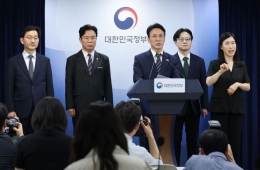
Gyeonggi Province Governor Lee Jae-myung visited the site on the day to check the preparation status and facilities and encouraged the officials. Present were KAIST President Lee Kwang-hyung, KAIST COVID-19 Response Science and Technology New Deal Project Director Bae Choong-sik, and KAIST Professor Nam Taek-jin.
Governor Lee said, "This special living treatment center seems to be an excellent system where science and technology and medical quarantine systems are very closely and cutting-edge combined," adding, "I hope we can quickly mass-produce it and consider exporting it worldwide. It is another good item that can raise South Korea's capability, technological level, and national prestige."
He continued, "I hope we can join forces to create a model medical quarantine system and set a precedent for responding to pandemics that will repeatedly occur."
KAIST President Lee Kwang-hyung responded, "From the general public's perspective, the most frightening thing is that hospitals are saturated and there is nowhere to go, but the mobile ward can free people from that anxiety, so it will be a great help," adding, "I am very pleased that the world's first mobile negative pressure ward developed by KAIST can contribute to COVID-19 quarantine."
Gyeonggi Province's second special living treatment center will consist of 28 beds in 14 rooms (2 persons per room) and one room (X-ray room, treatment room). Operation will be handled by Anseong Hospital of Gyeonggi Provincial Medical Center. Gyeonggi Province will oversee overall operation, and KAIST will be responsible for ward construction and facility complaint response.
Self-treatment confirmed patients who require monitoring will be admitted here for a short term of 1 to 3 days. If abnormal signs occur, they will be transferred to a dedicated (severe) hospital, and if there are no special issues, they will return home.
The biggest feature of the second special living treatment center is the use of the mobile negative pressure ward. Unlike existing living treatment centers, it operates in a face-to-face treatment format such as doctor and nurse rounds.
Depending on the patient's health condition, oxygen therapy, X-rays, and blood tests are also possible. The 'mobile negative pressure ward,' developed by KAIST as part of the Korean-style quarantine package technology development project and the world's first of its kind, is a block-type module with an air tent structure equipped with advanced medical facilities for negative pressure isolation.
KAIST developed the technology in July last year and, based on pilot operations (at the Korea Institute of Radiological & Medical Sciences and Konyang University Hospital), is now operating this center. For example, the emergency room at Konyang University Hospital installed it as a negative pressure isolation room, where 138 patients were treated over two months starting in June, and it is still in operation.
The mobile negative pressure ward excels not only in biological safety for medical staff and patients but also in protecting the privacy of hospitalized patients. Additionally, through the 'pass box' installed in the ward, items can be delivered without entering the room, reducing the difficulty for medical staff who must wear protective suits every time they enter.
Furthermore, the mobile negative pressure ward can be quickly set up, modified, or converted for use. When not in use, its weight and volume can be reduced by more than 70% and stored like military supplies. The modular package can also be transported by air, allowing the entire ward to be exported or provided to developing countries.
The second special living treatment center in Gyeonggi Province using the mobile negative pressure ward presents a new paradigm for the Korean quarantine system and is significant in establishing an efficient and optimized model for negative pressure beds.
In particular, when organically linked with Gyeonggi Province's self-treatment program, which has stably managed over 2,100 people since last March, the province expects it to greatly contribute to alleviating the shortage of hospital beds caused by the increase in confirmed cases during the fourth wave of COVID-19.
Hot Picks Today
!["Not Everyone Can Afford This: Inside the World of the True Top 0.1% [Luxury World]"](https://cwcontent.asiae.co.kr/asiaresize/93/2026051507261063923_1778797570.png) "Not Everyone Can Afford This: Inside the World of the True Top 0.1% [Luxury World]"
"Not Everyone Can Afford This: Inside the World of the True Top 0.1% [Luxury World]"
- While All Eyes Were on Samsung and Hynix, This Company Surged 50% to New Highs in Four Days [Weekend Money]
- "Now Our Salaries Are 10 Million Won a Month" Record High... Semiconductor Boom Drives Performance Bonuses at Major Electronic Component Firms
- "Sold Out Everywhere" The Surprising Story of the 'Purple Gold' Philippine Yam That Has Captivated the World [Delicious Stories]
- Experts Already Watching Closely..."Target Price Set at 970,000 Won" Only Upward Momentum Remains [Weekend Money]
The province plans to use the operational demonstration data from this center as reference material for responding to future infectious disease disasters.
© The Asia Business Daily(www.asiae.co.kr). All rights reserved.