Hankyung Research Institute "Significant Increase in Net Tax Burden on Future Generations Due to Fiscal Deterioration in 2019"
Professor Jeon Young-jun of Hanyang University Reveals Findings in Report on "Generational Net Tax Burden Changes Due to Government Fiscal Shifts"

[Asia Economy Reporter Kim Heung-soon] A study has revealed that the lifetime net tax burden on future generations to be born will significantly increase due to the large deficit recorded in the fiscal balance in 2019.
The Korea Economic Research Institute (KERI), under the Federation of Korean Industries, announced this on the 31st through a report titled "Net Tax Burden by Generation According to Changes in Government Finances," commissioned to Professor Jeon Young-jun of Hanyang University. The net tax burden refers to the amount of taxes and social insurance premiums combined minus public transfer income such as welfare benefits.
Future Generations' Net Tax Burden Increases by 129.41 Million to 143.06 Million KRW Due to 2019 Fiscal Deficit Deterioration
The report claimed that the deterioration of the fiscal balance in 2019 caused a sharp increase in the net tax burden on future generations. It first pointed out that the fiscal balance worsened drastically in 2019. The integrated fiscal balance shifted from a surplus of 31.2 trillion KRW in 2018 to a deficit of 12 trillion KRW in 2019, and the management fiscal balance deficit widened from 10.6 trillion KRW in 2018 to 54.4 trillion KRW in 2019. Due to this fiscal deterioration, the 'lifetime net tax burden' (FLGA) of future generations increased significantly compared to 2018. In contrast, the burden on the current generation showed little change.
Specifically, when other in-kind benefits such as health and education services were considered as government consumption and analyzed, the net tax burden on future generations increased by 143.06 million KRW per person, while the current generation saw only a slight increase (up to 7.53 million KRW) across most age groups. Even when other in-kind benefits were included as transfer income, the net tax burden on future generations rose by 129.41 million KRW, whereas the current generation's increase was up to 5.95 million KRW. There was a slight decrease among younger and elderly age groups.
Fiscal Deficit Worsening in 2019 Also Expanded Intergenerational Inequality
The report pointed out that the worsening fiscal balance in 2019 increased the net tax burden on future generations, thereby expanding intergenerational inequality (GI). GI is calculated by dividing the difference in net tax burden between future and current generations by the current generation's net tax burden. An increase in GI indicates that the burden on future generations is greater than that on the current generation, thus widening intergenerational inequality.
According to the report, when other in-kind benefits are regarded as government consumption rather than transfer income, intergenerational inequality decreased from 250.8% in 2014 to 225.5% in 2017 but surged to 267.2% in 2019. Even when other in-kind benefits were included as transfer income, intergenerational inequality expanded significantly from 494.1% in 2018 to 648.7% in 2019.
Due to the fiscal deterioration from 2018 to 2019, the scale of tax adjustments needed to achieve long-term fiscal balance also increased substantially. If tax burdens are raised in 2022, the required tax adjustment scale rose by 6.8 percentage points from 47.4% (2018) to 54.2% (2019). When tax increases are combined with reductions in transfer income, the required tax adjustment scale in 2022 increased by 3.8 percentage points from 28.6% (2018) to 32.4% (2019). Including other in-kind benefits as transfer income showed an increase of 3.5 percentage points from 26.2% (2018) to 29.7% (2019).
Hot Picks Today
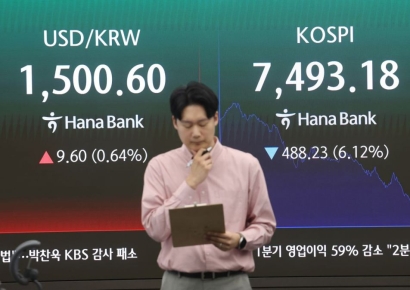 After Topping 8,000 Instead of Hitting 10,000... KOSPI Plunges—When Will It Rebound?
- "Samsung and Hynix Were Once for the Underachievers"... Hyundai Motor Employee's Lament
- [Breaking] Court Rules Against Samsung Electronics Union...1 Billion Won per Day Penalty for Exceeding Strike Scope
- Court Partially Grants Samsung Electronics' Injunction to Prohibit Industrial Action... 100 Million Won Penalty Per Day for Violations
- "That? It's Already Stashed" Nightlife Scene Crosses the Line [ChwiYak Nation] ③
Professor Jeon said, "Since the fiscal balance in 2020 is expected to have worsened compared to 2019, indicators of fiscal soundness and intergenerational inequality are also likely to have deteriorated further," adding, "Fiscal policy reforms aimed at restoring fiscal soundness must be implemented."
© The Asia Business Daily(www.asiae.co.kr). All rights reserved.