
[Asia Economy Reporter Junho Hwang] Since the release of the Federal Open Market Committee (FOMC) minutes last month, fears about tapering (quantitative easing reduction) have increased. The market expects that discussions on tapering could take place as early as the next FOMC meeting, with official implementation possibly announced at the August Jackson Hole speech. There is also a view that an official announcement could be made at the December FOMC meeting, just before the term expiration of Fed Chair Jerome Powell, who was appointed by former U.S. President Donald Trump. Since the absorption of liquidity in the U.S. significantly affects not only the U.S. stock market but also the economy of allied countries like South Korea, market participants are closely monitoring the Fed's movements.
Jaeman Lee, a researcher at Hana Financial Investment Research Center, said in a stock strategy report on the 23rd, "The market is recalling the period of 2013-2014." In May 2013, then Fed Chair Ben Bernanke mentioned tapering. An official announcement was made at the December FOMC meeting just before his term ended. From January to October 2014, the asset purchase scale was reduced by $10 billion monthly, and the asset purchase policy was terminated. From June to December 2013 was the tapering preparation phase, and 2014 can be seen as the actual implementation phase. During the preparation phase, international crude oil (WTI) was priced at $108 per barrel (August 2013), and the U.S. Consumer Price Index (CPI) year-over-year (YoY) growth rate peaked at 1.8% in June before turning downward. Meanwhile, the unemployment rate, which reflects the real economy, also fell (from 7.6% to 6.7%), and based on the possibility of tapering implementation, the U.S. 10-year Treasury yield surged from 1.7% to 3.0%. At that time, the KOSPI rebounded on the judgment that tapering was being prepared based on real economic improvement rather than inflation. Growth stocks such as software (42% price return) and cyclical stocks like shipbuilding (30%) showed simultaneous strength.
On the other hand, during the actual tapering implementation phase in 2014, the U.S. 10-year Treasury yield actually declined. Unlike the U.S., emerging market stocks including the KOSPI experienced a long-term sideways phase. At that time, in the KOSPI, stocks that played the role of growth stocks such as cosmetics (+69% price return), hotel/leisure (+20%), and consumer staples showed strength. Conversely, cyclical stocks such as shipbuilding, refining, and chemicals underperformed. Lee said, "Currently, it is necessary to consider this as a tapering preparation phase similar to the second half of 2013. First, if the 10-year Treasury yield rises based on U.S. labor market improvement as in 2013, cyclical sectors could also be highlighted." However, he added, "Currently, the PBRs of refining, chemicals, steel, construction, machinery, and shipbuilding sectors are at or near the levels seen when the U.S. 10-year Treasury yield rose to 3% in 2013," and explained, "Among them, the banking sector is the most attractive investment based on PBR (2013 peak PBR was 0.61x, currently 0.42x)."
Hot Picks Today
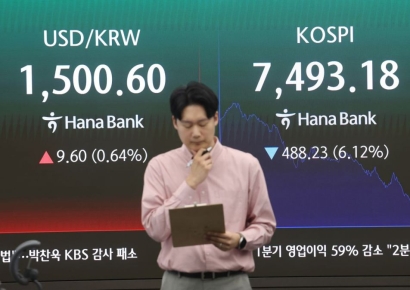 After Topping 8,000 Instead of Hitting 10,000... KOSPI Plunges—When Will It Rebound?
- "Samsung and Hynix Were Once for the Underachievers"... Hyundai Motor Employee's Lament
- [Breaking] Court Rules Against Samsung Electronics Union...1 Billion Won per Day Penalty for Exceeding Strike Scope
- Six Economic Organizations Urge Withdrawal of Samsung Electronics Strike Plan...Warn of National Loss of Opportunity
- "That? It's Already Stashed" Nightlife Scene Crosses the Line [ChwiYak Nation] ③
Meanwhile, Lee expects that due to economic improvement and inflation expectations this year, most sectors will see sales increase compared to the previous year. However, he believes that the degree of operating profit margin improvement will vary by sector during the sales growth phase. Considering the outlook for both sales growth (QoQ, %) and operating profit margin improvement (QoQ, %p) in the first and second halves of 2021 for sectors that showed significant operating profit margin improvement during past sales growth phases, he forecasts a bright outlook for sectors such as media, hotel/leisure, and IT hardware.
© The Asia Business Daily(www.asiae.co.kr). All rights reserved.







