Nationalist Party Victory in Kosovo Early Election... Tensions with Serbia Expected to Escalate
Nationalist-leaning 'Jagyoldang' Wins Over 47% of Votes... Overwhelming 1st Place
"Peace Agreement with Serbia May Become More Difficult"

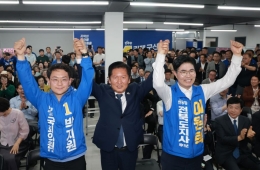
On the 14th (local time), immediately after exit polls predicted a victory for the Vet?vendosje (VV) party in the early general election, VV leader Albin Kurti (center) is taking photos with supporters. Prishtina (Kosovo) - Photo by Reuters
View original image[Asia Economy Reporter Kim Suhwan] The early general election held in Kosovo has virtually confirmed the return to power of a nationalist-leaning party. As a result, tensions with neighboring Serbia, with which Kosovo has conflicts over independence, are expected to escalate, leading to speculation that the political situation on the Balkan Peninsula, often called Europe's powder keg, has entered a foggy state.
According to local media such as Kosovopress on the 14th (local time), with 91% of the votes counted in the early general election held that day, the nationalist-leaning left-wing party 'Vet?vendosje (VV)' secured 47.71% of the vote, far ahead of the center-right Kosovo Democratic Party (PDK), which obtained 17.3%. This early election was held following the Kosovo Constitutional Court's decision in December last year to invalidate the election of Deputy Prime Minister Abdulla Hoti as Prime Minister due to his criminal record, ruling that he was disqualified from the position and ordering a re-election.
Albin Kurti, leader of VV, said in a public speech immediately after VV's victory was confirmed, "Today is another historic day since the end of the Kosovo War," adding, "It shows that our democracy is functioning properly."
Through this election, VV succeeded in returning to power after 11 months since its fall in March last year over issues related to COVID-19 response. At that time, conflicts arose with the coalition partner, the center-right Kosovo Democratic League (LDK), over COVID-19 measures, leading to a no-confidence motion against the cabinet led by LDK, which passed and caused the coalition to collapse after 51 days. Subsequently, LDK's Hoti was appointed Prime Minister and led a transitional government.
AFP analyzed the landslide victory of VV in this election as "reflecting voters' desire for change due to dissatisfaction with the existing political establishment."
VV advocates a tougher diplomatic stance toward Serbia amid ongoing conflicts over Kosovo's independence, demanding reparations for damages caused by the Kosovo War and the return of stolen artifacts. Kurti himself, a former student movement leader who resisted Serbia's oppressive policies during the Kosovo War, has criticized previous government leaders for adopting an overly submissive diplomatic approach toward Serbia.
With VV's return to power confirmed by this election, there are expectations that the peace agreement efforts between Kosovo and Serbia, led by the Western world, will become more difficult. The U.S. media outlet Politico reported, "VV has declared it will make no concessions to Serbia during the peace agreement process," adding, "Kurti's aggressive diplomatic stance has put the United States and the European Union (EU), which have been working to restore diplomatic relations between Kosovo and Serbia, in a difficult position."
Meanwhile, Kosovo has a per capita national income of $4,300 (approximately 4.76 million KRW), making it one of the poorest countries in Europe. In the late 1990s, during the breakup of the Yugoslav Federation, Kosovo attempted to secede from Serbia, leading to the so-called 'Kosovo War,' in which about 13,000 people lost their lives.
Hot Picks Today
!["Not Everyone Can Afford This: Inside the World of the True Top 0.1% [Luxury World]"](https://cwcontent.asiae.co.kr/asiaresize/93/2026051507261063923_1778797570.png) "Not Everyone Can Afford This: Inside the World of the True Top 0.1% [Luxury World]"
"Not Everyone Can Afford This: Inside the World of the True Top 0.1% [Luxury World]"
- While All Eyes Were on Samsung and Hynix, This Company Surged 50% to New Highs in Four Days [Weekend Money]
- "Now Our Salaries Are 10 Million Won a Month" Record High... Semiconductor Boom Drives Performance Bonuses at Major Electronic Component Firms
- "150 Trillion-Won National Growth Fund Launches... Construction Stocks Stir Again" [Weekend Money]
- Experts Already Watching Closely..."Target Price Set at 970,000 Won" Only Upward Momentum Remains [Weekend Money]
Nine years after the end of the civil war, in 2008, Kosovo declared independence from Serbia with the approval of the United Nations, the United States, and Western Europe. However, Serbia and its allies, including Russia, China, as well as five EU member states?Greece, Spain, and others?have not recognized Kosovo's independence and have even blocked its admission to the United Nations.
© The Asia Business Daily(www.asiae.co.kr). All rights reserved.