Despite Spending 25 Trillion Won, Worst Employment Slump... Government Again Promotes 'Gonggong Iljari'
Employment Shock Worsens Due to COVID-19 Impact
Number of Employed Persons Last Year Drops Most in 22 Years
Experts Say "Public Jobs Have Limits in Solving Employment Crisis"

The employment shock caused by the novel coronavirus disease (COVID-19) has been severe. According to the 'December 2020 and Annual Employment Trends' released by Statistics Korea on the 13th, the number of employed people last year was 26,904,000, a decrease of 218,000 compared to the previous year.
/Photo by Yonhap News
[Asia Economy Reporter Kang Juhee] The employment shock caused by the spread of the novel coronavirus infection (COVID-19) is reaching its worst level. The number of employed people last year decreased at the largest rate since the 1998 foreign exchange crisis, and the number of unemployed people recorded the highest level since 2000.
Although the government implemented measures such as investing 25 trillion won in the job budget last year and providing 940,000 public jobs, most of these were short-term or focused on elderly employment, failing to prevent employment difficulties among the youth.
Experts suggest that it is urgent to create sustainable long-term jobs rather than temporary jobs like public employment.
According to the 'December 2020 and Annual Employment Trends' announced by Statistics Korea on the 13th, the number of employed people last year was 26,904,000, down 218,000 from the previous year. This is the largest decrease in 22 years since 1998 (-1,276,000), right after the foreign exchange crisis.
There have been only four occasions when the annual number of employed people decreased compared to the previous year: 1984 due to the oil shock and domestic recession (-76,000), 1998 foreign exchange crisis (-1,276,000), 2003 credit card crisis (-10,000), and 2009 global financial crisis (-87,000).
Other employment indicators such as unemployment rate, employment rate, and economically inactive population also worsened. The number of unemployed people last year was 1,108,000, an increase of 45,000 (4.2%) from the previous year. This is the highest since related statistics began in 2000.
The number of unemployed people exceeded one million for five consecutive years following 2016 (1,009,000), 2017 (1,023,000), 2018 (1,073,000), and 2019 (1,063,000). The unemployment rate, which is the proportion of unemployed people among the economically active population, rose 0.2 percentage points from the previous year to 4.0%, marking the highest since 2001 (4%). The youth (ages 15?29) unemployment rate rose back to the 9% range at 9.0%, the first time in two years since 2018 (9.5%).
The employment rate fell 0.8 percentage points to 60.1%, the lowest since 2013 (59.8%). The OECD comparison standard employment rate for ages 15?64 was 65.9%, down 0.9 percentage points from the previous year, marking the lowest since 2015 (65.9%).

On the 12th, an unemployment benefits briefing session was held for unemployed individuals at the Seoul Employment Welfare Plus Center in Jung-gu, Seoul. Photo by Hyunmin Kim kimhyun81@
View original imageAmong the population over 15 years old, the economically inactive population, who are neither employed nor unemployed, was 16,773,000, an increase of 455,000 (2.8%) compared to the previous year. This increase was the largest since 2009 (495,000). Among them, the population who did not engage in economic activities regardless of household duties or studies, categorized as 'resting,' was 282,000 (13.5%).
By age group, only those aged 60 and over saw an increase in employed people, while all other age groups experienced decreases. The number of employed people aged 60 and over increased by 375,000, of which 236,000 were aged 65 and over, and 124,000 were aged 70 and over. This appears to be influenced by the government's public job policies increasing elderly employment.
On the other hand, the number of employed people in their 20s (-146,000) decreased the most in 22 years since 1998 (-563,000). The number of employed youth (ages 15?29) also decreased by 183,000, the largest since 1998 (-616,000). Those in their 30s (-165,000), 40s (-158,000), and 50s (-88,000) also saw decreases in employment.

Hong Nam-ki, Deputy Prime Minister and Minister of Economy and Finance, is attending the 'Emergency Economic Central Countermeasures Headquarters Meeting and Korean New Deal Related Ministers Meeting' held on the 13th at the Government Seoul Office in Jongno-gu, Seoul. Photo by Kang Jin-hyung aymsdream@
View original imageFaced with the worst employment indicators, the government announced plans to additionally prepare measures to revitalize youth employment and create jobs.
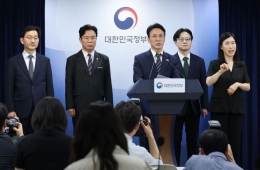
On the 13th, Hong Nam-ki, Deputy Prime Minister and Minister of Economy and Finance, held an emergency economic central countermeasure headquarters and Korean New Deal ministerial meeting, stating, "The employment situation in December worsened due to the combined effects of the third wave of COVID-19 in November last year and the base effect," and added, "We will additionally prepare measures to revitalize youth employment and expand women's jobs in the first quarter of this year."
Deputy Prime Minister Hong also said, "More than 45% of public institution recruitment this year will be completed in the first half, and the recruitment process for 22,000 interns will be promptly initiated this month. Furthermore, to alleviate short-term employment shocks, the public sector will play a supporting role in the first quarter, when the employment shock is expected to be the greatest, by focusing on hiring 80% (830,000 people) of the directly planned job projects and 44% (28,000 people) of social service jobs planned for this year."
However, there are many skeptical views regarding the government's public job policies. Although the government supplied about 940,000 public sector jobs last year, most were focused on elderly employment and short-term jobs, which was not very effective in solving youth employment difficulties.
With the government's public job projects ending in November last year, the number of employment insurance subscribers in December increased by only 239,000, significantly less than the nearly 400,000 increase in the previous month. Some point out that this clearly reveals the limitations of short-term public job policies funded by public finances.
Experts emphasize that creating sustainable and developing jobs is important for generating quality employment. Professor Kim Taegi of Dankook University's Department of Economics criticized, "It is true that the economy worsened due to COVID-19, but the employment crisis had already appeared before COVID-19. The government's income-led growth policy did not help job creation at all and rather resulted in destroying the employment market."
Hot Picks Today
!["Not Everyone Can Afford This: Inside the World of the True Top 0.1% [Luxury World]"](https://cwcontent.asiae.co.kr/asiaresize/93/2026051507261063923_1778797570.png) "Not Everyone Can Afford This: Inside the World of the True Top 0.1% [Luxury World]"
"Not Everyone Can Afford This: Inside the World of the True Top 0.1% [Luxury World]"
- While All Eyes Were on Samsung and Hynix, This Company Surged 50% to New Highs in Four Days [Weekend Money]
- "Now Our Salaries Are 10 Million Won a Month" Record High... Semiconductor Boom Drives Performance Bonuses at Major Electronic Component Firms
- "150 Trillion-Won National Growth Fund Launches... Construction Stocks Stir Again" [Weekend Money]
- Experts Already Watching Closely..."Target Price Set at 970,000 Won" Only Upward Momentum Remains [Weekend Money]
He continued, "Despite the clear failure of the policy, the government is still focusing only on creating public jobs this year. Without creating long-term jobs, employment difficulties and income inequality will inevitably worsen. Sustainable jobs must be created, such as shifting labor to booming new industries."
© The Asia Business Daily(www.asiae.co.kr). All rights reserved.