Gwangju Mayor Lee Yong-seop: "I Will Make Next Year 'Gwangju's Time' That No One Can Follow"
Gwangju's 2 Years 6 Months of Top 100 Achievements & 2021's 15 Major Policy Directions Announced
Labor-Management Win-Win Model Gwangju-type Job Bearing Fruit, GGM Car Production Next Year
After 16 Years of Debate, Urban Railway Line 2 Phase

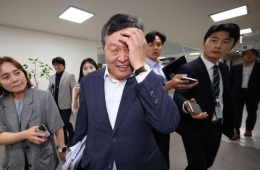
On the morning of the 28th, Lee Yong-seop, Mayor of Gwangju Metropolitan City, held a year-end press conference in the city hall's medium conference room, announcing the top 100 major achievements (30 core achievements) over 2 years and 6 months since the launch of the 7th local government and the 15 major policy directions for 2021. Photo by Gwangju Metropolitan City
View original image[Asia Economy Honam Reporting Headquarters Reporter Park Seon-gang] On the 28th, Lee Yong-seop, Mayor of Gwangju Metropolitan City, held a year-end press conference and announced the top 100 major achievements (30 core achievements) over 2 years and 6 months since the launch of the 7th local government, along with 15 major policy directions for 2021.
Since the launch of the 7th local government under Mayor Lee Yong-seop 2 years and 6 months ago, it is evaluated that the administration quickly settled on a normal track by solving long-standing issues one after another based on innovation and communication, and produced numerous significant achievements that can change the future map of Gwangju.
Gwangju, which was losing people due to lack of jobs, is transforming into a city where AI companies and talents come, and is leaping from a political hub to an economic hub.
The core values running through the 7th local government of Gwangju are innovation and communication, and the remarkable achievements are also considered possible because they were supported by innovation and communication.
Through innovation and communication, the Gwangju-type job project, a world-unique labor-management win-win model, was successfully implemented, and the path to the era of artificial intelligence in Gwangju, which no one had ever taken, was opened.
The issue of Urban Railway Line 2, which had been debated for 16 years, was resolved through public discussion, and despite an extremely insufficient budget, the Gwangju World Swimming Championships were successfully held as a “low-cost, high-efficiency” profitable event.
During the unprecedented COVID-19 crisis, proactive response, bed solidarity with Daegu, and active cooperation of citizens were the core driving forces that safely protected the Gwangju community, all based on innovation and communication.
Gwangju’s remarkable achievements are also reflected in various statistics.
The city attracted 124 major national projects that will change the future map of Gwangju and created 46 achievements with the titles of “first in the country, only in the country, largest in the country.” Recognizing these achievements, it recently received the highest grade in the government innovation evaluation hosted by the Ministry of the Interior and Safety, among a total of 140 meaningful awards.
Moreover, despite the severe crisis of COVID-19, the opening of the AI era in Gwangju was possible because of the “innovative prediction that only the artificial intelligence industry, the core of the 4th Industrial Revolution, can be the breakthrough for the underdeveloped Gwangju to leap into a global leading city.”
The city is also moving swiftly with civil society organizations to declare a bold Green New Deal vision to realize Korea’s first carbon-neutral, energy self-sufficient city by 2045 as another innovative challenge.
Next year, Gwangju plans to use these achievements as stepping stones to rapidly promote the so-called three major New Deals of Gwangju: the AI-centered Digital New Deal, the carbon-neutral Green New Deal, and the win-win and safety-oriented Human New Deal, aiming to realize a “just and prosperous Gwangju.”
Mayor Lee Yong-seop said, “I believe it is my mission to create a ‘just and prosperous Gwangju’ by adding prosperity to justice and to establish it as Korea’s future and a global leading city. I have been running tirelessly every day with the determination to write a new history of Gwangju,” and added, “In the New Year of the Year of the Ox, I will ensure that the seeds of innovation carefully sown so far take deep root and bear fruit, leading to job creation and revitalization of the local economy.”
Hot Picks Today
!["Rather Than Endure a 1.5 Million KRW Stipend, I'd Rather Earn 500 Million in the U.S." Top Talent from SNU and KAIST Are Leaving [Scientists Are Disappearing] ①](https://cwcontent.asiae.co.kr/asiaresize/93/2026051914165468840_1779167814.png) "Rather Than Endure a 1.5 Million KRW Stipend, I'd Rather Earn 500 Million in the U.S." Top Talent from SNU and KAIST Are Leaving [Scientists Are Disappearing] ①
"Rather Than Endure a 1.5 Million KRW Stipend, I'd Rather Earn 500 Million in the U.S." Top Talent from SNU and KAIST Are Leaving [Scientists Are Disappearing] ①
- Given Grants, Then Says "No Launch" ... Innovative Korean Technology Ultimately Forced Overseas
- [Breaking] Chairman Park Sookeun: "Possibility of Agreement Instead of Samsung Electronics Labor-Management Mediation Proposal"
- "If That's the Case, Why Not Just Buy Stocks?" ETFs in Name Only, Now 'Semiconductor-Heavy' and a Playground for Short-Term Traders
- "No Cure Available, Spread Accelerates... Already 105 Dead, American Infected"
He continued, “With a spirit of adaptive innovation (응변창신), we will take the lead in change and pioneer new paths to make 2021 a ‘time of Gwangju’ that no one can follow. I ask our citizens to continue to trust and walk this path with us as always.”
© The Asia Business Daily(www.asiae.co.kr). All rights reserved.
![Cheaper Than Candy, Yet Impossible to Find... Fears of a 'Pediatric Medical Crisis' as Pharmaceutical Companies Halt Production [Why&Next]](https://cwcontent.asiae.co.kr/asiaresize/307/2026051910065268365_1779152813.jpg)