"Expectations for Restoring Korea-China Relations to Pre-THAAD Levels during Xi Jinping's Visit to Korea Next Year"
FKI, 2021 China Economic Outlook Survey

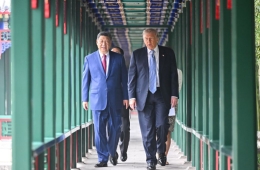
[Asia Economy Reporter Dongwoo Lee] It has been pointed out that if Chinese President Xi Jinping's visit to South Korea, which was canceled due to the COVID-19 pandemic, takes place next year, it could serve as an opportunity for Korean companies' activities in China to recover to the level before the THAAD (Terminal High Altitude Area Defense) incident.
The Federation of Korean Industries (FKI) announced on the 28th that, based on a survey of 31 China economic experts on the '2021 Outlook and Challenges for the Chinese Economy and Korea-China Trade and Investment,' assuming the Korea-China relationship was at 100 just before the THAAD incident, the relationship between the two countries is expected to recover and rise to about 104 if President Xi's visit is realized.
It is explained that with President Xi's visit as a turning point, the lifting of China's travel restrictions and improvement in Korea-China relations, along with the easing of the COVID-19 situation and recovery of China's domestic demand, the economic relationship between the two countries could surpass the level before the THAAD incident. Previously, China implemented tangible and intangible sanctions in response to South Korea's decision to deploy THAAD in 2016, causing the number of Chinese visitors to South Korea to plummet from about 8 million in 2016 to 4 million in 2017.
China economic experts forecast China's economic growth rate in 2021 to be 7.8%, an increase of 5.6 percentage points from this year. In particular, due to the low growth base effect this year, the growth rate is expected to be the largest increase since 2013. The International Monetary Fund (IMF) also projected China's economic growth rate next year at 8.2%.

South Korea's export growth rate to China next year is also expected to be 8.1%, turning positive after two years of negative growth. Exports to China until October this year decreased by 3.7% compared to the same period last year due to trade contraction caused by COVID-19. However, this is considered a relatively favorable level compared to the overall export decline of -8.2% during the same period.
After the inauguration of the new U.S. administration next year, 51.6% of respondents expect the U.S.-China trade dispute to ease, which is about four times higher than the 12.9% who expect it to intensify. The FKI analyzed that this could have a somewhat positive effect on domestic export companies struggling due to the U.S.-China trade dispute and the spread of protectionism.
Experts identified the following as supplementary tasks for the Korea-China 'Fast Track' implemented since May: 'simplification of quarantine procedures (38.7%)', 'expansion of applicable areas (25.8%)', 'establishment of a one-stop service window (19.4%)', and 'increase in flight operations (16.1%)'.
As priority tasks for smooth Korea-China business, respondents answered in order: 'enhancing utilization of the Korea-China Free Trade Agreement (FTA) and the Regional Comprehensive Economic Partnership (RCEP) (30.1%)', 'easing entry restrictions for businesspeople (25.8%)', and 'facilitating logistics and transportation (16.1%)'. There is an opinion that more focus should be placed on strengthening economic ties with China through multilateral and free trade channels such as the RCEP, which was signed on the 15th of last month.

Experts responded that Korean companies should pay attention to artificial intelligence (20.7%), data centers (19.6%), industrial internet (18.5%), and 5G (17.4%) in the Chinese market, where large-scale investments are expected next year. In May, China announced plans to expand investment in seven new types of infrastructure totaling 10 trillion yuan (approximately 1,700 trillion won) over the next five years as a total solution for qualitative growth, domestic demand stimulation, and supply reform at the National People's Congress.
Hot Picks Today
 "Do We Need to Panic Buy Again?" War Drives 30% Price Surge... Even the Bedroom Feels the Impact
- "Is a 10,000 KOSPI Breakthrough Possible?" Target Index Raised by 40%... Securities Firms Release Outlook [Weekend Money]
- "Contact Me First If Houses Are Built": Wealthy Clients Eyeing... Will Ultra-High-End Residences Worth 20 Billion Won Be Developed? [Real Estate AtoZ]
- "Anyone Who Visited the Room Salon, Come Forward"… Gangnam Police Station Launches Full Staff Investigation After New Scandal
- Trump's Remark on "Detailed Talks with Xi Jinping on Taiwan Arms Sales" Sparks Controversy... Taiwan Moves to Defuse Tensions (Comprehensive)
Kim Bong-man, Director of International Cooperation at the FKI, said, "Despite the resurgence of COVID-19, China is expected to achieve positive economic growth this year and high growth of around 8% next year. If we utilize China's economic recovery and the seven new infrastructure investment plans, there will be great opportunities for Korean companies' business in China."
© The Asia Business Daily(www.asiae.co.kr). All rights reserved.