'Strengthening Regulations on Department Stores and Shopping Malls' Bill Postponed to Next Year... Expect Coordination Between Ruling and Opposition Parties
Restrictions on Complex Shopping Mall Openings Following Large Mart Limits
Mandatory Department Store Closures and Expansion of Traditional Commercial Preservation Zones
Amendments to Distribution Act Under Subcommittee Review... Difficult to Pass Within This Year
Retail Industry Relieved... Eyes on Next Year
Public Hearing Expected to Gather Industry Opinions

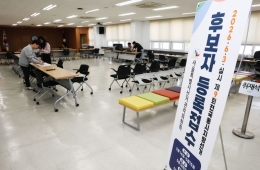
On the 16th, when the number of new COVID-19 confirmed cases reached 1,078, the highest since the first case was reported in the country on January 20th, a large shopping mall in downtown Seoul appeared quiet. Photo by Hyunmin Kim kimhyun81@
View original image[Asia Economy Reporter Cha Min-young] As it becomes difficult for the bill to strengthen regulations on the distribution industry, including complex shopping malls?a joint policy pledge of the ruling Democratic Party of Korea and the Together Citizens' Party with 177 seats?to pass the regular session of the National Assembly within this year, the industry is breathing a sigh of relief. Among the 15 bills, 14 are either awaiting or undergoing review by the relevant committees, and additional feedback is expected to be collected through industry public hearings around February next year. A distribution industry official expressed urgency, saying, "If government regulations are strengthened amid the crisis caused by the novel coronavirus infection (COVID-19), companies will inevitably falter."
According to related industries and the National Assembly on the 19th, among the 15 bills to amend the Distribution Act, only one bill proposed by 11 lawmakers including Lee Jang-seop of the Democratic Party of Korea has passed the subcommittee review of the Industry, Trade, Energy, Small and Medium Enterprises Committee, which is the relevant committee. This bill extends the current regulation period on traditional commercial preservation zones and quasi-large stores, which expires on November 23 this year, by five years. The remaining 14 bills are either under subcommittee review or awaiting review. The subcommittee is effectively concluding the National Assembly session after the 4th subcommittee meeting held on the 26th of last month.
The bills to amend the Distribution Act proposed in the 21st National Assembly focus on tightening regulations on large distribution companies under the pretext of protecting traditional markets and promoting the mutual development of local small business owners. Among the 15 bills, eight, which constitute the majority, contain regulatory strengthening measures on the opening of large-scale stores such as large marts, complex shopping malls, and department stores, as well as regional coexistence. In particular, the bill regulating complex shopping malls, which was pending in the 20th National Assembly, raised concerns as it was expected to accelerate legislation with the emergence of the ruling party's majority. These include ▲ adding complex shopping malls to the list of large-scale stores subject to opening restrictions and including mandatory holidays and operating hour restrictions for department stores and duty-free shops (proposed by Democratic Party lawmaker Lee Dong-joo) and ▲ expanding the traditional commercial preservation zone, which restricts the opening of large-scale stores, from a 1 km radius from the traditional market boundary to within 20 km (proposed by Democratic Party lawmaker Kim Jeong-ho). On the other hand, only three bills deal with easing regulations related to large-scale stores.

On the 24th, when social distancing in the metropolitan area was raised to Level 2, a large shopping mall in Seoul city showed a quiet appearance. Photo by Hyunmin Kim kimhyun81@
View original imageThe problem is that the traditional commercial preservation zone, which restricts the opening of large-scale stores to protect traditional markets and small business owners, has shown unclear policy effects since its enactment in March 2012. According to the research results of the Korea Distribution Science Association's "Evaluation of 10 Years of Distribution Regulation and Win-Win Plan for Large and Small Distribution" released last September, during the eight-year mandatory holiday regulation period for large marts, a balloon effect was detected where consumers who left for e-commerce, convenience stores, food material marts, and health & beauty (H&B) stores shifted to other business types. In fact, the proportion of small supermarkets with sales under 500 million KRW was 87.7% in 2014 but decreased by 4.6 percentage points to 83.7% in 2019, and the market share (MS) decreased by 1.5 percentage points during this period. Among the 465 respondents, only 27 (5.81%) answered that they used traditional markets on the mandatory holiday of large marts.
As a counterbalance to the strengthening of offline channel regulations, e-commerce companies have grown rapidly, and this year, combined with the COVID-19 pandemic, traditional offline channels have been cornered. E-Mart sold 10 stores in a sale-and-leaseback format at the end of 2019 and is preparing to sell the Gayang branch at the end of this year. Homeplus sold four stores in a sale-and-leaseback format. Lotte Mart, at the Lotte Shopping level, prepared a strong restructuring plan to reorganize 30% (about 200) of inefficient offline stores, including not only marts but also department stores. According to the Distribution Science Association, when a large mart closes, it is analyzed that there is an employment reduction effect of 1,616 people in surrounding stores, including supermarkets, restaurants, and retailers within a 1 km radius of the large mart. When the radius is expanded to within 3 km, the estimated reduction is 7,898 people.
Hot Picks Today
 "Suspicious Timing?"...Trump Traded Stocks After Praising Wartime Capabilities
- "I Went to 10 Convenience Stores and Still Couldn't Buy It": The Bread Sensation That Sold 100 Million Units Already [The Way We Shop Now]
- [Breaking] Trump: "U.S. and Nigerian forces eliminate IS number two"
- There Is a Distinct Age When Physical Abilities Decline Rapidly... From What Age Do Strength and Endurance Drop?
- "Contact Me First If Houses Are Built": Wealthy Clients Eyeing... Will Ultra-High-End Residences Worth 20 Billion Won Be Developed? [Real Estate AtoZ]
A distribution industry official said, "A public hearing to hear the industry's opinions next year is expected to be arranged around February to March through coordination between the ruling and opposition parties," adding, "Although even this is uncertain due to COVID-19 issues, I hope that policies focused on easing regulations rather than strengthening them will be introduced, considering the industry's desperate reality."
© The Asia Business Daily(www.asiae.co.kr). All rights reserved.