"South Korea's Punishment of Companies for Industrial Accidents Among the Highest in Major Countries"

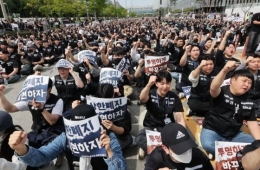
[Asia Economy Reporter Dongwoo Lee] Amid growing controversy in the National Assembly over whether to pass the Serious Accident Corporate Punishment Act, which significantly strengthens corporate penalties for industrial accidents, concerns have been raised that South Korea's current level of punishment for industrial accidents under the existing Industrial Safety and Health Act is already stronger than that of major countries, and that the preventive effects of stricter penalties remain uncertain.
On the 16th, the Korea Economic Research Institute announced that a comparative analysis of the 'industrial safety-related laws' currently enforced in South Korea and the G5 countries (United States, United Kingdom, Japan, Germany, France) revealed that even without enacting a separate Serious Accident Corporate Punishment Act, South Korea imposes very strong penalties on companies when industrial accidents occur.
Under the Industrial Safety and Health Act, if a worker dies due to a violation of safety and health obligations, South Korea imposes imprisonment of up to 7 years or a fine of up to 100 million won on the business owner. Furthermore, if worker deaths occur repeatedly within 5 years, the sentence is increased by 50%.
In contrast, the United States (fines up to $7,000), Germany (fines up to 5,000 euros), and France (fines up to 10,000 euros) impose only fines for violations, while Japan (imprisonment up to 6 months or fines up to 500,000 yen) and the United Kingdom (imprisonment up to 2 years or unlimited fines) have imprisonment levels significantly lower than South Korea.
Among countries that have separate laws imposing corporate penalties for industrial accidents besides the Industrial Safety and Health Act, only the United Kingdom does so. South Korea's Serious Accident Corporate Punishment Act is analyzed to have excessively broad and severe penalty provisions compared to the UK's Corporate Manslaughter and Corporate Homicide Act.
South Korea's Serious Accident Corporate Punishment Act covers a wide range of subjects for obligations and penalties, including not only business owners and CEOs but also directors and those who exert substantial influence over decision-making. The obligations to prevent hazards and risks are described vaguely and broadly as ensuring 'no harm to life, body safety, or health,' making it difficult for companies to predict the scope of their duties.
The UK's Corporate Manslaughter and Corporate Homicide Act requires that gross negligence by senior management be the substantial cause of the industrial accident for punishment to be possible, making the conditions for penalties strict and limited. In contrast, South Korea's Serious Accident Corporate Punishment Act punishes business owners, management officials, and corporations for deaths or injuries, whereas the UK law punishes only corporations and only in cases of death.
Looking at countries such as the United Kingdom, Australia, and Canada, which have strengthened criminal penalties for corporations regarding industrial accidents, the preventive effect of stricter corporate penalties on industrial accidents appears uncertain.
In the UK, the number of industrial accident deaths per 100,000 workers decreased from 0.7 in 2006, just before the Corporate Manslaughter and Corporate Homicide Act was enacted, to 0.5 in 2009, immediately after its implementation, but then showed an increasing trend from 2011 onward. Australia and Canada also showed a continuous decrease in industrial accident deaths even before strengthening corporate penalties, making the effect of stricter penalties unclear.
Hot Picks Today
 Cerebras Soars 70% on IPO Debut: Is Nvidia's Reign Ending as a New AI Semiconductor Power Emerges?
- [Breaking] KOSPI Plummets After Hitting 8,000 Triggering Sell-Sidecar
- Flight Cancellations End With "We Refunded You"... Consumers Left to Bear Hotel and Rental Car Losses
- "Mom, Isn't It Comfortable Living With Me?"... 'Unexpected Result' Shows Increased Drinking Out of Frustration
- "After Vowing to Become No. 1 Globally, Sudden Policy Brake Puts Companies’ Massive Investments at Risk"
Choo Kwang-ho, Director of Economic Policy at the Korea Economic Research Institute, argued, "Since the Serious Accident Corporate Punishment Act could cause side effects such as contraction of corporate activities and job losses, additional legislation should be avoided for the prevention of industrial accidents. Instead, the focus should be on institutional support that can establish effective safety management systems in workplaces."
© The Asia Business Daily(www.asiae.co.kr). All rights reserved.