KOSPI 12-Month Forward PER Returns to 13x After 4 Months... Overheating VS Growth
12-Month Forward PER Hits Highest Level Since 2000 'Dotcom Bubble'
"3000 Easily Surpassed" VS "Caution Needed Amid Liquidity-Driven Risk Asset Preference"
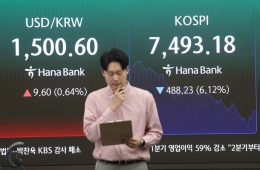
![On the morning of the 11th, when the KOSPI started on an upward trend, an employee is working in the dealing room at the Hana Bank headquarters in Jung-gu, Seoul. <br>[Image source=Yonhap News]](http://www.asiae.co.kr/news/img_view.htm?img=2020121115220860984_1607667728.jpg)
On the morning of the 11th, when the KOSPI started on an upward trend, an employee is working in the dealing room at the Hana Bank headquarters in Jung-gu, Seoul.
[Image source=Yonhap News]
[Asia Economy Reporter Minwoo Lee] As the KOSPI continuously hits record highs and approaches the 2800 mark, valuation indicators have also surged to historic levels. While concerns about overheating are emerging, some analyses suggest that the market should be viewed through a new lens.
According to financial information provider FnGuide on the 13th, as of the 9th, the 12-month forward price-to-earnings ratio (PER) of the KOSPI stood at 13.02 times. This marks the first time in four months that it has surpassed 13 times since mid-August when it recorded 13.15 times.
The PER is an indicator that assesses the current stock price relative to earnings per share. A higher PER means stocks are trading at a higher price compared to earnings. Except for recent times, the only other period when the 12-month forward PER exceeded 13 times was during the 2000 "dot-com bubble" (June 20, 2000, at 20.1 times).
Given the unusual situation, opinions in the securities industry are divided. KB Securities does not view this as overheating. If the price-to-book ratio (PBR) and price-to-sales ratio (PSR) had also surged, it could be interpreted as overheating, but currently only the PER has risen sharply. KB Securities researcher Eun-taek Lee explained, "While the stock market has surged relative to net assets and sales, it is difficult to call it overheating. The fact that only the PER is high suggests that either the KOSPI’s profit margin is at a historic low or that securities analysts’ earnings estimates are overly conservative, which seems a more appropriate interpretation."

Shinhan Investment Corp. predicts that the KOSPI could surpass 3000. Since South Korea’s response to COVID-19 was relatively good and the domestic stock market can benefit from global economic recovery, it is expected to reduce its valuation discount compared to the global market, similar to the period from 2004 to 2007. Shinhan researcher Songcheol Kang said, "The domestic stock risk premium is approaching the levels seen then. Just as Korea’s materials and industrial sectors experienced high growth based on China’s economic expansion from 2004 to 2007, the valuation discount could narrow around new growth industries such as semiconductors and batteries."
Assuming valuations remain the same as now, and considering only the expected profit increase one year from now, the KOSPI could rise more than 15% from its current level. Even if expected profits are revised down by 10% in a year, assuming the domestic market’s valuation discount relative to the global market decreases to 2006 levels (relative P/E of 0.75 times, a 10% valuation increase), the index could rise more than 15%, reaching the 3150?3200 range. Kang added, "With low interest rates and limited investment alternatives, market liquidity waiting to be invested exceeds 60 trillion won. Despite the recent sharp rise, it is difficult to simply label the market increase as overheating."
Hot Picks Today
 "Samsung and Hynix Were Once for the Underachievers"... Hyundai Motor Employee's Lament
- "Sold Everything Fearing Bankruptcy, Then It Soared 3,900 Times: How a Stock Once Feared for Delisting Became an AI Powerhouse"
- "All Major Corporations Could Leave"... Business Community Fears Overseas Factory Relocation Due to Strike Risks
- Fiscal Pressure Mounts Amid Surging U.S. Treasury Yields...Exceeds Supplementary Budget Estimate by 0.04%p
- "That? It's Already Stashed" Nightlife Scene Crosses the Line [ChwiYak Nation] ③
On the other hand, some caution that the possibility of overheating remains. Hanwha Investment & Securities researcher Seungyoung Park pointed out, "The KOSPI rally since last month has characteristics of a liquidity-driven market caused by increased risk asset preference. This differs from 2017 when corporate earnings market consensus was rising and valuations were low."
© The Asia Business Daily(www.asiae.co.kr). All rights reserved.