Multiple Representative Litigation System and ILO 3 Laws Likely to Pass One After Another, Tightening Regulations on Companies
![[Image source=Yonhap News]](http://www.asiae.co.kr/news/img_view.htm?img=2020120818560954498_1607421369.jpg)
Democratic Party, Conscious of Public Opinion, Proposes Some Concessions
"But the Essence of Corporate Regulation Bills Remains Unchanged"
[Asia Economy Reporter Sung Kiho] The business community is concerned that other contentious issues in the corporate regulation law are being processed one after another, overshadowed by the controversy over the '3% rule' (limiting the voting rights of the largest shareholder to 3% when electing audit committee members). Although the Democratic Party has proposed some concessions in response to critical public opinion, key issues that tighten corporate management, such as the multiple derivative lawsuit system and expanded regulations on private interest appropriation, are expected to pass without much scrutiny.
In particular, regarding the multiple derivative lawsuit system, the Democratic Party of Korea submitted a revised bill somewhat softened in response to opposition from the business community and opposition parties, but it appears that important regulatory aspects remain intact. The business community has strongly opposed the legislation itself, fearing excessive litigation. In response, the ruling party strengthened the plaintiff qualification requirements: for listed companies, shareholders must hold at least 0.5% of shares for more than six months, and for unlisted companies, shareholders must hold at least 1%. The previous government proposal required 0.01% for listed companies and 1% for unlisted companies. However, the business community points out that this is not significantly different from the previous government proposal. Choi Moon-seok, head of the Corporate Management Team at the Korea Employers Federation, said, "Although the shareholding requirement has been raised, the fact that the door has been opened remains unchanged. Especially for small and medium-sized enterprises, it is possible to secure shares with a small amount, and their legal teams and response organizations are insufficient, so they could suffer significant damage."
The three laws for ratifying the International Labour Organization (ILO) conventions (Labor Union Act, Public Officials Union Act, Teachers Union Act), which passed the National Assembly's Environment and Labor Committee, are also seen as factors that could shake corporate management systems. The main issue in these bills is the amendment to the Labor Union and Labor Relations Adjustment Act, which allows dismissed workers and unemployed persons to join unions. During the bill's processing, the ruling party deleted a proviso clause from the original government proposal that allowed dismissed workers to join unions but restricted non-worker union members' access to workplaces. This change reflects only the labor sector's opinions.
Lee Sang-ho, head of the Employment Policy Team at the Federation of Korean Industries, said, "It is bewildering that a crucial labor relations bill causing enormous repercussions for companies has been passed unilaterally. The 'employer alternative rights,' such as a complete ban on workplace occupation, were omitted, reflecting only the labor side's position, making the situation even more difficult for employers than the original government proposal." He added, "Since it is difficult to reverse once the bill is passed, I believe the legislative process should be halted at the plenary session of the National Assembly."
At least, the amendment to the Fair Trade Act, which passed the Political Affairs Committee with a revision maintaining the exclusive prosecution rights of the Fair Trade Commission, is a relief for companies. However, the provision expanding the scope of private interest appropriation regulations targeting the controlling family was passed as is. If the bill passes the plenary session, the number of companies subject to the Fair Trade Commission's regulations on preferential transactions is expected to surge.
Hot Picks Today
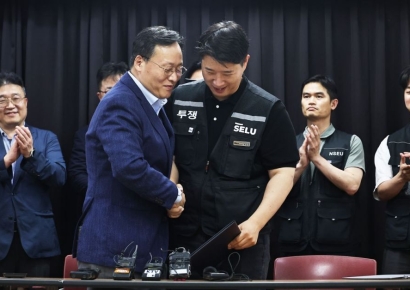 Up to 600 Million Won for Semiconductors, 160 Million Won Bonus for Loss-Making Non-Memory… Samsung Electronics Labor and Management Reach Tentative Deal on Unprecedented Performance Compensation (Comprehensive)
- "Could I Also Receive 370 Billion Won?"... No Limit on 'Stock Manipulation Whistleblower Rewards' Starting the 26th
- "From a 70 Million Won Loss to a 350 Million Won Profit with Samsung and SK hynix"... 'Stock Jackpot' Grandfather Gains Attention
- [Scientists Are Disappearing]④A Shaky Regional Research Ecosystem... "Professors Now Take the Initiative"
- "Who Is Visiting Japan These Days?" The Once-Crowded Tourist Spots Empty Out... What's Happening?
Under current law, companies are regulated for private interest appropriation if the controlling family holds 30% or more shares in listed companies and 20% or more in unlisted companies. The amendment unifies this to 20% or more for both and also regulates subsidiaries in which these companies hold more than 50% of shares. For example, Hyundai Glovis, where the controlling family holds 29.9%, is currently exempt from Fair Trade Commission regulations but would become subject to regulation if the bill passes.
© The Asia Business Daily(www.asiae.co.kr). All rights reserved.
!["Please Help": How Much Do Those Bowing 90 Degrees Really Earn? [Data Pick]](https://cwcontent.asiae.co.kr/asiaresize/307/2026052010120870131_1779239528.png)