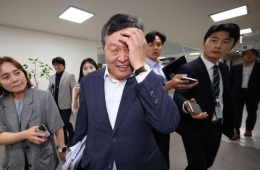
[2020 National Audit] Kim Hyun-soo, Minister of Agriculture, Food and Rural Affairs, "Expanding Major Grain Self-Sufficiency Base... Strengthening Food Security"
![[Image source=Yonhap News]](http://www.asiae.co.kr/news/img_view.htm?img=2020100711081629418_1602036497.jpg)
[Sejong=Asia Economy Reporter Kim Hyun-jung] Kim Hyun-soo, Minister of Agriculture, Food and Rural Affairs, announced plans to strengthen the domestic self-sufficiency base for major grains such as wheat and soybeans, which are dependent on imports. He also presented plans to expand the role of rural areas in response to the increased demand for low-density societies triggered by the COVID-19 pandemic.
Minister Kim made these remarks on the morning of the 7th during the National Assembly’s Agriculture, Food, Rural Affairs, Oceans and Fisheries Committee’s audit of the Ministry of Agriculture, Food and Rural Affairs held in Yeouido, Seoul.
He explained, "We will strengthen food security in preparation for uncertainties in the global supply chain," adding, "We will begin establishing specialized production complexes within this year and expand infrastructure such as storage and distribution facilities." He further stated, "To ensure stable grain procurement in emergencies, we will also build an overseas procurement base in cooperation with private companies."
He expressed intentions to transform rural areas in response to the shift toward a low-density society triggered by COVID-19. Minister Kim emphasized, "We will change rural areas so that they can meet the demands of urban residents," and added, "We will strengthen the function of towns and townships as residential spaces by expanding living infrastructure, and comprehensively reorganize and improve rural spaces by designating separate zones for factories and livestock facilities to relocate and concentrate them through pilot projects."
In line with the overall digitalization of the economy and society, efforts will be made to spread digital agriculture and environmentally friendly farming. He explained, "We will promote demonstration projects to expand smart farms, which are currently focused on facility horticulture, to open fields and discover smart farm models optimized for open-field agriculture," and added, "We will reduce the use of fertilizers and pesticides linked to the public payment system and expand renewable energy such as solar power in rural areas."
Additionally, through reports on major issues, he announced plans to stabilize supply and demand during the rice harvest season by purchasing about 60% of this year’s production stably through public stockpiling and support for paddy purchase funds for mountain area distribution companies. He also mentioned implementing necessary supply and demand stabilization measures such as purchasing damaged rice due to typhoons and acquiring paddy rice depending on supply and demand trends. To recover from heavy rain and typhoon damage, various disaster recovery funds and disaster insurance payments will be provided.
Hot Picks Today
!["Rather Than Endure a 1.5 Million KRW Stipend, I'd Rather Earn 500 Million in the U.S." Top Talent from SNU and KAIST Are Leaving [Scientists Are Disappearing] ①](https://cwcontent.asiae.co.kr/asiaresize/93/2026051914165468840_1779167814.png) "Rather Than Endure a 1.5 Million KRW Stipend, I'd Rather Earn 500 Million in the U.S." Top Talent from SNU and KAIST Are Leaving [Scientists Are Disappearing] ①
"Rather Than Endure a 1.5 Million KRW Stipend, I'd Rather Earn 500 Million in the U.S." Top Talent from SNU and KAIST Are Leaving [Scientists Are Disappearing] ①
- Given Grants, Then Says "No Launch" ... Innovative Korean Technology Ultimately Forced Overseas
- [Breaking] Chairman Park Sookeun: "Possibility of Agreement Instead of Samsung Electronics Labor-Management Mediation Proposal"
- "If That's the Case, Why Not Just Buy Stocks?" ETFs in Name Only, Now 'Semiconductor-Heavy' and a Playground for Short-Term Traders
- "No Cure Available, Spread Accelerates... Already 105 Dead, American Infected"
Furthermore, he explained plans to promote revitalization of rural areas through activation of return-to-farming and return-to-village programs, improvement of agricultural product supply and demand management systems, and reform of the livestock industry structure.
© The Asia Business Daily(www.asiae.co.kr). All rights reserved.
![Cheaper Than Candy, Yet Impossible to Find... Fears of a 'Pediatric Medical Crisis' as Pharmaceutical Companies Halt Production [Why&Next]](https://cwcontent.asiae.co.kr/asiaresize/307/2026051910065268365_1779152813.jpg)