[Weekly Market Review] Abundant Liquidity Confirmed Amid IPO Frenzy... 60 Trillion Won Deposits Supporting the Stock Market
Domestic Stock Market Defends Against 1% Drop Amid US Market Crash...Individuals Net Buy Over 1 Trillion KRW
Top Issue in First Week of September: 'Kakao Games' Subscription
Subscription Refunds Reach 58 Trillion KRW, Some Expected to Flow into Stock Market
In Cooling Market Phase, Increased Interest in New Deal Policy Sectors and Companies
"With COVID-19 Resurgence and Global Financial Market Volatility, Domestic Market Stability Is Hard to Guarantee"
[Asia Economy Reporter Oh Ju-yeon] 'What was expected has come'
On the 3rd (local time), the U.S. stock market fell by the largest margin since the COVID-19 outbreak, raising the possibility that the overheated stock market may enter a correction phase this month. On the following day, the 4th, the domestic stock market also saw the KOSPI and KOSDAQ plunge by 2-3% in early trading due to the U.S. market crash, but the decline narrowed thanks to active net buying by individual investors and net buying of futures by foreigners. The abundant liquidity confirmed in the public offering frenzy, such as the refund of subscription payments from Kakao Games, which had the largest ever subscription deposits and competition rate, is interpreted as having supported the downside of the domestic stock market again. Securities firms analyze that although the domestic stock market may show a correction due to increased volatility in September, it will not exhibit the same market conditions as in March, and the period will be short-lived.

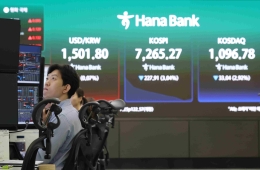
On the 4th, the KOSPI index opened sharply lower due to the plunge in the US stock market. On this day, dealers were busy working in the Hana Bank dealing room in Euljiro, Seoul. Photo by Mun Ho-nam munonam@
View original imageAccording to the Korea Exchange on the 5th, the domestic stock market started sharply down with the KOSPI and KOSDAQ indices falling 2.64% and 3.75% respectively from the previous trading day due to the U.S. market crash, but the decline narrowed during the session thanks to net buying by individuals. The KOSPI, which had dropped to the 2330 level, recovered to the 2370 level, and the KOSDAQ index, which briefly fell to 841 and barely held the 840 level, rebounded to 865, ending with losses of -1.15% and -0.93%, respectively.
The impact of individual net buying was significant. On that day alone, individuals net bought more than 1.2 trillion KRW in the KOSPI market and over 220 billion KRW worth of stocks in the KOSDAQ market. This contrasts with foreigners and institutions, who consistently net sold in both markets.
From the 1st to the 4th of this month, foreigners and institutions net sold approximately 740 billion KRW and 1.05 trillion KRW, respectively. Individuals absorbed all of this selling. They focused on buying the 1.76 trillion KRW worth of stocks sold by these groups. The refund of subscription payments from Kakao Games’ public offering, which attracted a record subscription deposit of 58.55 trillion KRW and closed with a competition rate of 1500 to 1, was returned on this day, and it is speculated that some of this money flowed back into the stock market.
One of the biggest events in the domestic stock market during the first week of September was the Kakao Games subscription. Kakao Games’ public offering amount was 3.2 million shares (76.8 billion KRW), about 40% of the recent SK Biopharm offering, but the subscription deposits far exceeded 31 trillion KRW at that time, and the subscription refund amount is estimated to be around 58 trillion KRW. As a result, investor deposits also surpassed 60 trillion KRW.
Lee Jae-sun, a researcher at Hana Financial Investment, said, "We believe individual liquidity will support the bottom of the stock market," adding, "With increased interest in public offering subscriptions such as Kakao Games and Big Hit Entertainment, refund money after future IPO subscriptions is likely to remain in securities accounts as standby funds for stock market investment or for re-subscription to public offerings."
Additionally, sectors and companies related to the government’s New Deal policy are expected to partially offset the correction pressure caused by the overheated stock market.
Lee said, "The possibility of early success in COVID-19 containment is increasing, and the New Deal Fund and the KRX BBIG K-New Deal Index announced by the Korea Exchange are likely to support supply-demand improvements centered on growth companies."
Kim Il-hyuk, a researcher at KB Securities, predicted, "The sectors and stocks that stock investors should pay attention to will be directly exemplified by the 'KRX BBIG K-New Deal Index' announced by the Korea Exchange on the 3rd."
Kim added, "Since related ETFs are scheduled to be listed early in October, this will directly lead to supply-demand effects. Also, with time remaining until October, we can expect active funds to enter ahead of passive funds, creating a preemptive buying effect."
Although the domestic stock market performed relatively well despite the U.S. market crash, there is also analysis that stability cannot be guaranteed if the COVID-19 resurgence shakes the global financial market.
Lee Kyung-min, a researcher at Daishin Securities, explained, "Expectations for the Korean New Deal have been strongly incorporated, but it will take time for these expectations to materialize and lead to corporate earnings improvements. While the policy momentum can be viewed positively in the long term, in the short term, policy expectations need to be toned down."
He added, "The variable to watch next week is the dollar," warning, "We are cautious about the possibility of increased volatility in the foreign exchange market starting with the ECB monetary policy meeting on the 10th." The dollar’s rebound attempt could be another trigger for increased volatility in the global financial market.
Hot Picks Today
 After Topping 8,000 Instead of Hitting 10,000... KOSPI Plunges—When Will It Rebound?
- "Samsung and Hynix Were Once for the Underachievers"... Hyundai Motor Employee's Lament
- [Breaking] Court Rules Against Samsung Electronics Union...1 Billion Won per Day Penalty for Exceeding Strike Scope
- 'Real Strike' Looms as Samsung Union Grows More Hardline... How the 2024 Strike Process Compares
- "That? It's Already Stashed" Nightlife Scene Crosses the Line [ChwiYak Nation] ③
Lee said, "Even if short-term overheating and valuation burdens are relieved this time, a secondary upward trend can be expected because the cause of the correction is not fundamental variables but investor sentiment and supply-demand instability." He added, "While maintaining a strategy to increase weight during corrections, it is recommended to keep a cautious mindset for the time being, considering timing and levels."
© The Asia Business Daily(www.asiae.co.kr). All rights reserved.