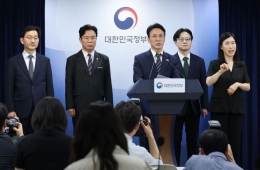
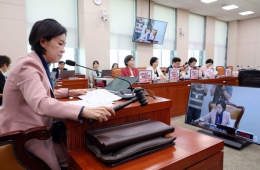
"Take Care of Our Citizens First" Seoul City Faces Controversy Over Disaster Relief Payments to Foreigners
Human Rights Commission Recommends "Disaster Relief Funds Should Be Given to Foreigners"
Seoul City Provides Emergency Living Expenses of 300,000 to 500,000 Won per Household to Foreigners
Citizens Complain "Isn't This Reverse Discrimination?", "Waste of Taxes"
Experts Say "Need to Present Criteria Acceptable to the Public"

Seoul City announced on the 26th of last month that it will provide emergency disaster living expenses to foreigners as well. Photo by Yonhap News
View original image[Asia Economy Reporter Kim Suwan] "Isn't this reverse discrimination against citizens?", "Why should we help foreigners with my taxes?"
The Seoul Metropolitan Government announced that it will provide up to 500,000 won in 'emergency disaster living expenses' to foreign residents living in Seoul in relation to the COVID-19 pandemic, sparking controversy.
Civilians are expressing dissatisfaction with providing disaster relief funds to foreigners while even Koreans are struggling. Some argue that the city's decision actually encourages reverse discrimination, while others point out that foreign residents are also members of society who pay taxes and therefore should receive disaster relief funds.
The city stated that this support was decided by accepting the recommendation of the National Human Rights Commission of Korea (NHRCK). Experts suggested that since the support is operated with tax money, each local government should present criteria that citizens can accept.

Notice on the Eligibility Criteria for Seoul City's Emergency Disaster Living Expenses. Photo by Seoul City Website Capture
View original imageThe Seoul Metropolitan Government began accepting online applications from the 31st of last month to provide emergency disaster living expenses to foreigners. From the 14th, on-site applications can be made at district offices or community centers in each autonomous district.
The support targets foreign residents who have registered their foreigner residence in Seoul for more than 90 days (as of the 27th of last month) and are legally allowed to work or engage in profit-making activities in Korea.
Foreigners residing under student or general training status, those engaged in industries not permitted by their visa, and illegal immigrants are excluded from support. Also excluded are marriage immigrants who received emergency disaster living expenses in March.
The income criteria are the same as when emergency disaster living expenses were provided to Koreans in March, requiring income at or below 100% of the median income. In other words, monthly income exceeding △1-person household 1,757,194 won △2-person household 2,991,980 won △3-person household 3,870,577 won △4-person household 4,749,174 won △5-person household 5,627,771 won is not eligible.
The support amount is 300,000 won for 1-2 person households, 400,000 won for 3-4 person households, and 500,000 won for households of 5 or more. The city estimates that about 95,000 households (approximately 197,000 people) residing in Seoul will receive support through this measure.
According to the Ministry of Justice's 'Status of Registered Foreigners by Region,' as of March this year, there are a total of 1,264,686 foreigners residing in Korea, with 22.1% or 280,126 living in Seoul.

The city stated that this support was decided by accepting the recommendation of the National Human Rights Commission. On the 26th of last month, the city explained the reason for implementing foreigner disaster relief funds, saying, "This support accepts the NHRCK's recommendation that emergency disaster living expenses should be provided to foreign residents who are suffering hardships similar to Koreans due to COVID-19, to prevent 'infringement of equality rights due to discrimination without reasonable grounds.'"
Earlier, in June, the NHRCK recommended improving related measures to ensure that foreign residents registered as residents are not excluded from disaster relief fund policies, stating, "Differentiating treatment of foreign residents registered as residents constitutes discrimination without reasonable grounds and infringes on equality rights."
Migrant labor organizations welcomed Seoul's decision to provide emergency disaster living expenses to foreigners and urged other local governments to join.
The Korea Migrant Human Rights Center and the Migrant Workers Hope Center issued a statement on the 28th of last month, saying, "Support funds provided to stabilize the lives of residents plunged into economic crisis due to COVID-19 should not be applied discriminatively based on nationality or residence status," and "We urge not only Seoul but also other local governments and the government to implement disaster relief fund policies equally."
On the other hand, citizens are strongly opposing, saying, "Isn't this reverse discrimination against citizens?" and "Why give to foreigners when the financial situation is bad?" There are also calls to reconsider the decision to provide disaster relief funds to foreigners.
Housewife Kang (44) said, "Those who need help now are not only foreigners. When all citizens are struggling due to COVID-19, is it right to help foreigners with taxes?" She raised her voice, saying, "There are many marginalized groups and self-employed people who desperately need help. Please reconsider now."
There are concerns that even foreigners who do not pay taxes might receive support funds. Office worker Kim (36) said, "Foreigners probably don't pay taxes," and added, "Even if they do, would they pay as much as our citizens?" He continued, "I don't understand that the taxes I paid are used like this. There was no consent from the citizens. Especially, it's absurd to learn about such an important matter through an article."

Some point out that foreign residents also pay taxes and excluding them from support is discrimination.
A man in his 20s, office worker A, said, "If you look at the application form, it means giving to foreign office workers living in Seoul who pay taxes and work," adding, "They pay taxes just like Koreans. It is not right to blindly criticize without knowing well. If those who pay the same taxes do not receive disaster relief funds, that would also be discrimination."
As controversy over foreigner disaster relief funds continues, a Seoul city official said, "The NHRCK recommended that excluding foreigners from disaster relief funds is discrimination and should be corrected, so we decided to provide this support," adding, "There is a misunderstanding among citizens. This support is not for all foreigners. It is for low-income groups with visa qualifications that allow employment and profit-making activities, and who have faithfully reported income and fall below 100% of the median income."
A community center official in Seoul also explained, "To apply, you must meet the set conditions. Those who entered illegally or foreigners who do not pay taxes cannot even submit the documents," and "The city has established thorough payment criteria by issuing guidelines according to the NHRCK's recommendations."
Experts suggest that support should be directed only to foreigners who have made significant contributions in taxes.
Hot Picks Today
 "Now Our Salaries Are 10 Million Won a Month" Record High... Semiconductor Boom Drives Performance Bonuses at Major Electronic Component Firms
- Wallets Open Wide on Big News...300 Trillion Won Heads to the U.S., "Tax Breaks" Fail to Keep Funds at Home
- "Realizing How Fast Money Disappears: Should You Try Only the Essentials for 5,000 Won? [The Basics of Benefits]"
- "Heading for 2 Million Won": The Company the Securities Industry Says Not to Doubt [Weekend Money]
- Experts Already Watching Closely..."Target Price Set at 970,000 Won" Only Upward Momentum Remains [Weekend Money]
Professor Lee Eunhee of Inha University's Department of Consumer Studies said, "In the case of this foreigner disaster relief fund, it is supported with taxes, not donations or gifts," and suggested, "Therefore, criteria that citizens can accept should be presented." She added, "I understand that countries like the United States and Japan also provide disaster relief funds to foreigners but with very strict conditions," and "I think it is appropriate for Korea to provide support to those who meet certain criteria, such as having lived here for 3 to 5 years."
© The Asia Business Daily(www.asiae.co.kr). All rights reserved.