Kim Ki-moon "Korean Companies Need Alternatives to Stay in China"
President of the Korea Federation of SMEs
Discusses Economic Cooperation Between SMEs of Both Countries with Chinese Ambassador to Korea

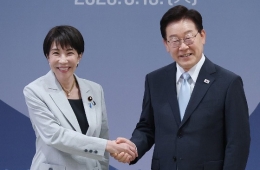
Kim Ki-moon, President of the Korea Federation of Small and Medium Business (left), and Xing Haiming, Chinese Ambassador to Korea, are posing for a commemorative photo at the 'Strengthening Economic Cooperation between Small and Medium Enterprises of Both Countries' meeting held at the federation's headquarters in Yeouido, Seoul on the 27th.
View original image[Asia Economy Reporter Kim Daeseop] "Recently, many Korean companies that have entered China are relocating to Southeast Asia. It is necessary to carefully examine the reasons why they are leaving China and to prepare alternatives so that companies can remain in China."
Kim Gi-moon, Chairman of the Korea Federation of SMEs, said this on the 27th while meeting with Xing Haiming, the Chinese Ambassador to Korea, who visited the federation's headquarters in Yeouido, Seoul. He added, "This year, global trade has sharply contracted due to border closures caused by the COVID-19 pandemic, and especially, there have been significant difficulties in exchanges between Korean and Chinese companies."
On this day, Chairman Kim and Ambassador Xing discussed ways to strengthen economic cooperation between SMEs of the two countries. Ambassador Xing Haiming, known as a "Korean Peninsula expert," has served for over 30 years in roles related to the Korean Peninsula, including as Minister-Counselor at the Chinese Embassy in Korea and the Chinese Embassy in North Korea.
Chairman Kim stated, "Fortunately, through consultations between the two governments, a fast-track system has been introduced to support business activities of entrepreneurs, but it seems there are still many issues to resolve, such as the limited application areas. The Federation of SMEs will actively promote the understanding that if the Chinese government establishes supplementary policies, it will be beneficial for Korean SMEs to remain in China."
According to the Federation of SMEs, since the establishment of diplomatic relations in 1992, trade volume between Korea and China has increased 39-fold. Human exchanges have increased 80-fold, with over 10 million people traveling between the two countries annually. Additionally, Korea is the second-largest investor in China. By 2019, the cumulative investment in China exceeded 70 billion dollars.
Chairman Kim explained, "Korea and China have become very valuable economic cooperation partners to each other. The Federation of SMEs, as an economic organization representing SMEs, has been cooperating with China in various ways." He also said, "I have heard that there is a possibility of President Xi Jinping visiting Korea within this year. If President Xi visits, I expect cooperation between Korea and China to be further strengthened."
The Federation of SMEs plans to continue its support efforts for the development of SMEs in both countries through active cooperation with the Chinese Embassy in Korea. The Chinese Embassy in Korea expects to expand cooperation between companies of the two countries, including attracting overseas investment and enterprises through Hainan, China's free trade port.
Hot Picks Today
!["Rather Than Endure a 1.5 Million KRW Stipend, I'd Rather Earn 500 Million in the U.S." Top Talent from SNU and KAIST Are Leaving [Scientists Are Disappearing] ①](https://cwcontent.asiae.co.kr/asiaresize/93/2026051914165468840_1779167814.png) "Rather Than Endure a 1.5 Million KRW Stipend, I'd Rather Earn 500 Million in the U.S." Top Talent from SNU and KAIST Are Leaving [Scientists Are Disappearing] ①
"Rather Than Endure a 1.5 Million KRW Stipend, I'd Rather Earn 500 Million in the U.S." Top Talent from SNU and KAIST Are Leaving [Scientists Are Disappearing] ①
- "No Cure Available, Spread Accelerates... Already 105 Dead, American Infected"
- "If That's the Case, Why Not Just Buy Stocks?" ETFs in Name Only, Now 'Semiconductor-Heavy' and a Playground for Short-Term Traders
- "Reporters Who First Revealed Jo Jinwoong's Juvenile Offense History Cleared of Juvenile Act Violation"
- "How Did an Employee Who Loved Samsung End Up Like This?"... Past Video of Samsung Electronics Union Chairman Resurfaces
Ambassador Xing Haiming responded, "As the Chinese Ambassador to Korea, I will maintain continuous interest in exchanges between SMEs of the two countries and will perform the role of a bridge well."
© The Asia Business Daily(www.asiae.co.kr). All rights reserved.