[Column] Thirty-somethings Going All-In Out of Frustration... Are They Speculators?
[Asia Economy Reporter Moon Jiwon]
"I feel sorry that people in their 30s borrowed all they could to buy what corporations put on the market." (Kim Hyunmi, Minister of Land, Infrastructure and Transport)
"Housewives and young people have jumped into the speculative frenzy, and speculative sentiment has spread like an epidemic." (Choo Mi-ae, Minister of Justice)
These are recent remarks made by frontline ministers as housing prices remain stubbornly high despite the government's successive real estate measures. Each time a new policy is announced, Seoul housing prices rise, increasing public confusion and frustration, yet the government shifts responsibility outward to people in their 30s, housewives, and young people rather than addressing internal accountability. Can the young generation, who pool every resource out of anxiety that they must buy a house now or never, simply be dismissed as speculators?
On the 25th, when Minister Kim appeared before the National Assembly's Land, Infrastructure and Transport Committee and responded to questions from So Byung-hoon of the Democratic Party of Korea, he said, "I feel sorry that people in their 30s borrowed all they could to buy what corporations and multi-homeowners put on the market." This sparked criticism in the market. Although Minister Kim’s comment seemed to express concern for the 30s age group engaging in 'panic buying,' the context implied that because people in their 30s absorbed the flood of listings, the decline in housing prices was limited.
In fact, since its inception, the government has been quick to blame external factors for the rapid rise in housing prices despite continuous ultra-strong real estate measures. Minister Kim, in June, attributed the surge in housing prices under the current administration to "inheriting a situation where all real estate regulations were lifted by the previous government." When criticized that more than 20 measures had no effect, he blamed "the media" and "private statistics."
Minister Choo’s remarks follow the same line. Recently on Facebook, she stated, "The rapid rise in real estate prices is due to speculators." She explained that speculators include not only wealthy asset holders but also ordinary housewives and young people. Since these groups are buying houses, the measures cannot be effective, so "it cannot be said to be entirely the government's fault."
The market’s response is cold. On real estate-related online forums, complaints arise such as, "The government created anxiety that forced even those uninterested in real estate to buy houses; can they just pass the responsibility onto these people?" The government maintains that since real estate-related bills have been passed, significant effects will appear starting in August, but record-high prices continue in places like Eonma Apartments in Gangnam-gu. According to the Bank of Korea, the Housing Price Expectation Consumer Sentiment Index (CSI) for those under 40 reached 131 this month, the highest ever recorded.
Hot Picks Today
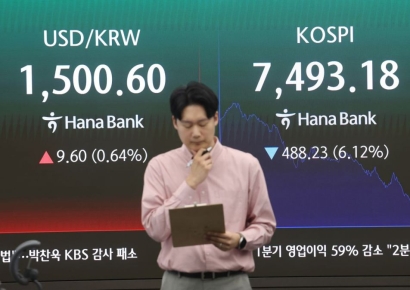 After Topping 8,000 Instead of Hitting 10,000... KOSPI Plunges—When Will It Rebound?
- "Samsung and Hynix Were Once for the Underachievers"... Hyundai Motor Employee's Lament
- [Breaking] Court Rules Against Samsung Electronics Union...1 Billion Won per Day Penalty for Exceeding Strike Scope
- Six Economic Organizations Urge Withdrawal of Samsung Electronics Strike Plan...Warn of National Loss of Opportunity
- "That? It's Already Stashed" Nightlife Scene Crosses the Line [ChwiYak Nation] ③
No Young-min, Chief Presidential Secretary, added fuel to the fire by saying at the National Assembly the day before, "The majority of the public supports the policy." Many experts predict that even if housing prices show a negative turn in Korea Real Estate Board statistics as the government hopes, prices will only fall slightly as they did from March to May before rising again. If the Blue House and government ignore dissatisfied voices and insist on their 'my way' by only accepting statistics and opinions they want to see and hear, restoring housing prices to previous levels will be difficult.
© The Asia Business Daily(www.asiae.co.kr). All rights reserved.







