How Is the KOSPI Record High Created and How High Can It Go?
Actual Corporate Profit Changes Are Key... New Growth Industries Emerge When Record Highs Are Updated
"Unexpected Reasons May Trigger Bear Market Entry... Interest Rates Must Be Watched"
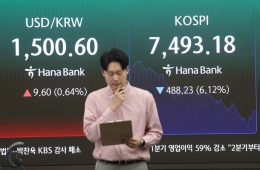
[Asia Economy Reporter Minwoo Lee] After five major crises in the domestic stock market, the KOSPI index mostly recovered to previous peak levels but did not all reach new record highs. It is analyzed that whether new highs were achieved depended on the emergence of new growth industries and changes in corporate profits.
According to Hana Financial Investment on the 16th, since 1995, the average time taken to recover to previous peak levels during five KOSPI rebound phases was 1.1 years, with a recovery rate of 97% compared to the peak.
The five major periods when the KOSPI sharply dropped were ▲September 2001 (dot-com bubble burst and US 9/11 attacks) ▲October 2008 (global financial crisis) ▲September 2011 (advanced countries' fiscal crisis) ▲February 2016 (international oil price plunge, emerging market crisis) ▲March 2020 (US-China trade dispute, COVID-19). Among these, in 2002 and 2012, the KOSPI recovery rates reached 92% and 94% of previous peaks respectively but did not record new highs. In contrast, in 1999, 2010, and 2017, the index surpassed previous peaks and set new records.

Corporate Profit Changes Are Key... "This Time, 2800 Is Possible"
It was analyzed that the formation of new highs depends on changes in corporate profits. In 2003 and 2012, KOSPI operating profits decreased compared to the previous year. Conversely, in 1999, 2010, and 2017, operating profits increased year-over-year. Starting from this year as the bottom, KOSPI operating profits are expected to increase by 38% and 10% in 2021 and 2022 respectively compared to the previous year. Lee Jaeman, a researcher at Hana Financial Investment, predicted, "Based on estimated G2 economic growth rates and the expected trends of export and operating profit growth rates, the KOSPI is likely to record new highs in the first half of 2021 and could rise up to 2800."

A commonality in phases when the KOSPI set new highs was the emergence of new growth industries. In 1999, telecommunications; in 2010, automobiles; and in 2017, semiconductor-related companies newly entered or advanced into the top 10 by market capitalization on the KOSPI. These companies also had a high contribution to the absolute profit growth of the KOSPI at the time.
The researcher explained, "While profit growth rates may be important during the recovery process based on liquidity effects after a crisis, to surpass recovery and set new highs, the absolute profit level and expansion of profit share seem crucial. Since many new growth companies are currently included in the top 10 by market capitalization on the KOSPI, it is now time to adopt a strategy that selects leading stocks by considering absolute profit levels and contribution to KOSPI profit growth rather than just profit growth rates."
Downturns Come Unexpectedly... Need to Monitor Interest Rate Situation
However, it was pointed out that the recent stock price rise could reverse unexpectedly. The researcher said, "Risks that seem unlikely, such as the breakdown of the US-China trade agreement and the visibility of national debt risks due to fiscal deficits in major countries, could cause the bull market to turn bearish. Even during liquidity expansion phases, indices can experience short-term corrections; in fact, on a weekly basis, the Nasdaq and KOSPI have seen declines of up to -7% and -10% respectively."
Hot Picks Today
 "Samsung and Hynix Were Once for the Underachievers"... Hyundai Motor Employee's Lament
- "Sold Everything Fearing Bankruptcy, Then It Soared 3,900 Times: How a Stock Once Feared for Delisting Became an AI Powerhouse"
- Court Partially Grants Samsung Electronics' Injunction to Prohibit Industrial Action... 100 Million Won Penalty Per Day for Violations
- President Lee: "Corporate Management Rights Should Be Respected as Much as Labor Rights"...Final Samsung Labor-Management Negotiations (Comprehensive)
- "That? It's Already Stashed" Nightlife Scene Crosses the Line [ChwiYak Nation] ③
Attention was also drawn to the recent rebound of value stocks, which had been relatively weak throughout this year. The researcher noted, "Since 2009, S&P 500 value stocks have outperformed growth stocks by about four months annually, which can be understood as a narrowing of the return gap with growth stocks based on rising US market interest rates. However, I remain skeptical about whether the US 10-year Treasury yield can recover to the pre-pandemic level of 1%." The judgment is that value stocks can rise, but the duration is relatively shorter compared to growth stocks.

The end of the low-interest-rate environment also needs to be observed. The interest coverage ratio of KOSPI-listed companies dropped from 9 times in 2017 to 4 times in Q1 2020. Considering the 2000?2019 average was 6.5 times, a rapid rise in interest rates could bring struggling companies back into the spotlight.
© The Asia Business Daily(www.asiae.co.kr). All rights reserved.