Moon Administration, Regulatory Innovation Only in Words... Low Processing Rate
Two Months Since the Launch of the Private Support Center, 13 Cases Handled

[Asia Economy Reporters Jang Se-hee and Moon Chae-seok] The government introduced a private regulatory sandbox (regulatory exemption system) last May to enhance corporate convenience, but criticism is emerging that the review process is delayed and its effectiveness is low. Although the government announced plans to activate private investment and reform regulations through the Korean New Deal, critics point out that the reality remains challenging. It has been revealed that the government-led regulatory sandbox also has a processing rate of only about half.
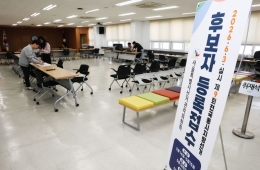
According to data received by Asia Economy on the 20th from the Korea Chamber of Commerce and Industry (KCCI) Sandbox Support Center, KCCI has received 93 applications since its launch last May but has processed only 13 cases so far (processing rate 14%).
The regulatory sandbox is a system that exempts or defers existing regulations for a certain period when new products or services are launched, first introduced in January last year. After one year of implementation, the government conducted evaluations and collected opinions, then announced supplementary measures last January. The most emphasized point was the establishment of a private reception window in addition to existing public institutions. Accordingly, KCCI launched the Sandbox Support Center on May 12. At that time, the government explained, "The purpose is to expand the regulatory sandbox support function, which had been operated only by public institutions, into the private sector to lower the barriers for companies and better represent them."
However, two months after operation, the processing rate remains extremely low, leading to criticism that aside from adding one more reception window, there is no effect of lowering the 'barrier.' The reason for the low processing rate is that although a private reception window was added, applications received by KCCI must still be transferred to ministries for approval. According to KCCI, when a regulatory sandbox case is received, it goes through legal review → agenda preparation → ministry review request → expert committee (presided over by a first-level official) → regulatory exemption review committee (presided over by a minister) to obtain approval. Although the "one-stop support" was emphasized at the launch, the process ultimately follows the same procedure as the existing public institution reception.
The irregular schedule of the regulatory exemption review committee also slows down processing. The committee, chaired by a minister, is held about once every two to three months, making quick review difficult. A KCCI official said, "Large companies usually complete their own legal review, so the process can proceed relatively quickly, but small and medium enterprises often only have ideas and take a long time starting from legal review." He added, "After sending the case to ministries such as the Ministry of Trade, Industry and Energy, the Ministry of Science and ICT, and the Financial Services Commission, each ministry holds an expert committee meeting, which takes time."
Hot Picks Today
 "Do We Need to Panic Buy Again?" War Drives 30% Price Surge... Even the Bedroom Feels the Impact
- [Breaking] Lee Jae-yong: "All Samsung members are united as one... We must pool our wisdom and move in a single direction"
- "Is a 10,000 KOSPI Breakthrough Possible?" Target Index Raised by 40%... Securities Firms Release Outlook [Weekend Money]
- "Anyone Who Visited the Room Salon, Come Forward"… Gangnam Police Station Launches Full Staff Investigation After New Scandal
- "Student ID Rentals Reach 500,000 Won... Black Market and Line-holding Services Surge"
The government-led regulatory sandbox processing performance has even regressed compared to the previous year. According to the Industrial Convergence Regulatory Sandbox, as of July, 95 out of 165 cases (processing rate 57.6%) have been processed, barely exceeding half. Although the government improved the system by granting the right to request changes to demonstration exemption conditions for applicant companies as a development plan one year after the sandbox implementation, the processing rate dropped by 20.4 percentage points compared to the same period last year. Professor Sung Tae-yoon of Yonsei University's Department of Economics urged, "Industrial regulations should not simply increase reception windows like handling complaints. It is important that received projects lead to actual approval and become new growth engines."
© The Asia Business Daily(www.asiae.co.kr). All rights reserved.





![[Breaking] Lee Jae-yong: "All Samsung members are united as one... We must pool our wisdom and move in a single direction"](https://cwcontent.asiae.co.kr/asiaresize/307/2026010108513575608_1767225095.png)