"US-China Relations Have Worsened, but Will Not Reach the Worst"
Interview with Professor Seojeong Geon of Kyung Hee University
Damage Control System Operating Between Both Sides
China Criticism, No Major Disagreement Between GOP and Democrats
Possibility of Relationship Improvement After Presidential Election Remains
[Asia Economy Reporter Naju-seok] "Although the United States and China are clashing over issues such as Hong Kong and the South China Sea, I have heard that there is a system in place to control damage behind the scenes. Communication is maintained to prevent escalation into a full-scale war."
On the 16th, Professor Seo Jeong-geon of Kyung Hee University's Department of Political Science and International Relations (pictured), an American expert, predicted in a phone interview with Asia Economy that although US-China relations have deteriorated, it will not lead to the worst crisis. Professor Seo introduced that "even if there is a military clash between the US and China, no politician insists on going full-scale."

Although the US government issued executive orders concerning Hong Kong's special status due to the Hong Kong National Security Law (Hong Kong Security Law), he also expressed the view that since these are executive orders and not laws, they can be overturned at any time. He explained, "In a globalized economy, both the US and China need each other," adding, "The more the US retaliates against China, the higher the component prices rise, inevitably weakening the competitiveness of US industries."
US media also cited US government officials suggesting that the US might slow down its sanctions against China. CNBC reported, quoting multiple sources, that the Trump administration might delay the start of sanctions due to concerns over worsening relations with China.
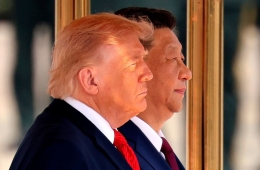
According to the memoirs of former US National Security Council (NSC) advisor John Bolton, President Donald Trump publicly criticized China but asked Chinese President Xi Jinping for help in the election during their meeting. This indicates that the US and China have formed a kind of 'hostile symbiotic relationship.'
Professor Seo explained, "During the Cold War between the US and the Soviet Union, it was problematic to loudly criticize the USSR while privately having different conversations. However, in the post-Cold War era, criticizing China on one hand while asking for more US agricultural purchases on the other is difficult to criticize." This means there is room for both the US and China to conduct flexible diplomacy.
There were also remarks that the US's willingness to engage in full-scale war has weakened. He said, "The US has changed a lot after the post-Cold War period and the failure of the Iraq War," adding, "The Republican Party now focuses on economic nationalism and stricter immigration control, and if it forms hostile relations like during the Cold War regarding military or security issues, it will be hard to gain support."
There was also speculation that although President Trump tries to make US-China relations an election issue, it will not be easy. Professor Seo analyzed, "Criticizing China was an agenda led by the Democratic Party, currently the opposition, and the Republican Party emphasized free trade, but with Trump's emergence, the Republican Party also joined in," adding, "This is a new situation that did not exist before." There is little disagreement between the Democratic and Republican parties on China policy.
Hot Picks Today
!["Even If I Lose My Investment, the Government Will Cover It"... The Fund Attracting Retail Investors' Attention [Weekend Money]](https://cwcontent.asiae.co.kr/asiaresize/93/2026051609052165501_1778889921.jpg) "Even If I Lose My Investment, the Government Will Cover It"... The Fund Attracting Retail Investors' Attention [Weekend Money]
"Even If I Lose My Investment, the Government Will Cover It"... The Fund Attracting Retail Investors' Attention [Weekend Money]
- AI Said to Eliminate Jobs, but This Role Sees 800% Surge in Hiring [Tech Talk]
- "One Person Bets 13.5 Billion Won to Have Lunch with the Investment Guru"
- There Is a Distinct Age When Physical Abilities Decline Rapidly... From What Age Do Strength and Endurance Drop?
- On Teacher's Day, a Student's Gifted Cake Had to Be Cut into 32 Pieces... Why?
He also predicted the possibility of restoring relations after the presidential election. Professor Seo said, "Currently, no one can talk about it because it is the election season, but after the election, there is a possibility of change in relations," adding, "It won't return to the US-China relations during the times of former Presidents Bill Clinton or George Bush, but there is room for improvement at the institutional and economic levels."
© The Asia Business Daily(www.asiae.co.kr). All rights reserved.