[Weekly Market Outlook] Focus on Q1 Earnings Season... "Low Possibility of Index Crash"
Performance Expectations Lowered After COVID-19 Spread
Box KOSPI Range...Low Possibility of W-Shaped Double Recession
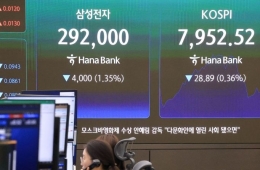
[Asia Economy Reporter Minji Lee] Following the sharp rebound of the KOSPI after the spread of the novel coronavirus infection (COVID-19), next week's stock market focus is expected to be on the first-quarter earnings season. The securities industry views this as the first event since the COVID-19 outbreak, which will help gauge how much related indicators might impact the stock market. Hana Financial Investment projected the KOSPI's expected band at 1820?1870 points, while NH Investment & Securities anticipated it to move between 1760 and 1870 points.
![[Image source=Yonhap News]](http://www.asiae.co.kr/news/img_view.htm?img=2020013009285730654_1580344137.jpg)
◆ Yonggu Kim, Researcher at Hana Financial Investment: The market consensus for KOSPI's operating profit in 2020 is 146.3 trillion KRW, with the first quarter expected to record 26.9 trillion KRW. The downward revision of earnings estimates has been ongoing daily since the COVID-19 outbreak. However, unless there is a shock to earnings at a level threatening the survival of most companies, the market impact is expected to be limited.
It is judged that the current stock price has already largely priced in the possibility of barely reaching 100 trillion KRW in operating profit for 2020. By sector, internet & gaming, construction, pharmaceuticals & bio, food & beverage, and utilities are considered less affected by COVID-19.
The KOSPI plunged 35.7% from January 22, when COVID-19 began spreading, to March 23, then rose about 23.9% until April 9. The current stock price is in the 1800?2050 point range, entering a box market phase. Considering policy coordination among major global countries and expectations for virus treatments and vaccine development, the possibility of a market re-recession is expected to be low.
To break out of the box market range, it is necessary to observe the extent to which the effects of policy coordination to counter economic recession will manifest. Additionally, it is important to consider how much global demand and investment can improve after the resumption of economic activities, and whether inflation rates can exit the deflationary zone and move out of negative territory. Taking these into account, the domestic stock market is expected to continue a gradual upward trend.
◆ Byungyeon Kim, Researcher at NH Investment & Securities: The confirmed net profit for KOSPI in 2019 was 71 trillion KRW. This year, it was expected to reach 100 trillion KRW, a 43% increase from the previous year. However, considering the sharp downward revisions due to the COVID-19 outbreak, net profit is now expected to decrease by 2.4% compared to the previous year. Over the past month, the change rates in first-quarter earnings forecasts for sales, operating profit, and net profit are estimated to have decreased by 3.2%, 15.7%, and 19%, respectively.
Following Samsung Electronics' earnings guidance announcement, this year's net profit forecast was revised down to 26.7 trillion KRW. SK Hynix's net profit forecast is 5 trillion KRW. Considering that the semiconductor and equipment sectors contribute nearly 50% to the KOSPI's net profit growth rate, sectors outside of semiconductors and equipment need to record over 40 trillion KRW in net profit to maintain earnings growth compared to last year. If the impact of COVID-19 continues into the second half, the burden from downward earnings revisions is expected to increase.
Hot Picks Today
 If They Fail Next Year, Bonus Drops to 97 Million Won... A Closer Look at Samsung Electronics DS Division’s 600M vs 460M vs 160M Performance Bonuses
- RIA Accounts Surpass 240,000 Subscriptions... Sold Nvidia, Bought Samsung Electronics
- Room Prices Soar from 60,000 to 760,000 Won and Sudden Cancellations: "We Won't Even Buy Water in Busan" — BTS Fans Outraged
- "Manhole Cover Blasts Open in 12 Seconds... The Reason Behind the 'Gangnam Flood Disaster' [Report]"
- "Who Is Visiting Japan These Days?" The Once-Crowded Tourist Spots Empty Out... What's Happening?
Currently, there is skepticism in the stock market about V-shaped and W-shaped rebounds. Unlike 2008, when recession, credit crunch, and liquidity concerns unfolded over time, the current crisis has occurred comprehensively in a short period. Unless the bankruptcy of major U.S. airlines materializes, the possibility of a W-shaped rebound is considered low. Considering concerns and caution about a COVID-19 resurgence, the downside support level is expected to be around 1700 points.
© The Asia Business Daily(www.asiae.co.kr). All rights reserved.
!['WHO Declares International Public Health Emergency' Why the Untreatable 'Variant Ebola' Is More Deadly Than COVID-19 [Reading Science]](https://cwcontent.asiae.co.kr/asiaresize/307/2026052110164072055_1779326201.png)
!["Please Help Us": How Much Do Those Bowing 90 Degrees These Days Actually Earn? [Data Pick]](https://cwcontent.asiae.co.kr/asiaresize/307/2026052010120870131_1779239528.png)