Focus on 'Zero' COVID-19 Cases... China Emphasizes Importance of the Two Sessions

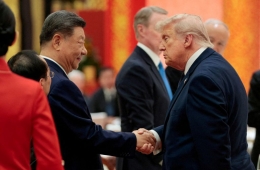
Chinese President Xi Jinping (left) and Premier Li Keqiang arrived at the opening ceremony of the National People's Congress at the Great Hall of the People in Beijing on the 5th (local time). Beijing, China - Photo by Reuters Yonhap News
View original image[Asia Economy Beijing=Special Correspondent Park Sun-mi] China is attempting a method to completely block the possibility of external inflow while easing internal controls as a final response to the novel coronavirus infection (COVID-19). This is interpreted as preparatory work to declare the end of COVID-19 and focus all efforts on economic normalization through the National People's Congress and the Chinese People's Political Consultative Conference (the Two Sessions), China’s largest political events held from late April to early May.
◆Rumors of the Two Sessions being held in late April to early May= In Beijing, rumors are spreading that the Two Sessions, originally scheduled for early March but postponed due to COVID-19, will be held in late April to early May. As of the 29th, the Chinese government has not announced the schedule for the Two Sessions, but media reports inside and outside China increasingly expect the sessions to be held in late April to early May. Some reports even mention that provincial-level NPC members are said to be heading to Beijing at the end of March. Meanwhile, the city of Wuhan in Hubei Province, where the highest number of COVID-19 cases occurred, is set to lift its lockdown on April 8, creating an atmosphere where the end of COVID-19 could be declared.
The Chinese state-run Global Times recently highlighted opinions from Chinese experts who expect the Two Sessions to be held in late April to early May. Zhuang Deshui, deputy director of the Beijing University Center for Integrity Politics Research, said, "Zhong Nanshan, China’s top authority on infectious diseases and an academician of the Chinese Academy of Engineering, has indicated late April to early May as the period when COVID-19 can be fully controlled in China. It is reasonable for the Two Sessions to be held at that time. The most important condition for holding the Two Sessions is that the overall COVID-19 situation must be stable. No other factors should interfere with setting national development goals and roadmaps."
Jiang Shuhua, a member of the Chinese People's Political Consultative Conference and director of the Institute of Political Science at the Chinese Academy of Social Sciences, also stated, "Once movement restrictions on people in Hubei Province and Wuhan, the worst-hit areas, are lifted and people in other regions fully return to normal life, the Two Sessions will be held. The timing of the Two Sessions will be determined by the domestic COVID-19 situation in China, and the global spread will not have a significant impact."
◆Significance of holding the Two Sessions= The Two Sessions, held annually for two weeks in early March, summarize major achievements of the previous year in government work reports and present goals and directions for the current year. This year is particularly significant as it is the last year to realize one of the "Two Centenary Goals" promised by Chinese President Xi Jinping to the people ? the establishment of a moderately prosperous society in all respects (Xiaokang) and doubling the 2020 GDP compared to 2010.
However, this year’s Two Sessions are also interpreted as an opportunity to restore China’s image, which was damaged by last year’s trade war and the COVID-19 outbreak earlier this year. It is said that President Xi may use the Two Sessions, China’s largest political event attracting public attention, to declare the end of COVID-19 and strengthen his power through economic normalization. Despite the severe COVID-19 outbreak in China, President Xi has emphasized that China’s goals remain achievable and has prioritized achieving the first of the "Two Centenary Goals."
Consumption accounts for the largest share of China’s GDP, and there is a high possibility that China will declare the end of COVID-19 at the Two Sessions and promote consumption during the Labor Day holiday in early May. Last year, amid the trade war shock and consumption slowdown, China extended the Labor Day holiday from one day on May 1 to four days to stimulate consumption. This year, the Labor Day holiday lasts five days from May 1 to 5. Due to the global spread of COVID-19, Chinese consumers are more likely to spend domestically rather than abroad, making it crucial to declare the end of COVID-19 and encourage economic normalization at the Two Sessions.
◆China is creating an environment for holding the Two Sessions= Accordingly, China’s ban on foreign entry and significant reduction of international flights starting from the 28th is widely interpreted as an effort to reduce new COVID-19 cases to zero and create an environment conducive to holding the Two Sessions.
From the 28th, China closed its borders to foreigners, including those with valid visas and residence permits. Foreign airlines are allowed to operate only one flight per week to one Chinese city, with passenger capacity limited to 75%. Korean Air operates the Incheon-Shenyang route every Friday, and Asiana Airlines operated the Incheon-Shanghai route only once on the 29th, planning to operate only the Incheon-Changchun route from next month. Currently, new COVID-19 cases in China are concentrated on overseas imports. On the 28th, there were 45 new confirmed cases, including 44 imported cases. Among 28 new suspected cases, 27 were imported.
The rescheduling of large-scale events postponed due to COVID-19 also fuels speculation about the possibility of holding the Two Sessions. For these large events to be held one after another starting in May, President Xi must first officially declare the end of COVID-19 at the Two Sessions and commend those who contributed to the COVID-19 response.
The "China Food and Beverage & Liquor Expo" is scheduled to be held in Chengdu from May 21 to 23. This expo will be the first international expo held in China since COVID-19. Originally scheduled for three days from March 26 to 28, it was postponed due to COVID-19.
The China Import and Export Fair (Canton Fair), China’s largest trade fair, originally planned for April 15 but postponed due to the COVID-19 outbreak, is also likely to be held in May. Although the exact date has not been confirmed or announced, rumors are spreading in the export industry that the Guangdong provincial government is negotiating with the central government to hold the fair in May.
Hot Picks Today
 Cerebras Soars 70% on IPO Debut: Is Nvidia's Reign Ending as a New AI Semiconductor Power Emerges?
- "Too Much to Handle Alone": Teacher Assaulted for 20 Minutes While Restraining Elementary Student... Ended Only After 5 Staff Arrived
- "Nothing Has Changed": Union Rejects Samsung's Proposal... Further Talks Fail as Strike Proceeds
- "Mom, Isn't It Comfortable Living With Me?"... 'Unexpected Result' Shows Increased Drinking Out of Frustration
- "After Vowing to Become No. 1 Globally, Sudden Policy Brake Puts Companies’ Massive Investments at Risk"
© The Asia Business Daily(www.asiae.co.kr). All rights reserved.