46 Ssangyong Motor Dismissed Workers File Unfair Suspension Relief Request with Labor Commission
[Asia Economy Reporter Woo Su-yeon] Forty-six dismissed workers of Ssangyong Motor, who returned to the company after 11 years of dismissal, have submitted an application for relief from unfair leave to the Gyeonggi Regional Labor Relations Commission.
According to the Metal Workers' Union Ssangyong Motor Branch on the 9th, the Ssangyong Motor union submitted the application for relief from unfair leave to the Gyeonggi Regional Labor Relations Commission at around 11 a.m. that day. Ssangyong Motor had previously announced a plan to reinstate all workers dismissed in 2009, based on a social agreement dramatically reached in 2018 through negotiations among labor unions and the company.
Accordingly, the last 46 dismissed workers reported to the Pyeongtaek plant on the 7th of this month after 11 years, but the company notified them of "paid leave" at 70% of their ordinary wages, citing business difficulties.
Kim Deuk-jung, head of the Metal Workers' Union Ssangyong Motor branch, said, "Mahindra and Ssangyong Motor have broken the national social agreement," adding, "The reinstatement agreement for dismissed workers can only be renegotiated through four-party negotiations or the Win-Win Development Committee, and any agreement otherwise is invalid." Kim and the 46 reinstated workers plan to continue demanding workplace assignments by reporting to work as usual.

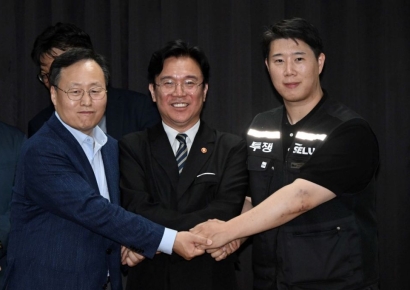
On the 7th of this month, 46 dismissed workers, including Kim Deuk-jung, head of the Metal Workers' Union Ssangyong Motor Branch, waved their hands as they crossed the main gate after reinstatement at the Ssangyong Motor headquarters in Pyeongtaek, Gyeonggi Province. Photo by Yonhap News
View original imageSsangyong Motor recently stated that delays in assigning reinstated dismissed workers to the workplace are inevitable amid worsening business conditions and ongoing self-rescue plans targeting existing employees. The company has announced management reform plans twice, including the return of bonuses and rotational leave, to reduce labor costs.
The 2009 Ssangyong Motor incident began when the company laid off about one-third of its executives and employees, triggering strong opposition from union members. At that time, around 1,700 employees left the company through voluntary retirement, while 165 who held out until the end were eventually dismissed.
Hot Picks Today
 Samsung Electronics Introduces New "Special Performance Bonus" for Semiconductors, Paid Entirely in Company Shares
- "Could I Also Receive 370 Billion Won?"... No Limit on 'Stock Manipulation Whistleblower Rewards' Starting the 26th
- "From a 70 Million Won Loss to a 350 Million Won Profit with Samsung and SK hynix"... 'Stock Jackpot' Grandfather Gains Attention
- Will Soaring Semiconductor Prices Support a Gradual Stabilization of the Household Debt Ratio? Why [BOK Focus]
- "Who Is Visiting Japan These Days?" The Once-Crowded Tourist Spots Empty Out... What's Happening?
Since then, Ssangyong Motor has reinstated dismissed workers sequentially as business conditions improved. The last group of 46 was scheduled to return earlier this year, but sudden deterioration in the company's management caused setbacks in their workplace return.
© The Asia Business Daily(www.asiae.co.kr). All rights reserved.







