The Financial Sector's First New Year Task: 'Managing Union Risks'
Yoon Jong-won, CEO of IBK, Fails First Day at Work Due to Union's Opposition to 'Parachute Appointment'
Kyobo Life Faces Union Backlash Over Introduction of 'Job-based Pay'
Union Risk Management and Communication Are Top Priorities

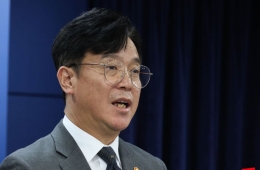
On the 3rd, union members held a rally to block the new IBK Industrial Bank of Korea President Yoon Jong-won's arrival at the IBK Industrial Bank of Korea headquarters in Jung-gu, Seoul, shouting slogans. Photo by Kim Hyun-min kimhyun81@
View original image[Asia Economy Reporter Kwon Haeyoung] 'Labor union risk management' has emerged as a major task in the financial sector this year. Following the failure of IBK (Industrial Bank of Korea) President Yoon Jong-won to report to work on his first day due to union opposition to the 'parachute appointment,' Kyobo Life Insurance in the insurance sector is facing union backlash after deciding to introduce a 'job-based pay system.' Amid the triple challenges of low interest rates, economic slowdown, and regulations, the overall financial industry is expected to go through a dark tunnel this year, making union risk management and communication with unions one of the key tasks in the financial sector.
According to the financial sector on the 3rd, Kim Hyung-sun, chairman of the IBK union, strongly opposed the inauguration of President Yoon, saying, "In the end, the Blue House appointed a parachute candidate as the new IBK president," and added, "The 10,000 union members of IBK have officially resolved to oppose the parachute president, and if the appointment is forced, we will not hesitate to engage in work stoppage protests and a general strike."
President Yoon attempted to report to work at around 8:28 a.m. that day but was blocked by the union's protest and had to turn back at 8:37 a.m., just nine minutes later, without entering the office.
Besides IBK, where union opposition is intense due to controversies over 'parachute appointments' and 'government-controlled finance,' many other financial institutions have faced union conflicts as a major issue from the beginning of the new year.
Kyobo Life Insurance has sparked controversy by announcing that it will expand the 'job-based pay system,' which pays wages based on tasks rather than rank, from executives and department heads to all employees starting this year. While the company aims to reward employees with heavier workloads and prevent 'free riders,' the union worries that job analysis and value assessment are difficult and could be exploited. The union immediately opposed, stating, "The company is rushing to unilaterally introduce the job-based pay system," and "No final agreement has been reached yet regarding the expansion of the job-based pay system, including changes to personnel regulations."
With the financial sector's shareholder meetings scheduled for March, there are concerns that labor-management conflicts may escalate as some financial company unions push for the introduction of a 'labor director system.' The KB Kookmin Bank union is likely to pursue this again this year. Particularly, tensions are rising in some financial companies as strong labor figures occupy the positions of financial union chairman and major bank union chairmen. For example, Park Hong-bae, the new financial union chairman, is a strong figure who led KB Kookmin Bank's strike for the first time in 19 years last year.
Amid expectations of a difficult financial business environment this year due to low interest rates, economic slowdown, and government regulations, union risk management has emerged as a major variable in management throughout the financial sector. Especially under the current pro-union government, the influence of unions has grown, increasing the burden on financial companies. Unions at Hana Financial Group and KEB Hana Bank have previously formed conflictual relationships with management by repeatedly demanding the resignation of chairpersons and presidents.
Hot Picks Today
 "Stocks Are Not Taxed, but Annual Crypto Gains Over 2.5 Million Won to Be Taxed Next Year... Investors Push Back"
- "Don't Throw Away Coffee Grounds" Transformed into 'High-Grade Fuel' in Just 90 Seconds [Reading Science]
- Signed Without Viewing for 1.6 Billion Won... Jamsil and Seongbuk Jeonse Prices Jump 200 Million Won in a Month [Real Estate AtoZ]
- "Groups of 5 or More Now Restricted"... Unrelenting Running Craze Leaves Citizens and Police Exhausted
- "Even With a 90 Million Won Salary and Bonuses, It Doesn’t Feel Like Much"... A Latecomer Rookie Who Beat 70 to 1 Odds [Scientists Are Disappearing] ③
A financial sector official said, "While IBK has grounds for union opposition due to parachute appointments and government-controlled finance controversies, some financial companies experience cases where unions abuse their power as a means of excessive welfare demands, management participation, and pressure on management," adding, "In a difficult business environment, how well labor and management unite and pool their capabilities could significantly impact the performance of financial companies this year."
© The Asia Business Daily(www.asiae.co.kr). All rights reserved.