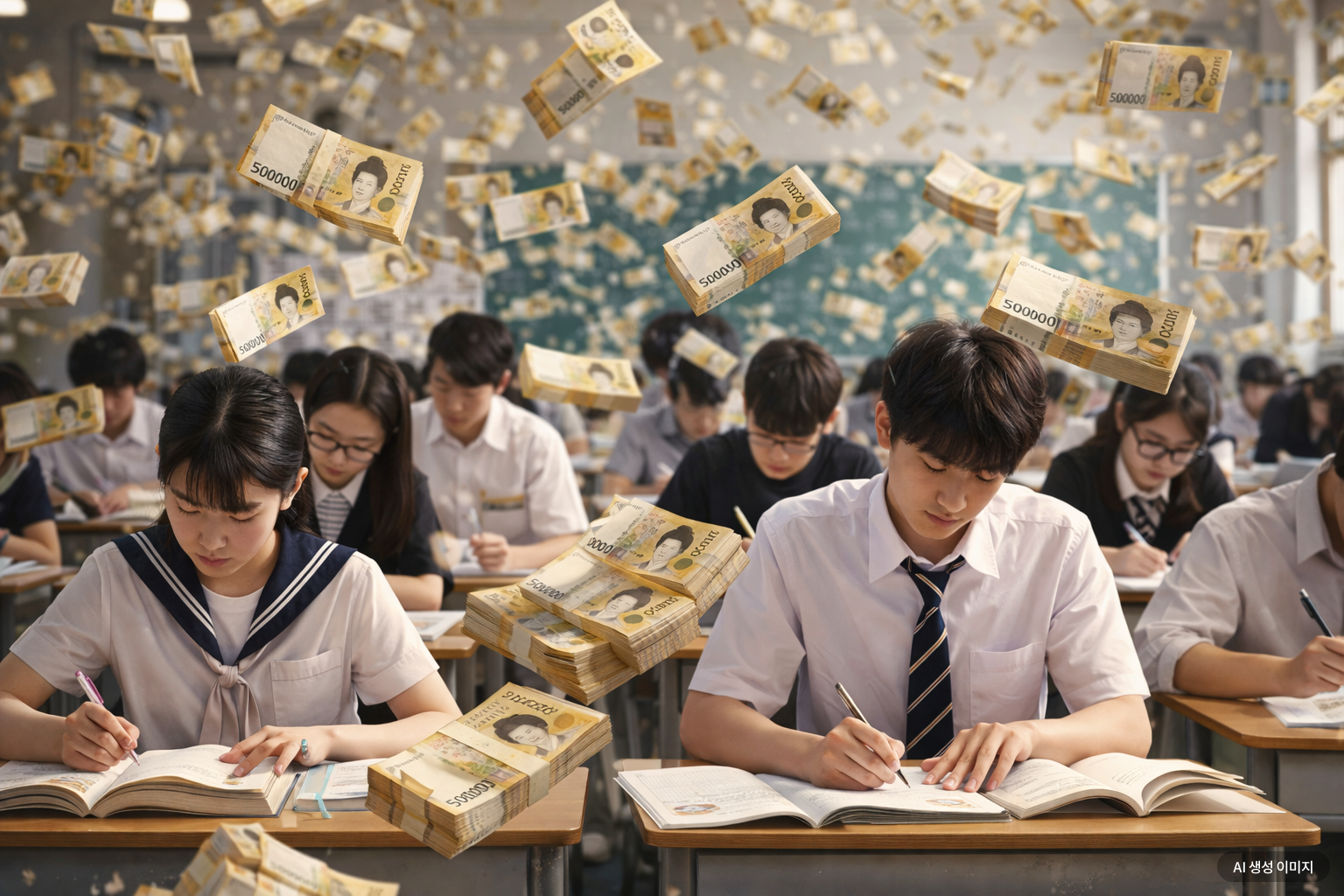

Last year, private education spending by elementary, middle, and high school students decreased for the first time since 2020. The Ministry of Education analyzed that policies such as after-school programs and EBS-linked initiatives had some impact.
According to the Ministry of Education on March 12, 2026, the total amount spent on private education last year was 27.5 trillion won, down 1.7 trillion won (5.7%) from the previous year. By school level, spending was 12.2 trillion won for elementary schools (down 7.9%), 7.6 trillion won for middle schools (down 3.2%), and 7.8 trillion won for high schools (down 4.3%), marking a decline across all groups.
Elementary -3.3%, Middle -5%, High -4.3%First Decrease Since the 'COVID-19 Shock' in 2020

This is the first time since 2020 that private education spending has decreased compared to the previous year. In 2020, spending dropped from 21 trillion won to 19.4 trillion won due to academy operation restrictions caused by COVID-19. However, after that, it reached record highs for four consecutive years: 23.4 trillion won in 2021, 26 trillion won in 2022, 27.1 trillion won in 2023, and 29.2 trillion won in 2024. If this trend had continued, it was expected that the total would surpass 30 trillion won in 2025, but last year saw a reversal, with spending decreasing.
The Ministry of Education interpreted this as being partly influenced by education policies aimed at reducing private education costs. A Ministry official said, "For elementary schools, public education services such as Neulbom School and after-school programs had a positive effect, and for middle and high schools, policies to supplement private education through EBS lectures appear to have played a role."
The rate of participation in private education also declined. The participation rate dropped by 4.3 percentage points year-on-year, from 80.0% to 75.7%. By school level, participation was 84.4% in elementary schools (down 3.3 percentage points), 73.0% in middle schools (down 5.0 percentage points), and 63.0% in high schools (down 4.3 percentage points). The average hours of participation were 7.4 hours for elementary, 7.2 hours for middle, and 6.6 hours for high school students, decreasing by 0.4, 0.5, and 0.4 hours, respectively.
'604,000 won per month'Private Education Students Are Spending Even More

The average monthly private education spending per student was 458,000 won, a decrease of 3.5% from the previous year. However, for students who actually participated in private education, the average monthly spending rose by 2.0% to 604,000 won. This is the first time that the average monthly cost for participating students has exceeded 600,000 won.
By school level, the per-student average spending for all students was 433,000 won for elementary schools, 461,000 won for middle schools, and 499,000 won for high schools, which represent decreases of 2.1%, 5.9%, and 4.0%, respectively. However, among students participating in private education, the per-student average was 512,000 won for elementary, 632,000 won for middle, and 793,000 won for high school students, showing respective increases of 1.7%, 0.6%, and 2.6%.
English: 281,000 wonMath: 270,000 wonKorean: 185,000 won

The average monthly private education spending per student on general subjects such as Korean, English, and math was 336,000 won, down 6.0% from the previous year. However, for students who participated, the figure rose by 7.9% to 595,000 won. Among general subjects, 'English' had the highest average monthly private education spending.
For students participating in private education, the average monthly spending on English was 281,000 won, which was higher than math (270,000 won), Korean (185,000 won), and social studies/science (166,000 won).
By grade, first-year high school students had the highest average monthly private education spending at 534,000 won, and among those participating, the figure was 806,000 won. Regarding this, a Ministry of Education official commented, "First-year high school students are going through a transitional period, so various factors such as adapting to new classes likely played a role."
-
Reporter Oh Jooyean moon170@asiae.co.kr
-
Edit Lee Seonju sjlee109@asiae.co.kr
© The Asia Business Daily(www.asiae.co.kr). All rights reserved.
!["Please Help Us": How Much Do Those Bowing 90 Degrees These Days Actually Earn? [Data Pick]](https://cwcontent.asiae.co.kr/asiaresize/323/2026052010120870131_1779239528.png)