National Statistical Research Institute 'Youth Quality of Life 2025' Report
Average life satisfaction score for ages 15 to 29 was 6.5 from 2021 to 2023 Ranked 31st out of 38 OECD countries, among the lowest Youth make up 20.1% of the total population... 25.8% of young people live alone Burnout rate was 32.2% last year, with concentration around the time of employment
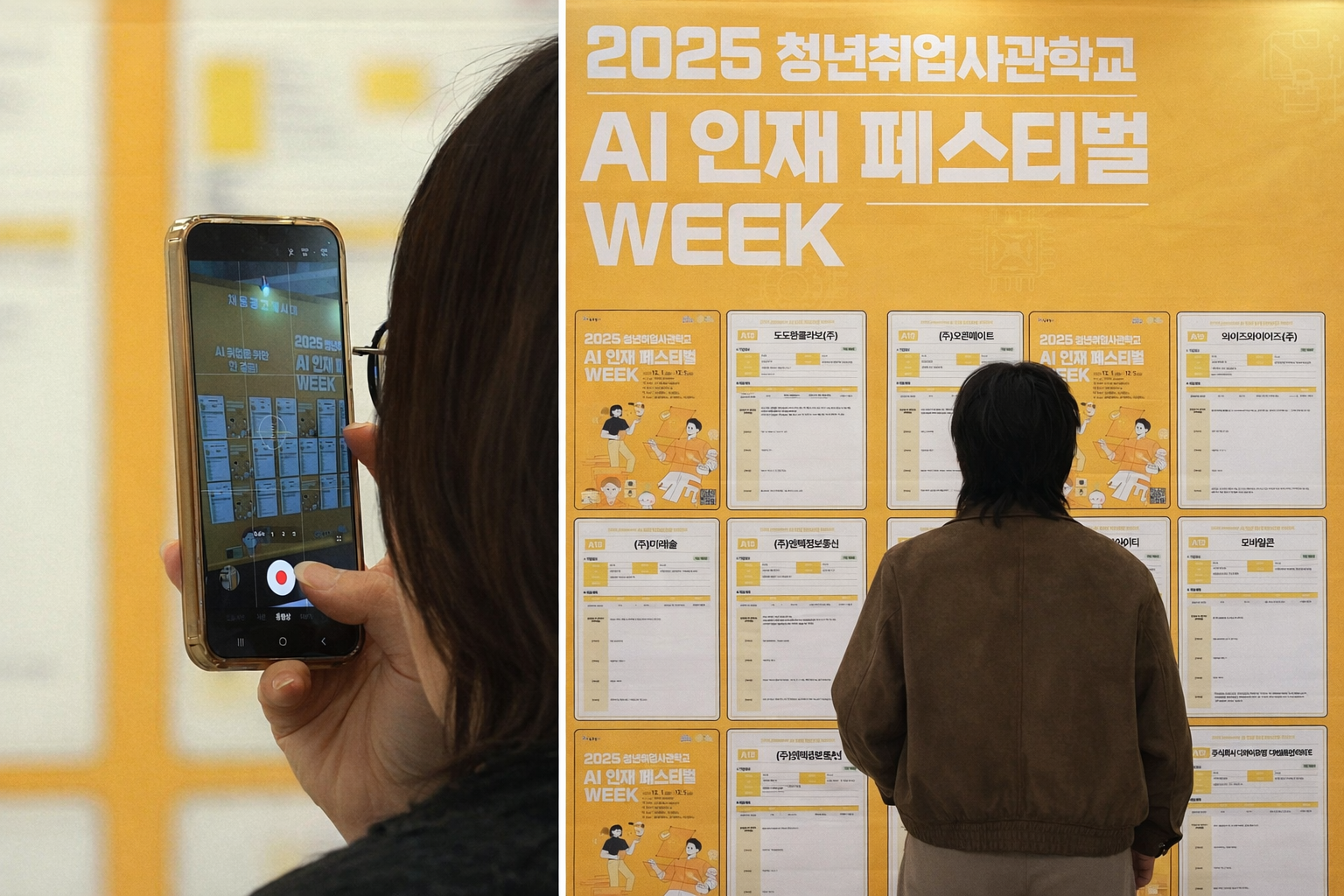
A view of the job posting board at the Job Plus Center of a university in Seoul. Photo by Yonhap News
The life satisfaction of young people in South Korea ranked 31st out of 38 countries in the Organisation for Economic Co-operation and Development (OECD), placing it among the lowest. Three out of ten young people have experienced burnout, with the burnout rate being relatively high among those aged 25 to 29, the age group entering the job market.
The National Statistical Research Institute of the National Data Office published the 'Youth Quality of Life 2025' report on December 16, 2025. This is the first time the report has been released. The report aims to provide a comprehensive overview of the quality of life for young people based on 62 indicators across 12 areas, including health, leisure, employment, and wages.
Youth Population Proportion at 20.1%, on a Downward Trend
According to the report, the youth population (ages 19 to 34) stood at 10,404,000 last year, accounting for 20.1% of the total population. The proportion was 28.0% in 2000, but gradually declined to 22.9% in 2010 and 21.1% in 2020, barely maintaining above 20%.
The unmarried rate among young people is on the rise. For men aged 30 to 34, the unmarried rate rose from 28.1% in 2000 to 74.7% last year, an increase of 46.6 percentage points. For women in the same age group, the rate increased by 47.3 percentage points, from 10.7% to 58.0%.
Due to increases in both non-marriage and late marriage, the number of young people living alone is rising. Last year, 25.8% of all young people lived alone. This figure was in the single digits at 6.7% in 2000, but rose to 12.5% in 2010 and has continued to increase since then.
Youth Satisfaction Ranks 31st out of 38 OECD Countries
Last year, the life satisfaction score of young people was 6.7. Narrowing down to youth aged 15 to 29, the average score from 2021 to 2023 was 6.5, ranking 31st out of 38 OECD countries. This was 0.3 points lower than the OECD average (6.8).
Three out of ten young people have experienced burnout. The burnout rate, defined as feeling mentally and physically exhausted, was 32.2% last year, lower than 33.9% in 2022. The burnout rate was higher among women (36.2%) than men (28.6%).
By age group, the burnout rate was relatively high at 34.8% for those aged 25 to 29, the period when many enter the job market. The burnout rate was 29.7% for those aged 19 to 24 and 31.9% for those aged 30 to 34.
The youth suicide rate was 24.4 per 100,000 people last year, an increase of 1.3 from the previous year. Over the past ten years since 2015, the suicide rate among those aged 25 to 29 increased by 6.6, the largest rise among youth age groups. The rate increased by 5.3 for those aged 19 to 24 and by 3.8 for those aged 30 to 34.
Relative Poverty Rate in the 7% Range... Lower than the OECD Average
Last year, the employment rate for ages 15 to 29 was 43.7% for men and 48.4% for women, with women having a 4.7 percentage point higher rate. On the other hand, for ages 30 to 34, the employment rate was 86.6% for men and 73.5% for women, with men having a 13.1 percentage point higher rate. The gender gap is gradually decreasing.
Last year, the unemployment rate for those aged 15 to 29 was 5.9%, continuing a recent downward trend. The expanded unemployment rate, which reflects a broader range of job-seeking intentions, also declined to 15.6% last year. The gap between the official and expanded unemployment rates was about 9.7 percentage points.
The relative poverty rate among young people declined from 11.3% in 2011 to 7.6% in 2023. For those aged 18 to 25, the relative poverty rate was 8.7% in 2022, the ninth lowest among OECD countries. This was 3.6 percentage points lower than the OECD average of 12.3%.
The proportion of students aged 18 to 21 enrolled in higher education institutions rose to 76.3% this year, up 1.4 percentage points from 74.9% the previous year. After reaching 52.5% in 2000, this rate continued to climb, plateaued during the 2010s, and has been on the rise again since 2020.




!['WHO Declares International Public Health Emergency' Why the Untreatable 'Variant Ebola' Is More Deadly Than COVID-19 [Reading Science]](https://cwcontent.asiae.co.kr/asiaresize/323/2026052110164072055_1779326201.png)
!["Please Help Us": How Much Do Those Bowing 90 Degrees These Days Actually Earn? [Data Pick]](https://cwcontent.asiae.co.kr/asiaresize/323/2026052010120870131_1779239528.png)