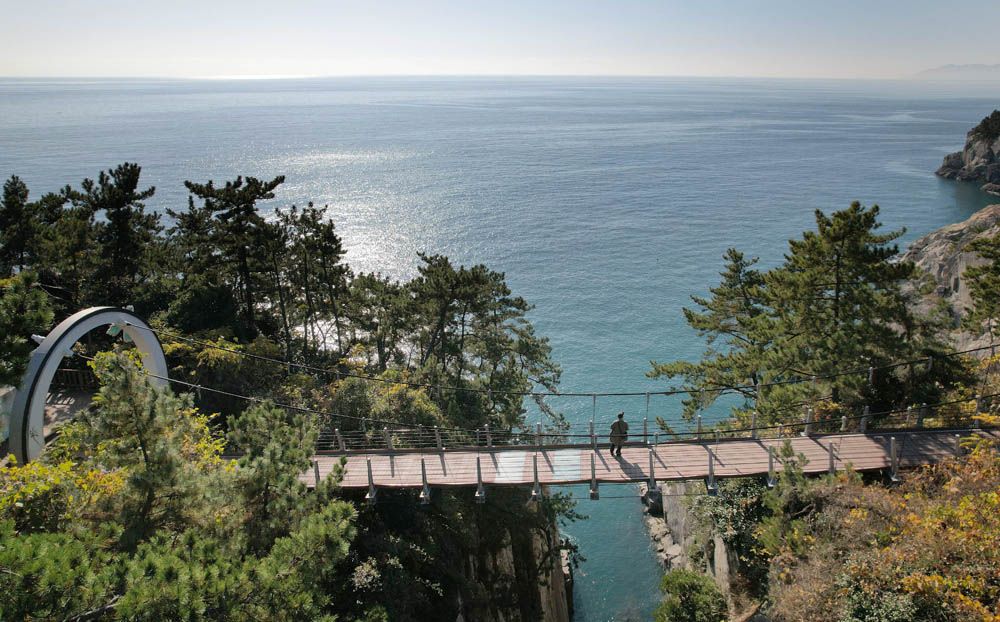


Geumo Island, where the late autumn atmosphere is vividly felt despite the early winter warm weather
원본보기 아이콘

There are 317 islands scattered across the sea off the coast of Yeosu. It is, quite literally, a sea of many islands. Among them, there is one island that is especially popular with mainland visitors: Geumodo, named for its resemblance to a golden turtle. It is the second largest island after Dolsando, which is so close to Yeosu that it is hardly considered an island anymore, and the 21st largest in South Korea. Its physical size is impressive, but its landscapes are even more breathtaking. The island features a coastal cliff trail known as Bireonggil, which offers spectacular views of the Dadohae Sea. 'Bireong' is the Yeosu dialect for 'cliff.' The original trail was a coastal path connecting villages, used by locals to gather firewood and go fishing. While there are some ups and downs along the way, the walk is not too strenuous. Simply walking alongside the dazzling sea is an exhilarating experience. But that's not all. There is something else as famous as Bireonggil: coastal hog fennel (bangpung). An astonishing 95% of the coastal hog fennel distributed nationwide comes from Geumodo. It became well-known for its reputed effectiveness in preventing wind-related ailments. After walking Bireonggil, enjoying a plate of coastal hog fennel pancake or a bowl of coastal hog fennel and abalone noodle soup is an unexpected luxury that will leave you deeply impressed.
The Deeper You Walk, the More Beautiful Bireonggil Becomes... A Perfect Day Where Sea and Cliffs Unite
The ferry departing from Dolsan Singi Port in Yeosu reached Yeocheon Port on the northern side of Geumodo in just 20 minutes. As soon as I set foot on the island, the late autumn scenery caught my eye. Although it was early winter, the southern breeze was warm, making late autumn memories linger even longer.


The five courses of Bireonggil, located on the island’s western side, stretch a total of 18.5 kilometers and take about 8 hours and 30 minutes to complete. Since 'Bireong' means 'cliff,' the trail essentially loops around the island, following the cliffs. Built upon the old paths that once connected villages, the trail allows you to sense traces of Geumodo’s residents along the way. If you walk briskly, you can complete the entire trail in a day, but to truly savor the nature, a two-day trip is ideal. If you need to return the same day, one or two courses are recommended. Following the advice from the tourist information center, I chose to walk Course 3.
Course 3 begins at Jikpo Village. Among the Bireonggil courses, this section has the most elevation changes, but it is not particularly difficult. It includes all the highlights of Bireonggil: observatories, a suspension bridge, and forests.
From the start, dense camellia trees form a tunnel. Though the sky occasionally peeks through, the walk to Galbaramtong Observatory, about one kilometer away, is enveloped in lush forest. Small birds dart swiftly from tree to tree, chirping cheerfully as if singing. The gentle sound of waves provided a soothing background to the entire scene.


Geumodo: An Island Where Time Flows Slowly... Course 3 Offers the Most Dramatic Views Among the Five Courses
I came to see the sea along Bireonggil, but the ocean was hidden by the thick forest. Geumodo is densely wooded with nutmeg, camellia, pine, hornbeam, citron, and more. In the past, people called Geumodo 'Geomeu-seom,' meaning 'dark island,' because the forests were so dense that the island appeared entirely black from a distance. There is a reason for this: until 1884, civilians were not allowed to live on the island. The Joseon Dynasty designated it as a 'Bongsan' (protected mountain), prohibiting indiscriminate tree felling. All the timber harvested here was sent to Hanyang (present-day Seoul) to make royal coffins.
After walking for some time, the forest suddenly opened up to reveal a breathtaking view of the sea. This was the Galbaramtong Observatory, perched on a sheer cliff. The colors of the sea were so varied and beautiful that the usual descriptions of 'emerald' or 'jade' did not do it justice.
After lingering for a while to admire the sea, I returned to the forest path, this time through a dense camellia grove. The sky appeared and disappeared between the bare branches of trees whose leaves had fallen. Although it was not yet the season for camellia blossoms, and I could not see their red flowers, I was so absorbed in the forest that I soon arrived at Maebong Observatory.


The view of Geumodo from the observatory was completely different. As the highest observatory on Bireonggil, it offered a sweeping panorama of the vast sea that made me feel completely liberated. Standing at the edge of the cliff, listening to the sound of waves, the noise of the city and the weight of daily life seemed to vanish like the wind. In the distance, small villages nestled along the indented coastline. Beyond Hakdong Village, the end point of Course 3, I could faintly see Simpo Village, while the islands of Ando and Sorido floated on the sea.
Descending from the observatory, I crossed 'Bireongdari,' a suspension bridge connecting narrow coastal cliffs carved by the sea. The middle of the bridge is made of transparent glass, offering a dizzying view of the cliffs dozens of meters below. The bridge sways with every step, making your knees tremble. With the sheer drop to the sea below, it’s no wonder. Sometimes, I had to wait for playful travelers to cross, gripping the railing tightly before making my way across. After crossing Bireongdari, the path leads back to Jikpo Village, the starting point of Course 3. If you came by car, it is best to return from either Maebong Observatory or Bireongdari. If you are using the village bus or plan to continue onto Course 4, head to Hakdong Village, the end point of Course 3. About 20 minutes past Bireongdari, you’ll reach a small coastal area-this is Hakdong Village, the final destination. Looking back at the late autumn sea, I was struck by its utter calm. The sunlight sparkled brilliantly on the water, so bright that I could barely look at the sea.
Geumodo (Yeosu) = Written and photographed by Cho Yongjun, travel journalist
◆Travel Information
▲Getting There=Bireonggil on Geumodo consists of five courses (18.5 km) running along the island’s western coast. Ferries depart from Yeosu Coastal Passenger Terminal, Dolsan Singi Port, and Baekya Island Pier. Among these, the Dolsan Singi Port-Geumodo Yeocheon route has the most frequent service. The one-way fare is 5,000 won for adults,

▲Local Cuisine=Coastal hog fennel is famous here, especially when harvested between March and April. There are several places on Geumodo that serve dishes featuring coastal hog fennel. Among them, the eco-friendly Coastal Hog Fennel and Abalone Noodle Soup restaurant is run by a grandmother who moved to the island with her husband 30 years ago. She serves delicious coastal hog fennel pancakes and coastal hog fennel and abalone noodle soup (10,000 won, pictured).

▲Sightseeing=With the opening of Ando Bridge, Ando-now connected to Geumodo-has become a must-see. The island is quiet, and the low hill to the right of the pier is worth the climb. From the summit, you can enjoy views of the crescent-shaped pebble beach and the charming landscape of Ando, with the Dadohae scenery stretching into the distance. The best scenic spot on Ando is undoubtedly Baekgeumpo Beach, with its fine sand, shallow waters ideal for summer swimming, and pale emerald-colored sea.
The sunset scenery on Geumodo is truly special. At dusk, the pastel blue sea is colored by the setting sun, shifting from deep yellow to orange, and finally to a reddish purple as time passes. The best place to watch the sunset is above Hamgumi Village. For a magnificent sunrise, climb the beacon mound on Mangsan (344 meters) early in the morning.
IndexCho Youngjun's Travel Diary
- A Breathtaking View from the Edge... Hidden Scenery Revealed Only to Those Who Walk
-

Reporter Cho Yongjun jun21@asiae.co.kr
-
Edit Yang Hyejin adoretj@asiae.co.kr
© The Asia Business Daily(www.asiae.co.kr). All rights reserved.
!["Please Help Us": How Much Do Those Bowing 90 Degrees These Days Actually Earn? [Data Pick]](https://cwcontent.asiae.co.kr/asiaresize/323/2026052010120870131_1779239528.png)