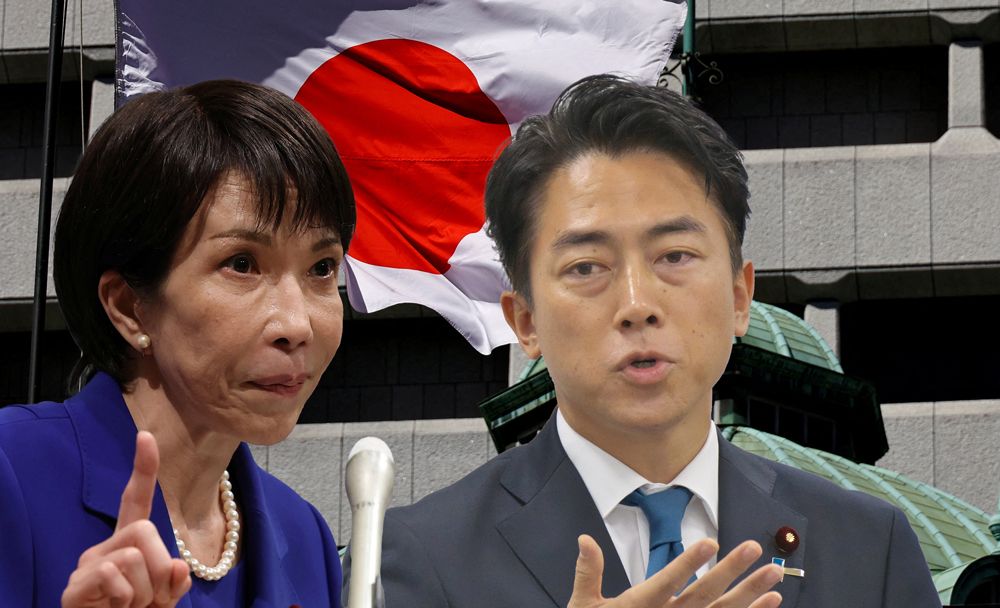
With the Liberal Democratic Party (LDP) presidential election in Japan scheduled for October 4, last-minute campaigning is in full swing. The election is being held just one year after the previous vote, following Prime Minister Shigeru Ishiba's announcement of his resignation, and competition is fierce among candidates vying for the next Japanese leadership. Currently, the race is shaping up as a two-way contest between Shinjiro Koizumi, Minister of Agriculture, Forestry and Fisheries and the second son of former Prime Minister Junichiro Koizumi, and Sanae Takaichi, former Minister for Economic Security, who is often referred to as the "female Abe."
Election on October 4... Takaichi and Koizumi Lead the Race
Japan operates under a parliamentary cabinet system, where the leader of the majority party becomes the prime minister and leads the government. Although both the House of Representatives and the House of Councillors are currently dominated by opposition parties, the opposition remains divided, making it likely that the new LDP president will become the next prime minister.
In the LDP presidential election, each of the 295 LDP-affiliated lawmakers casts one vote, and votes from party members (Japanese nationals who pay party dues) and party supporters (members of political organizations supporting the LDP) are converted to match the lawmakers' votes, totaling another 295 votes. This brings the total to 590 votes.
If a candidate wins a majority in the first round, they are elected. If no one secures a majority, a runoff is held between the top two candidates. In the runoff, 295 lawmaker votes are combined with votes from 47 local party organizations. If the election goes to a runoff, the lawmakers' votes become decisive in determining the winner.

Candidates attending the Liberal Democratic Party presidential election debate held in Tokyo, Japan, on the 24th. Photo by Reuters and Yonhap News Agency
원본보기 아이콘Koizumi Leads Among Lawmakers, Takaichi Among Party Members
This election features a rivalry between Minister of Agriculture, Forestry and Fisheries Koizumi, known in Korea as "Punkoolsekjwa," and former Minister for Economic Security Takaichi, dubbed the "female Abe." If Koizumi is elected, he will become the youngest LDP president and the youngest postwar prime minister. If Takaichi wins, she will become both the first female LDP president and Japan's first female prime minister. In last year's presidential election, Takaichi finished second, while Koizumi came in third.

Former Minister for Economic Security Takaichi, now 64, is a hardline right-wing politician who inherits the political line of former Prime Minister Shinzo Abe, including constitutional revision and Abenomics. Notably, she stands out in the LDP, which is dominated by male hereditary politicians, as a female, non-hereditary politician from an ordinary middle-class background. After graduating from university and attending Matsushita Institute of Government and Management, she was first elected to the House of Representatives in 1993.
However, she has long visited Yasukuni Shrine, where Class-A war criminals of the Pacific War are enshrined, and has declared that she will continue this practice even if she becomes prime minister, making diplomatic friction with neighboring countries such as South Korea and China inevitable if she is elected.

In contrast, Minister Koizumi is a 44-year-old male hereditary politician. He entered politics as his father's secretary in 2007, inherited his father's constituency and was elected in 2009, and has long been considered a potential future prime minister. While he is young, has a fresh image, and is considered attractive, concerns remain about his lack of experience. He is relatively reform-minded but, like Takaichi, has visited Yasukuni Shrine annually.
During his tenure as Minister of the Environment in 2019, he made a controversial remark that issues such as climate change should be addressed in a "fun, cool, and sexy" way, which became a meme in Korea as "Punkoolsekjwa."
Other Candidates Include Chief Cabinet Secretary Hayashi and Former LDP Secretary-General Motegi
Other candidates include Chief Cabinet Secretary Yoshimasa Hayashi (64), former Minister for Economic Security Takayuki Kobayashi (50), and former LDP Secretary-General Toshimitsu Motegi (69).

Currently, Koizumi leads in support among lawmakers, while Takaichi leads among party members. According to the Sankei Shimbun, which surveyed LDP lawmakers, about 30% of the 295 lawmaker votes are pledged to Koizumi as of September 28. Hayashi, considered a "dark horse," has support from about 20%, and Takaichi is supported by just over 10%.
According to a Jiji Press survey of LDP lawmakers as of September 25, 60 to 70 out of 295 lawmakers support Koizumi, while fewer than 40 support Takaichi. Hayashi is supported by around 50 lawmakers, similar to the Sankei Shimbun's findings.
A Nihon TV (Nippon Television) poll conducted on September 23-24 of 1,108 LDP party members and supporters found that 34% supported Takaichi, the highest share, followed by Koizumi (28%) and Hayashi (17%).
Given this landscape, the Sankei Shimbun predicts that no candidate will secure a majority in the first round, making a runoff likely. In last year's September presidential election, Takaichi led in the first round but failed to win a majority, resulting in a runoff against Prime Minister Ishiba, who finished second.
"A Foreigner Kicked a Deer"... Japan Shifts Further Right
Regardless of which candidate wins, there are expectations that the LDP presidential election will push Japan further to the right. Unlike Prime Minister Ishiba, who has a relatively moderate view of history, both leading candidates-Takaichi and Koizumi-have a record of visiting Yasukuni Shrine every year.
Additionally, the rise of the far-right new party Sanseito, which campaigned on a "Japanese First" slogan in the House of Councillors election in July, has had an impact. There is growing concern within the LDP that conservative votes are shifting to Sanseito, creating a sense of crisis.
Indeed, the candidates' pledges appear to reflect the influence of Sanseito's popularity, particularly regarding policies on foreigners. While these were not major issues in last year's election, this year candidates are actively proposing policies on crimes committed by foreigners and immigration restrictions.
Some candidates have even made statements that incite anti-foreigner sentiment. At a policy speech on September 23, Takaichi claimed that a foreign tourist kicked one of Nara Prefecture's famous deer while explaining her policies on foreigners, sparking controversy. When asked for evidence at a debate hosted by the Japan National Press Club the following day, she replied, "I have confirmed it in my own way." However, according to Nara Prefecture authorities, there is no record of a foreign tourist assaulting a deer.
Furthermore, Koizumi, who actively promoted the introduction of the selective married couple surname system-a reformist policy-during last year's LDP presidential election, has refrained from mentioning it this year, seemingly in consideration of conservative voters, signaling a retreat from his previous stance.
Potential for Deepening Historical Disputes with South Korea over Dokdo and Other Issues
So far, the candidates' remarks on Japan-South Korea relations have generally followed the line of the Ishiba cabinet. Both Koizumi and the far-right Takaichi have emphasized cooperation with key allies such as South Korea, the United States, and the Philippines.
However, concerns over historical disputes are expected to intensify. At present, both leading candidates have given ambiguous answers such as "I will decide appropriately" when asked about their intentions to visit Yasukuni Shrine, seemingly mindful of relations with neighboring countries and centrist voters. However, it is unlikely that such ambiguity will continue after the election. Some LDP lawmakers are reportedly concerned that Takaichi's election and her visits to Yasukuni Shrine could lead to diplomatic conflicts with South Korea and China.
On September 27, Takaichi attended the "Takeshima Day" event in Shimane Prefecture (Takeshima is the Japanese name for Dokdo, which Japan claims) and argued that the government representative should be upgraded to ministerial level, asserting that Takeshima is Japanese territory.
Meanwhile, the next Japanese prime minister faces the task of managing $550 billion in investments in the United States. With U.S. President Donald Trump considering a visit to Japan at the end of October for the first time in six years, topics such as expanding Japanese corporate trade investment and increasing defense spending are expected to be on the agenda.
In a debate on September 28, Takaichi mentioned the possibility of renegotiating with the United States, signaling potential repercussions if she is elected. She stated, "If there are any unfair elements that harm our national interests during the implementation process, we must clearly address them." In contrast, Koizumi commented, "I don't believe this agreement is that unfair," while other candidates took a more cautious approach. The Congressional Research Service (CRS) recently stated in a report that Prime Minister Ishiba's intention to resign could affect the implementation of the trade agreement.
-

Reporter Oh Suyon syoh@asiae.co.kr
-
Edit Lee Kijae happylee17@asiae.co.kr
© The Asia Business Daily(www.asiae.co.kr). All rights reserved.

![[Exclusive] "Looking Beyond Financial Statements for Future Value"... IBK Injects 170 Billion Won into 72 Innovative Companies](https://cwcontent.asiae.co.kr/asiaresize/304/2026011314545989464_1768283699.jpg)