"There was a time when business was so good that I had two employees, but now there are no customers, and I've been running at a loss for years."
Shoemakers Gathered Around Leather Warehouses During Japanese Colonial Era
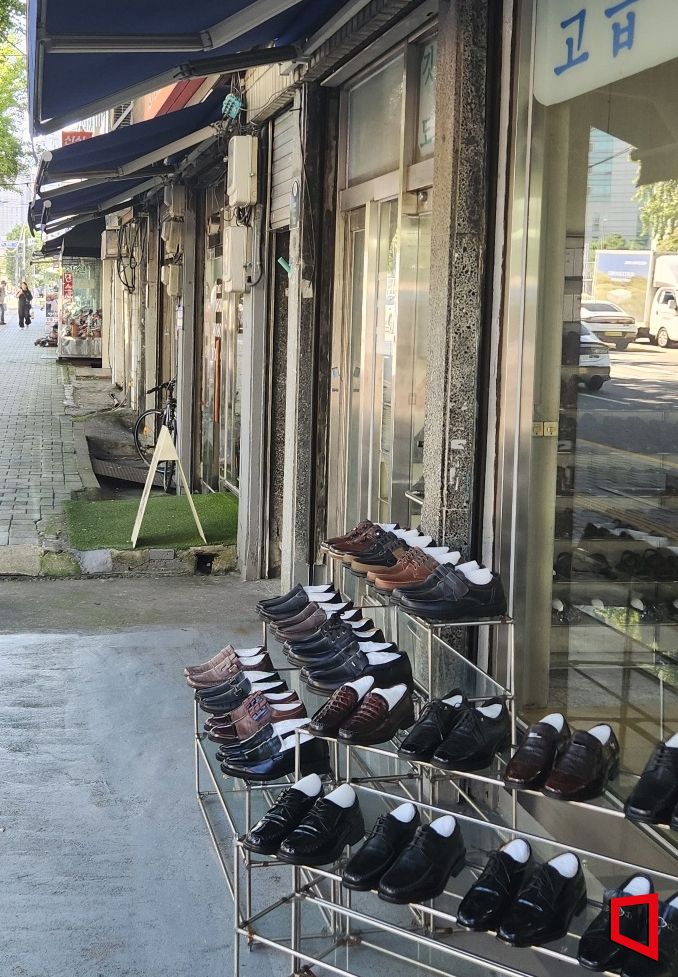
On the afternoon of the 12th at the handcrafted shoe street at Yeomcheon Bridge in Jung-gu, Seoul, Seo Taesik (66), who runs Seoul Shoes, said, "I have been making shoes since I was 20 years old, but the monthly rent for my shop, which is barely 10 square meters, is 700,000 won. When I sell a pair of shoes wholesale, I only make about 5,000 to 10,000 won in profit. In the past, I had many clients, but now, as shoe stores are closing one by one, things are getting increasingly difficult," he lamented.
Most of the passersby simply glanced at the shoe stores without entering. The shops that were open were eerily quiet, and one owner, deeply inhaling a cigarette, exhaled a sigh-laden puff of smoke. Empty stores with "For Lease" signs were noticeable throughout the area. In its heyday in the 1980s, hundreds of businesses thrived here, but now only about 30 remain, barely keeping the tradition alive.
Hundreds Thrived in the 1980s... Mass Closures Due to Online Competition
This street was formed in 1925, during the Japanese colonial period, as shoemakers gathered around leather warehouses. After the Korean War, they repaired and sold U.S. military boots, and in the 1970s and 1980s, they supplied shoes nationwide, enjoying their golden era. However, the mass import of cheap Chinese products and the rise of online shopping led to a decline. Cho Taeho (65), president of Hana Shoes, said, "In the past, people always wore dress shoes to wedding halls, but now they go in sneakers. Even if young people buy shoes, don't they just order them online?" he said with a wry smile.

On the afternoon of the 12th, Cho Taeho, president of Hana Shoes in Jung-gu, Seoul, is explaining about handmade shoes. Photo by Byun Seonjin
원본보기 아이콘Accessibility is also an issue. It is a long walk from the nearest Chungjeongno or Seodaemun subway stations, and even if you get off at Seoul Station, you have to cross a major road. In the past, many customers would park briefly to buy shoes, but since the Seoul Station overpass was turned into a park in 2015, parking has become impossible, further reducing foot traffic.
"Can't Keep Running on Debt"... Difficulties for Those Who Can't Wear Ready-Made Shoes
Jeon Eunju (60), president of Joeun Dance Shoes, which specializes in dance shoes, said, "I'm running the shop on borrowed money, and it's hard to sell even two or three pairs a day." She added that customers who stopped coming after COVID-19 have not returned. Ko Gihwang (70), who runs Italy Shoes, said, "If artisans like us disappear, what will happen to people who can't wear ready-made shoes? My biggest concern is that there will be no skilled workers left to meet the demand for specialty shoes."
-

Reporter Byun Seonjin sj@asiae.co.kr
-
Edit Lee Kijae happylee17@asiae.co.kr
© The Asia Business Daily(www.asiae.co.kr). All rights reserved.
!["Please Help Us": How Much Do Those Bowing 90 Degrees These Days Actually Earn? [Data Pick]](https://cwcontent.asiae.co.kr/asiaresize/323/2026052010120870131_1779239528.png)