Boston Dynamics, a robotics affiliate of Hyundai Motor Group, released a video on the 20th (local time) showing the humanoid robot Atlas solving problems and responding intelligently on its own, even in unexpected situations.
Boston Dynamics 'Atlas' Released video of parts carrying work Walking, crouching, lifting objects Full body coordinated movements displayed
Boston Dynamics has applied a Large Behavior Model (LBM), co-developed with the Toyota Research Institute (TRI), to Atlas, enabling the robot to make decisions and move naturally like a human.
Last year, Atlas successfully performed the task of transferring engine cover parts to a mobile storage container. In the latest video, Atlas is shown moving the robotic dog 'Spot' parts to a loading bay or shelf. Recently, humanoid robots have been rapidly advancing by integrating sophisticated artificial intelligence (AI) technology, raising expectations that they will assist with repetitive tasks in real industrial settings and improve productivity.
Hyundai Motor Group's robot-specialized affiliate Boston Dynamics released a video on the 20th (local time) showing the humanoid robot Atlas intelligently responding and solving problems on its own even in unexpected situations. Hyundai Motor
In this video, Atlas demonstrated coordinated full-body movements such as walking, crouching, and lifting objects to perform tasks like sorting and organizing parts.
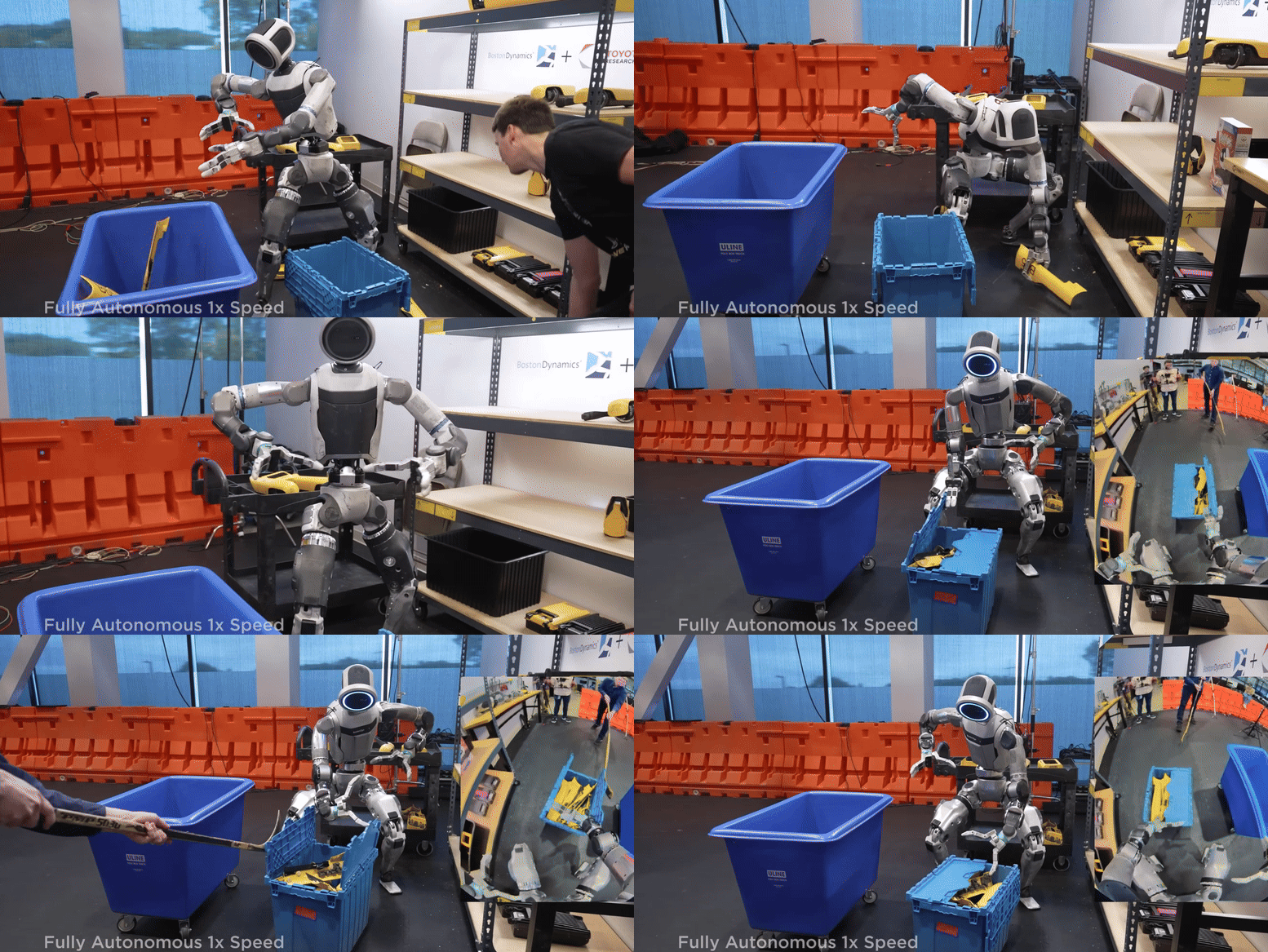
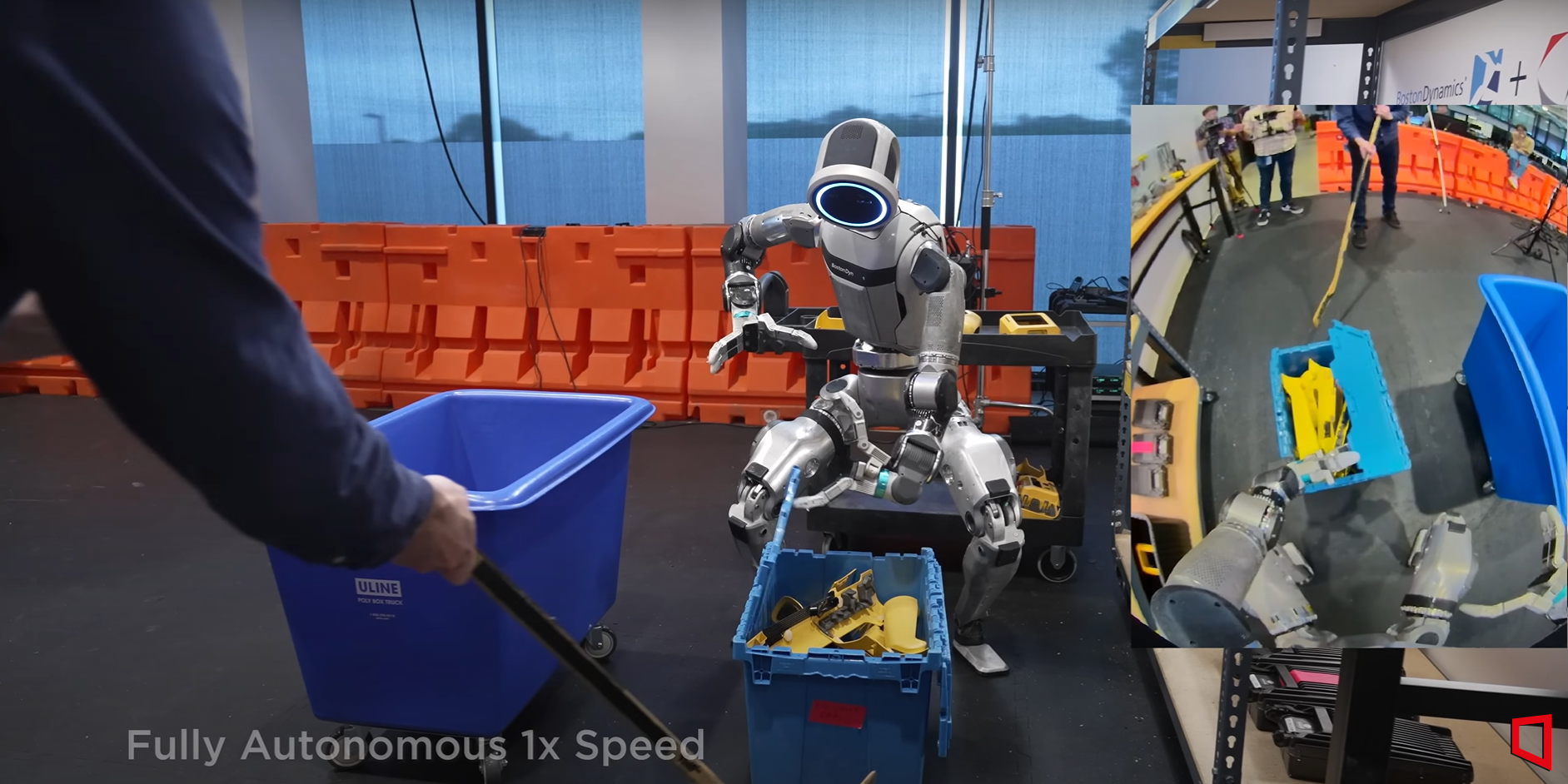
Notably, Atlas's ability to solve problems independently stands out. While Atlas was transferring parts from one box to another, a researcher attempted to disrupt the task by closing the box lid or dropping parts next to the box. However, Atlas remained unfazed, reopening the lid or picking up the dropped parts and placing them accurately in the box.
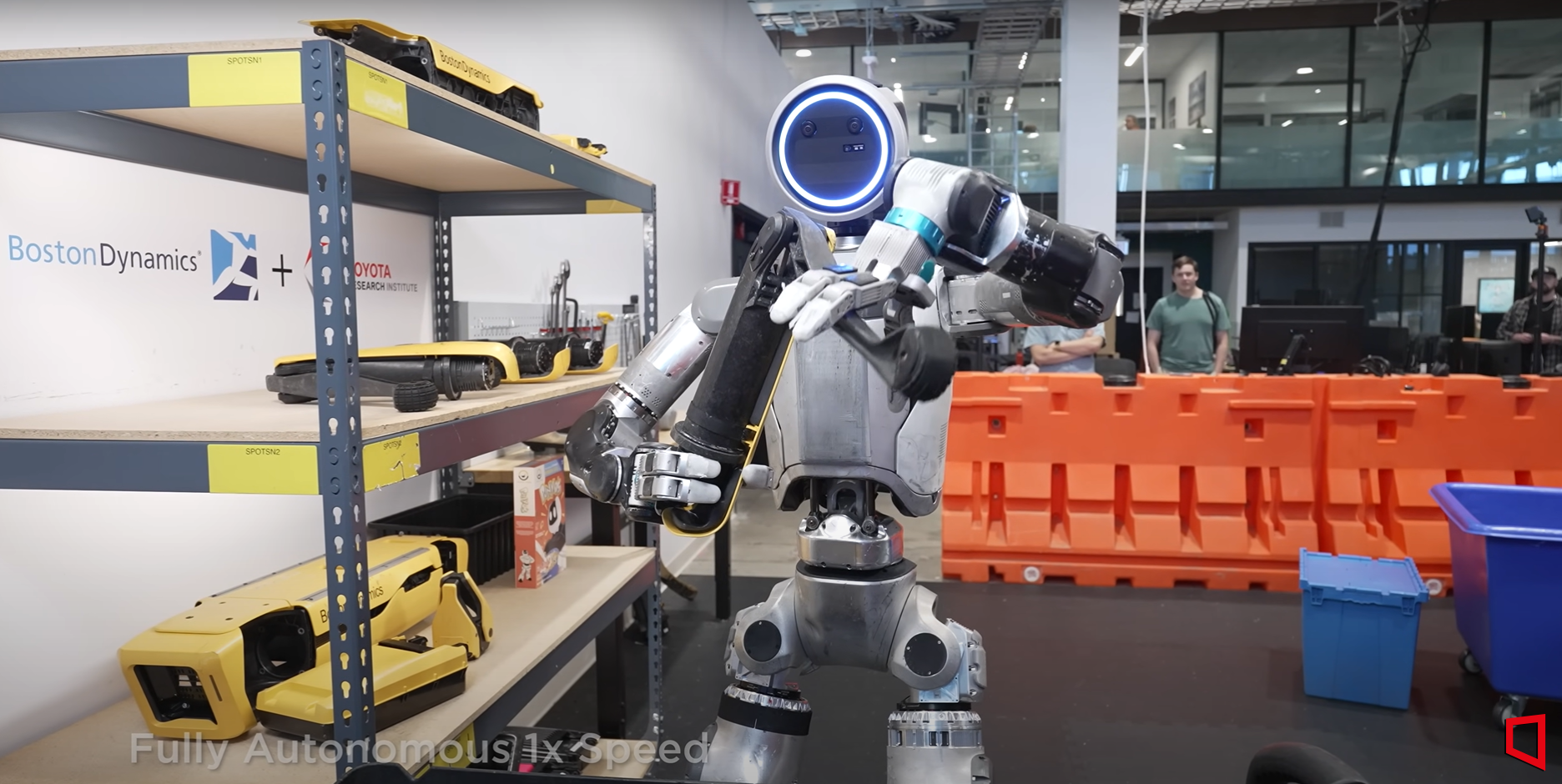
Atlas also demonstrated picking up Spot's leg parts, folding them, and precisely placing them on a shelf, as well as putting another part into a box on the lowest shelf. When Atlas determined that a part could not be placed directly into the box due to an obstruction on the shelf, it cleverly pulled the box forward, loaded the part, and then returned the box to its original position.
The LBM applied to Atlas utilizes an end-to-end approach, allowing the robot to quickly learn how to handle various types of objects and autonomously make decisions and control its actions without having to modify the development code for each new task.
Unfazed by human interference during missions Capable of independently handling unexpected situations Strength in mission execution through learning experience Currently learning to handle items delicately, such as tying knots and spreading blankets
In particular, while earlier robots struggled to respond immediately to problems, Atlas's strength lies in its ability to successfully carry out assigned tasks through learning experience, even without changes to its algorithms or hardware.
LBM is an AI model currently being developed to enable robots to autonomously make decisions and act like humans by learning from large-scale data collected through sensors, such as text, images, and video. This approach is known to improve the robot's motion prediction performance, allowing robots to operate up to twice as fast, even without additional training processes.
Boston Dynamics stated that Atlas is being trained to handle unstructured items delicately, such as tying knots or spreading out a disheveled blanket. The company explained that this demonstrates the potential for the robot to serve as an assistant not only in production sites but also in households.
Boston Dynamics and TRI plan to continue research that organically combines humanoid robots utilizing full-body movements, such as advanced manipulation and dynamic motion, with LBM.
Scott Kuindersma, head of robotics research at Boston Dynamics, said, "This video is an example of how general-purpose robots could change our daily lives and work. Training a single neural network for various manipulation tasks will not only advance general robotics, but also provide the foundation for high-performance robots like Atlas to use their entire bodies with precision and flexibility."
Meanwhile, last October, Boston Dynamics announced plans with TRI to accelerate the development of general-purpose humanoid robots and collaborate on areas such as human-robot interaction and safety. Boston Dynamics is working to enhance its technological capabilities by advancing humanoid robots using NVIDIA’s high-performance robotics chips and strengthening reinforcement learning-based robot AI research in collaboration with the Robotics and AI Institute (RAI).

!["Please Help Us": How Much Do Those Bowing 90 Degrees These Days Actually Earn? [Data Pick]](https://cwcontent.asiae.co.kr/asiaresize/323/2026052010120870131_1779239528.png)