2 Million Employed in Construction Industry Symbolically
[Construction Crisis Report] The Collapsed Lives of Day Laborers
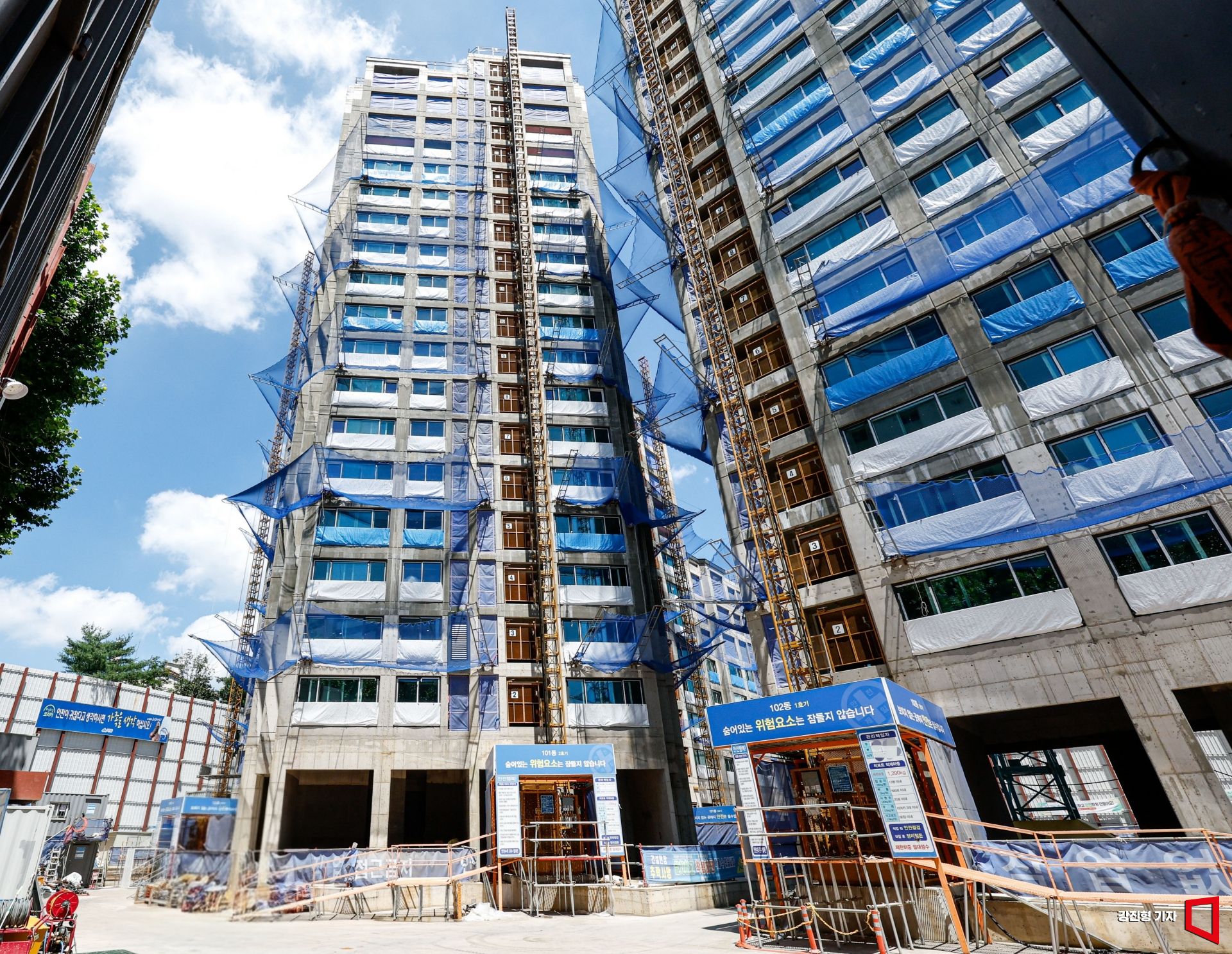
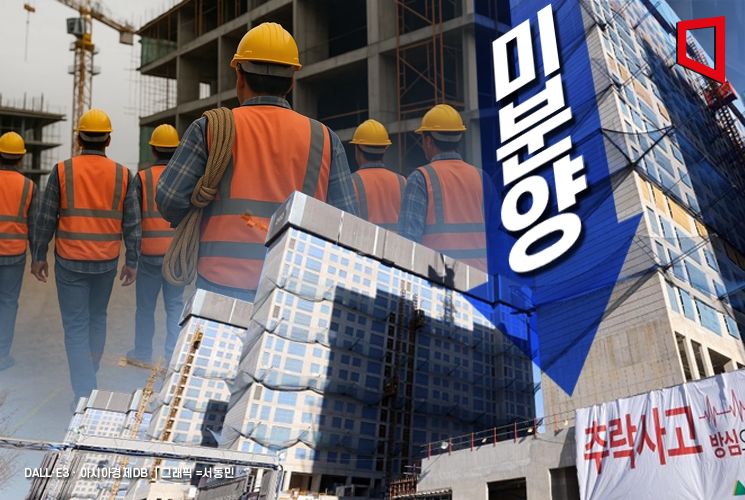
At 10 a.m., the construction site was silent. On July 22, under the scorching sun, an apartment construction site in Gwanum-dong, Buk-gu, Daegu seemed frozen in time. Despite it being peak working hours, no workers were in sight. White waterproof covers were draped over piles of scattered materials on the ground, and beneath a faded "Caution: Falling" banner, safety vests were stacked in heaps.
Between the 20-story apartment buildings, their gray concrete frames exposed, a tower crane stood still. Here, construction has been halted for eleven months due to delayed wage payments.
The apartment construction site in Daemyeong-dong, Nam-gu was also quiet. With less than 100 days left until the scheduled completion date, progress had reached only 34%. The project stopped because of insufficient funds caused by unsold units. Although it was just a 20-minute drive from Daegu Station and had good public transportation infrastructure, it was not enough to overcome the market downturn. The site, about 14,000 square meters (approximately 4,000 pyeong), was empty, and the steel bars installed to build the pillars and walls of the above-ground floors had been left unattended for a year.
Fell for the First Time in 8 Years This January
Unable to Afford Living Expenses, Relying on Private Loans
Unemployment Period Lengthened, Unable to Receive Unemployment Benefits
Unsold Units Everywhere... Only 'Ghost Apartments' Remain
The phrase "No. 1 in chronic unsold units" felt all too real. The apartment construction sites in this area were in a dire state. While driving through the area, I passed several sites surrounded by fences, many of which had halted construction. Some sites had only temporary fences installed and had not even broken ground for several months. In redevelopment zones, only empty houses remained, unable to be demolished. Some complexes stopped just two weeks before move-in due to disputes over cost-sharing between the cooperative and the contractor. Each site had its own story.
This was not just a problem in Daegu. Nearby regions faced similar situations. Kim, a construction worker with 25 years of experience whom I met in Jung-gu, Busan, said, "Currently, the only apartment construction site underway in the Gyeongnam area is in Jinju. In Busan, the number of sites has dropped to less than half compared to 2022, and this situation has continued for years."


A construction worker in his 40s from Gwangju explained, "The city is carrying out some special projects, but outside contractors win the bids at the lowest price, so they mostly use unregistered foreign workers who are paid less. Skilled local workers find it hard to get on site."
The downturn is spreading to the Seoul metropolitan area. Lee, a construction worker in his 50s from Incheon, said, "I haven't had work since March. There are many sites that have been left unattended for months, just surrounded by temporary fences." He added, "Incheon is still better off. It's even harder in other regions."
The impact of the crisis is also evident in the data. In the first quarter of this year, Daegu's real gross regional domestic product (GRDP) plummeted by 24.3%. Jeonnam (-24.0%), Sejong (-19.4%), and Gwangju (-18.5%) also saw significant declines. Major cities such as Seoul (-7.7%), Incheon (-7.2%), and Busan (-6.9%) were not exceptions. During the same period, the nationwide GRDP growth rate was 0.1%, a sharp slowdown from the previous quarter's 1.1%. The slump in the construction industry dragged down overall regional economic growth.
The Bank of Korea forecasts that construction investment growth will be -6.1% this year, the lowest since the Asian financial crisis in 1998 (-13.2%). The decrease in investment leads to fewer construction contracts and groundbreakings, which in turn reduces both employment and demand for materials. In fact, construction performance (completed work) in the first quarter of this year fell by 21.2% compared to the same period last year, the lowest level since the financial crisis.
Neither Unemployment Benefits Nor Insurance... Construction Workers Pushed Out of the Social Safety Net
The brunt of the construction downturn is hitting day laborers, who are already vulnerable. The symbolic "2 million" construction jobs figure fell below that mark in January this year for the first time in eight years since 2017. For six consecutive months, the number has remained in the 1.9 million range. According to Statistics Korea, as of June this year, there were 1.96 million construction workers, a decrease of 97,000 from the previous year. The number has declined for 14 consecutive months.

When daily jobs disappear, workers cannot cover living expenses. Many turn to emergency loans or private lenders, and in the process, some become credit delinquents. Kim said, "My income is unpredictable, but credit card bills and living expenses keep coming. When the period of unemployment was short, unemployment benefits helped me maintain a minimum standard of living, but when there is no work for a long time, even those benefits run out, leaving me with no options." The longer the period without work, the harder it becomes to meet the requirements for unemployment benefits (at least 180 days of work in the past 18 months).
The same goes for health insurance and the national pension. Workers must be employed for more than one month and work at least eight days a month, but many fail to meet these criteria and lose eligibility. The longer construction is suspended, the more workers are excluded from the social safety net. Health insurance, in particular, is a major blow. The moment they lose employee status, they become regional subscribers and must pay the full premium themselves. This adds fixed expenses when there is no income.
Construction machinery operators, such as excavator or tower crane drivers, are classified as "special type workers" and are not eligible for unemployment benefits. They are registered as sole proprietors, so even when they have no work, they are excluded from the welfare safety net.
A man in his 50s who drove a dump truck in Yeongcheon, Gyeongbuk, took his own life early last year. His colleague Kim said, "When construction stopped, he had to pay for fuel and gravel out of his own pocket, but no payment came in. He put his children through college, but he endured it all alone until the end." Most dump trucks and excavators are operated on installment plans, with monthly payments reaching 4 million won. If payments are overdue, finance companies repossess the equipment and auction it off. If credit card and living expenses are also overdue, life can collapse in an instant.
'Construction Crisis Report' Series Order
<1-1> Construction Sites at a Standstill, Collapsed Lives of Day Laborers
<1-2> "Three to Four More Bankruptcies"... Mid-sized Builders on the Chopping Block
<2-1> What Was Thought to Be a 'Lifeline' Became a 'Trap': Project Financing
<2-2> Easing Multi-homeowner Regulations, the Key to Local Real Estate Recovery
<3-1> "Every Day Is Nerve-racking": Shaken Subcontractors and Downstream Industries
<3-2> Even Major Companies Not Immune to Wage Arrears
<3-3> LH and Local Governments Also in Wage Arrears
<3-4> Even the President Stepped In... Urgent Need for Vertical Structure Reform
<3-5> This Company Survived Without Illegal Re-subcontracting
<4-1> Foreign Construction Workers Encroaching on Domestic Jobs
<4-2> Not 'Regulating Foreigners' but 'Protecting Domestic Workers'
<4-3> The Root Cause of Deteriorating Profitability: Frequent Rework
<1-2> "Three to Four More Bankruptcies"... Mid-sized Builders on the Chopping Block
<2-1> What Was Thought to Be a 'Lifeline' Became a 'Trap': Project Financing
<2-2> Easing Multi-homeowner Regulations, the Key to Local Real Estate Recovery
<3-1> "Every Day Is Nerve-racking": Shaken Subcontractors and Downstream Industries
<3-2> Even Major Companies Not Immune to Wage Arrears
<3-3> LH and Local Governments Also in Wage Arrears
<3-4> Even the President Stepped In... Urgent Need for Vertical Structure Reform
<3-5> This Company Survived Without Illegal Re-subcontracting
<4-1> Foreign Construction Workers Encroaching on Domestic Jobs
<4-2> Not 'Regulating Foreigners' but 'Protecting Domestic Workers'
<4-3> The Root Cause of Deteriorating Profitability: Frequent Rework
!["Please Help Us": How Much Do Those Bowing 90 Degrees These Days Actually Earn? [Data Pick]](https://cwcontent.asiae.co.kr/asiaresize/323/2026052010120870131_1779239528.png)