Since the confirmation hearing for Prime Minister nominee Minseok Kim, confirmation hearings without witnesses or references have become the "new normal." During the so-called "Super Week" of confirmation hearings for the new administration's ministers, several hearings proceeded without the adoption of any witnesses or references. As a result, there is a growing likelihood that the issues of adopting witnesses and references, as well as the discussion of conducting morality reviews behind closed doors, will be addressed together in the discussions to revise the Confirmation Hearing Act.
Confirmation Hearing Super Week Begins from July 14 to 18... 'Empty Hearings' Continue After Prime Minister Kim Minseok's Hearing
Among the four confirmation hearings held at the National Assembly on July 14, the hearings for Science and ICT Minister nominee Hoon Baeck, Unification Minister nominee Jeong Dongyoung, and Oceans and Fisheries Minister nominee Jeon Jae-su have no agreed-upon witnesses. For Gender Equality and Family Minister nominee Kang Sungwoo, only two witnesses unrelated to the controversial "staff abuse" allegations have been adopted.

Prime Minister nominee Minseok Kim is taking the oath at the confirmation hearing held at the National Assembly in Seoul on the 24th. Photo by Yonhap News
원본보기 아이콘
Science and ICT Minister nominee Hoon Baeck attends the National Assembly Science, ICT, Broadcasting and Communications Committee confirmation hearing on the 14th and responds to questions related to military service. Photo by Yonhap News
원본보기 아이콘
Jeong Dongyoung, nominee for Minister of Unification, is attending the confirmation hearing held by the Foreign Affairs and Unification Committee at the National Assembly on the 14th, looking at the committee members. Photo by Yonhap News
원본보기 아이콘
Jeon Jae-su, nominee for Minister of Oceans and Fisheries, is attending the confirmation hearing held at the Agriculture, Food, Rural Affairs, Oceans and Fisheries Committee full meeting in the National Assembly in Yeouido, Seoul on the 14th. Photo by Yonhap News
원본보기 아이콘In relation to this, Song Eon-seok, interim leader and floor leader of the People Power Party, criticized at an emergency party meeting at the National Assembly, saying, "They are creating empty confirmation hearings without submission of materials or adoption of witnesses for the nominees, employing the so-called 'bed soccer' tactic of Minseok Kim, where they just need to hold out for a day." Previously, during Prime Minister Kim's confirmation hearing, an unprecedented hearing was held without any witnesses or references.
Ruling Party's Overwhelming Majority Blocks Witness Adoption... Possible Linkage to Confirmation Hearing Act Amendment
The ruling and opposition parties decide on witnesses by agreement or vote, but if the opposition requests specific witnesses, the ruling party can reject the request, resulting in no adoption. In particular, since the Democratic Party holds a majority in all standing committees, the opposition has no effective means to force the adoption of witnesses other than public pressure. As a result, every hearing has seen conflict over the adoption of witnesses and submission of materials.

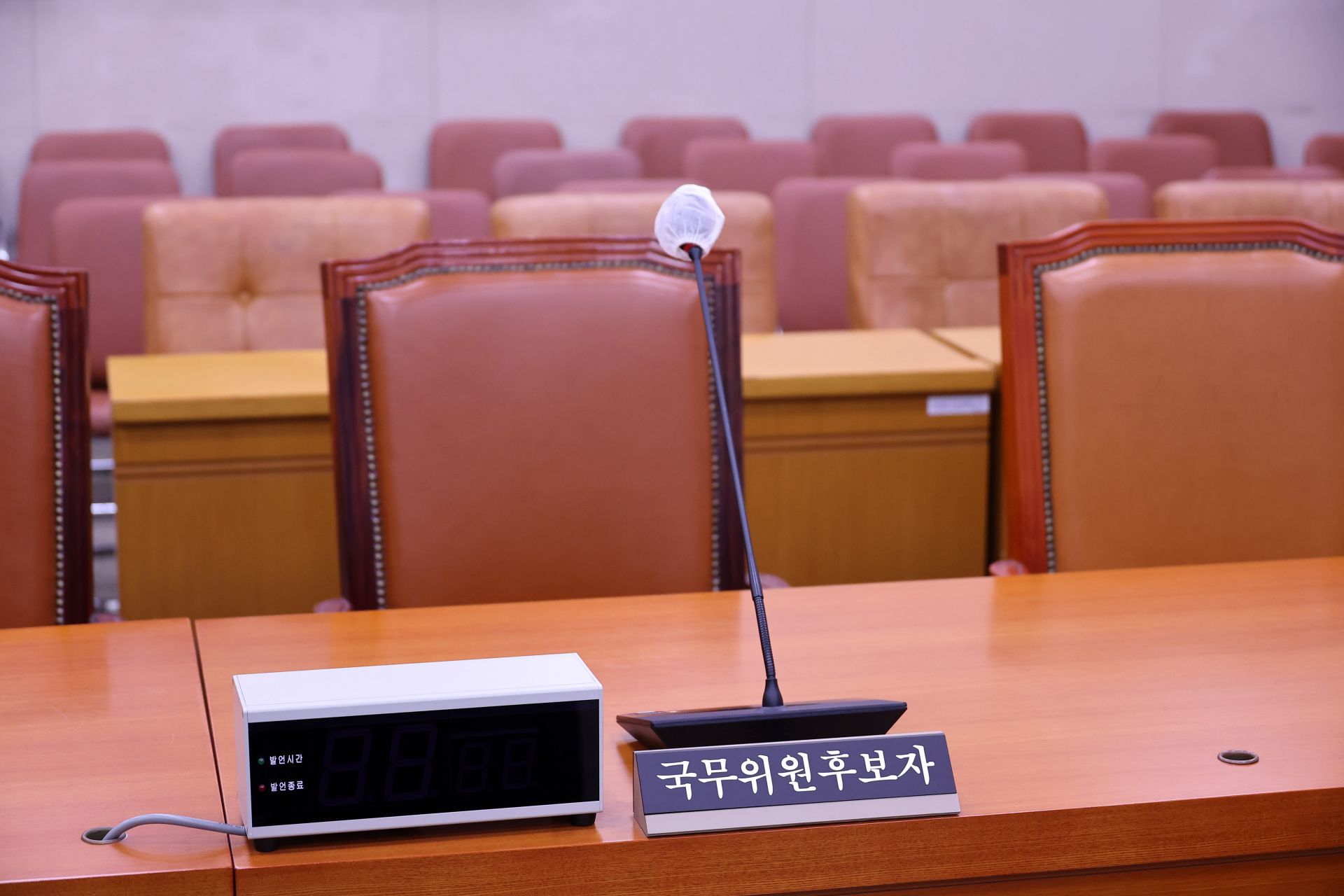
On the 14th, placards were attached to the seats of ruling and opposition party members at the National Assembly's Gender Equality and Family Committee during the confirmation hearing for Kang Sungwoo, Minister of Gender Equality and Family. Photo by Kim Hyunmin
원본보기 아이콘Within the Democratic Party, there are efforts to link confirmation hearings conducted without witness adoption to amendments to the Confirmation Hearing Act, which would require morality reviews to be conducted privately. Kim Sanghyuk, chief spokesperson of the Democratic Party, said on YTN Radio that "for confirmation hearings, the morality-related aspects should be conducted behind closed doors, with materials provided accordingly," and added, "I think it would be appropriate for public hearings to focus on policy-related questions."
Previously, Democratic Party lawmaker Kwon Chilseung had proposed an amendment to the Confirmation Hearing Act that would require morality reviews to be conducted privately, while strengthening the regulations on the submission of materials.
!["Please Help Us": How Much Do Those Bowing 90 Degrees These Days Actually Earn? [Data Pick]](https://cwcontent.asiae.co.kr/asiaresize/323/2026052010120870131_1779239528.png)