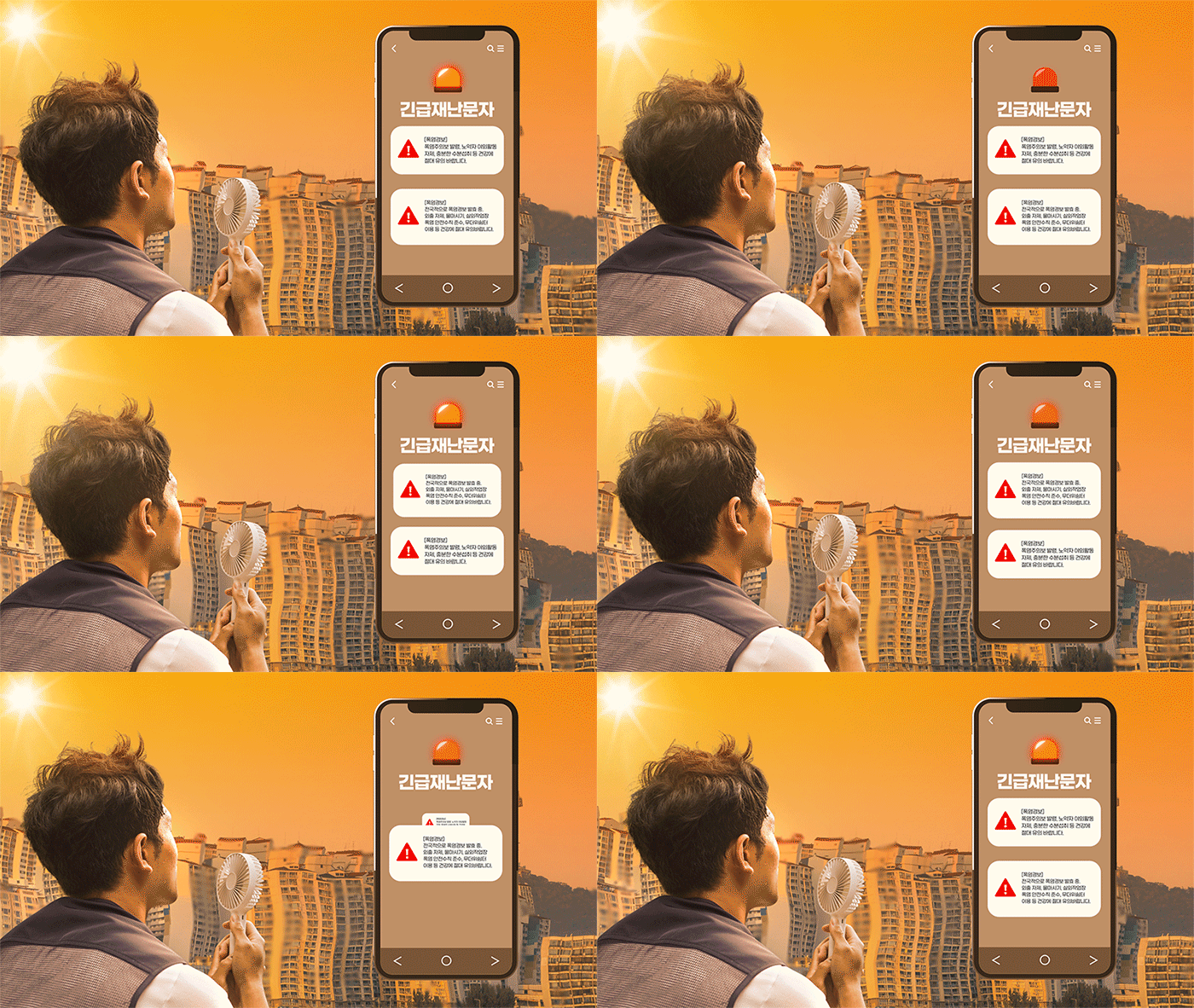
Since meteorological observations began in October 1907, this July has been the hottest on record. With heatwave advisories issued nationwide, Seoul has also experienced sudden torrential downpours, resulting in widespread damage.

On the 8th, during the ongoing heatwave, a farmer in a field in Dasan-myeon, Goryeong-gun, Gyeongbuk, wipes sweat while pulling weeds. Photo by Yonhap News
원본보기 아이콘
On the afternoon of the 8th, due to the ongoing drought caused by the heatwave, the rice paddy floor inside Hanon Crater in Seogwipo City, Jeju, is cracked wide open. Photo by Yonhap News
원본보기 아이콘
A large fan installed on the ceiling inside a Korean beef farm in Geumseong-myeon, Jecheon-si, Chungbuk, is continuously rotating, and a fogging disinfectant machine is constantly spraying water. Yonhap News
원본보기 아이콘
A "Heat Index Warning" sign is installed at a construction site in Gangnam-gu, Seoul, where a heatwave warning is in effect. An official stated that workers are working for 45 minutes and resting for 15 minutes. Yonhap News Agency
원본보기 아이콘
As tropical nights and heatwaves continue day after day, a cooling fog system spraying mist has been installed at the entrance of Gamcheon Culture Village in Saha District, Busan, allowing foreign tourists to cool down. Yonhap News
원본보기 아이콘
Citizens are taking a walk to beat the heat at the 5·18 Memorial Park in Seo-gu, Gwangju, where a heatwave advisory and tropical nights continue. Photo by Yonhap News
원본보기 아이콘Today's Highs: 26-36 Degrees Celsius... Occasional Torrential Showers
According to the Korea Meteorological Administration, on July 9, the daytime high temperatures are forecast to range from 26 to 36 degrees Celsius. In the afternoon, showers are expected in Jeju, in the late afternoon in the west coast areas of Incheon and Gyeonggi, and at night in the southern east coast of Gyeongbuk.
This week’s highest temperatures are the highest ever recorded. At 3:06 p.m. on July 8, the temperature in Seoul (measured at the Jongno-gu Seoul Meteorological Observatory) reached 37.7 degrees Celsius, surpassing the previous record of 36.8 degrees set on July 9, 1939, for the first time in 86 years. It was the hottest day in early July in 117 years. Incheon (35.6 degrees), Busan (34.5 degrees), and Daejeon (36.3 degrees) also recorded their highest temperatures.

Haze is rising on Yeouidaero in Yeouido, Seoul, where a heatwave warning is in effect. Yonhap News
원본보기 아이콘
On the evening of the 8th, when the daytime high temperature in Seoul rose to a record 37 degrees Celsius, citizens holding umbrellas waited for the pedestrian signal at Sejongno Intersection in Seoul as a shower passed by. Photo by Yonhap News
원본보기 아이콘Cold air flowing in from behind a trough approaching from the northwest has collided with the hot air mass over Korea, resulting in sudden torrential downpours. On July 8, heavy rain warnings and advisories were issued in the southwestern and northwestern parts of Seoul starting at 6:50 p.m. Intense rainfall of up to 68 mm per hour was recorded, with cumulative precipitation reaching up to 80 mm. As a result, roads in many areas were flooded, causing traffic congestion and accidents on wet roads.
'Heat Dome' to Last at Least Until the 16th... Expansion of North Pacific High-Pressure System a Key Variable
This oppressive heat is expected to continue at least until July 16. Under the influence of a high-pressure system over the northern East Sea, clear skies and easterly winds are causing intense heat, especially west of the Taebaek Mountains. The easterly winds bringing heat to the west of the Taebaek Mountains are expected to subside around July 11. However, after that, as a trough approaches from the northwest and a high-pressure system remains to the south of Korea, southwesterly winds will bring in hot and humid air, resulting in muggy weather. The eastern side of the Taebaek Mountains is expected to become extremely hot once again. It remains uncertain whether the heat will subside after the 16th. If the North Pacific high-pressure system expands again and brings southerly winds into Korea or covers the country, another heatwave could occur.
-

Reporter Lim Chunhan choon@asiae.co.kr
-
Edit Kim Yumi ymkim91@asiae.co.kr
© The Asia Business Daily(www.asiae.co.kr). All rights reserved.
!["Please Help Us": How Much Do Those Bowing 90 Degrees These Days Actually Earn? [Data Pick]](https://cwcontent.asiae.co.kr/asiaresize/323/2026052010120870131_1779239528.png)