

As the importance of supply chain stability and resource security grows
Competition over strategic materials is intensifying, spanning from advanced industries to the defense sector.
In particular, as China restricts exports of critical minerals,
countries including the United States are seeking new sources of supply.
Amid this trend, metals produced in Korea are emerging as strategic resources and are being rapidly exported overseas.
Piles of metal resembling black stones turn out to be a 'star export product'.

On the 11th, Hwang Yungeun, head of the Precious Metals Part 2 at the Onsan Smelter of Korea Zinc, is showing antimony raw materials at the antimony factory. This raw material is melted and impurities are removed using diaphragm electrolysis technology to increase the antimony purity up to 99.9%. Photo by Shim Sunga
원본보기 아이콘On June 11, we visited the antimony plant at Korea Zinc's Onsan Smelter in Ulsan.
In one area of the factory, dust raw materials that looked like black rocks were piled up like a mountain.
In fact, what is contained inside is a high value-added strategic metal: antimony.
This metal, which is produced as a byproduct when smelting zinc and lead,
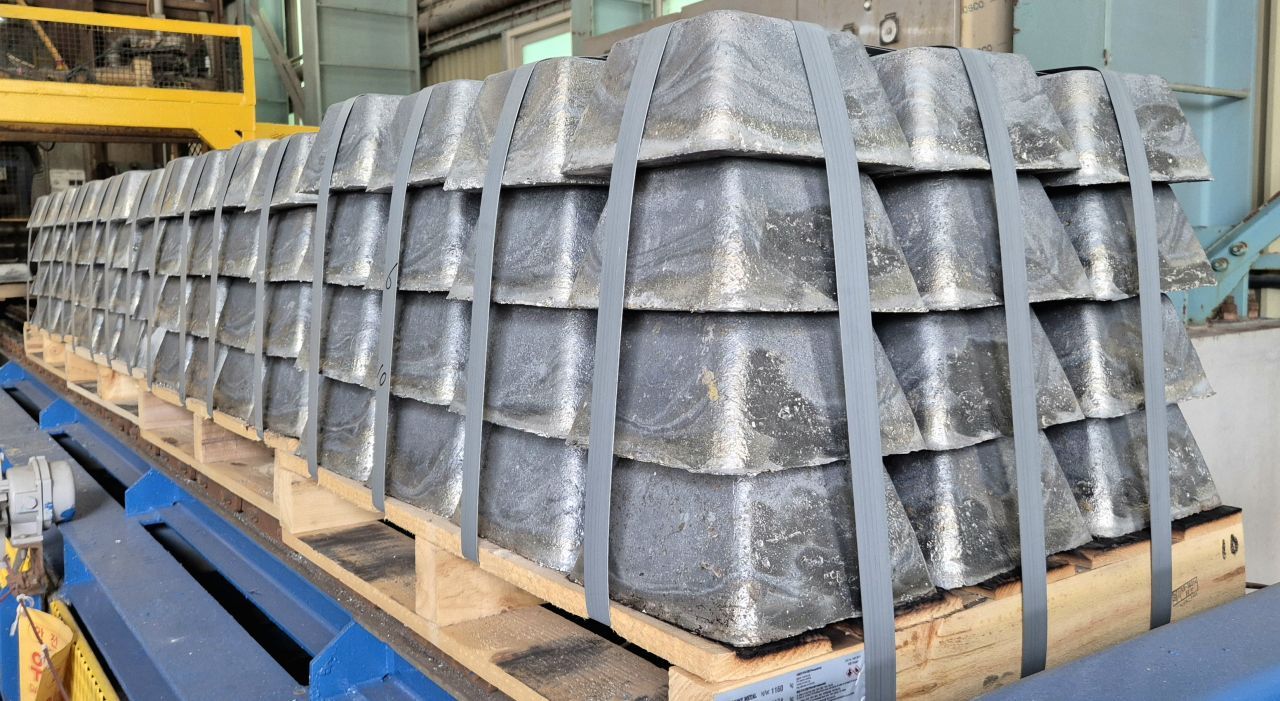
has recently been traded at a price exceeding 80 million KRW per ton, making it a leading export product.
Four days to remove impurities... Extracted at 99.9% purity

On the 11th, Hwang Yungeun, head of the Precious Metals 2 Part at the Onsan Smelter of Korea Zinc, explained while pointing to the finished antimony products at the antimony factory. The antimony ingot placed on a single pallet weighs 1 ton, and the price exceeds 80 million won per ton. Photo by Shim Sunga
원본보기 아이콘Inside the factory, five to six large induction furnaces were melting ore at high temperatures.
Afterward, the molten metal goes through a diaphragm electrolysis process to extract antimony,
a technique that uses electricity to separate and precipitate only the metal ions.
Through this process, antimony is refined to a purity of up to 99.9%,
and ten sets of 1 ton each are produced every day.
Hwang Yungeun, head of Precious Metals Part 2, explained, "The price has risen about six to seven times compared to early last year."
First direct export to a U.S. defense company
Recently, 20 tons of antimony produced at this plant were exported to Washington D.C., USA.
This is the first time that antimony produced domestically has been exported directly to a U.S. defense company.
This shipment is scheduled to be delivered to more than ten major U.S. defense companies next month.
Why is this metal in demand in the U.S.?
Antimony is an essential material for military supplies such as ammunition, missiles, and shells,
and is a strategic mineral used across advanced industries, including vehicle dashboards, tents, and heat-resistant materials.
Until now, the United States has relied on China for 62% of its total imports,
but in September last year, China restricted exports of antimony and related technologies,
causing supply chain instability to increase rapidly.
As a result, the United States is actively seeking new suppliers,
and Korea Zinc has set a goal of exporting a total of 350 tons this year.
If successful, this is expected to open a market worth more than 32.2 billion KRW annually.
'Silver liquid' indium is also being exported

On the 11th, an employee at the Indium plant of Korea Zinc Onsan Smelter was casting liquid indium. Each indium ingot produced this way weighs 5kg and is worth about 2.5 million KRW at the current market price. Photo by Shim Sunga.
원본보기 아이콘Just a ten-minute drive from the antimony plant, another rare metal, the indium plant, was also in operation.
Here, liquid indium with a silvery appearance is precisely cast
into solid ingot form.
Jongbin Jeon, team leader of the Electronic Materials Team, explained, "Although it looks simple,
casting it accurately to a uniform size requires skilled technique."
Because automation is difficult, most of the process is done by hand.
Immediate shipment after production... The warehouse is almost empty

On the 11th, Jongbin Jeon, a team leader of the Electronic Materials Team at the Production Headquarters 3 of Korea Zinc Onsan Smelter, is holding vacuum-packed indium at the indium warehouse of the Onsan Smelter. Each indium ingot made like this weighs 5kg and is worth about 2.5 million KRW at market price. Provided by Korea Zinc
원본보기 아이콘The indium warehouse located in one part of the factory was mostly empty.
Jeon said, "In the past, we sometimes had inventory piling up, but these days, shipments go out as soon as the product is made."
This plant operates more than 20 days per month, with an annual production target of 150 tons.
Korea Zinc supplies indium to the global market and continues to export steadily to the United States.
Indium is an essential material for advanced industries, including LCD displays, touchscreens, semiconductor substrates, aircraft engines, and solar panels.
It is used throughout the high-tech sector.
"Korea will play a bigger role in stabilizing strategic minerals"
A Korea Zinc representative said, "China's export controls on critical minerals have made Korea Zinc's role in the global supply chain even more important."
"We will focus even more on stabilizing the production of strategic minerals and cooperating with allied countries," he added.

The refining technology and production capabilities of domestic companies are becoming a stepping stone to becoming a hub for strategic resources, beyond simple exports.
Attention is focused on how Korea will continue to play this role in the future.
-

Reporter Shim Seongah heart@asiae.co.kr
-
Edit Hur Eunmi eungmimon@asiae.co.kr
© The Asia Business Daily(www.asiae.co.kr). All rights reserved.
!["Please Help Us": How Much Do Those Bowing Deeply for Your Vote Really Earn? [Data Pick]](https://cwcontent.asiae.co.kr/asiaresize/323/2026052010120870131_1779239528.png)