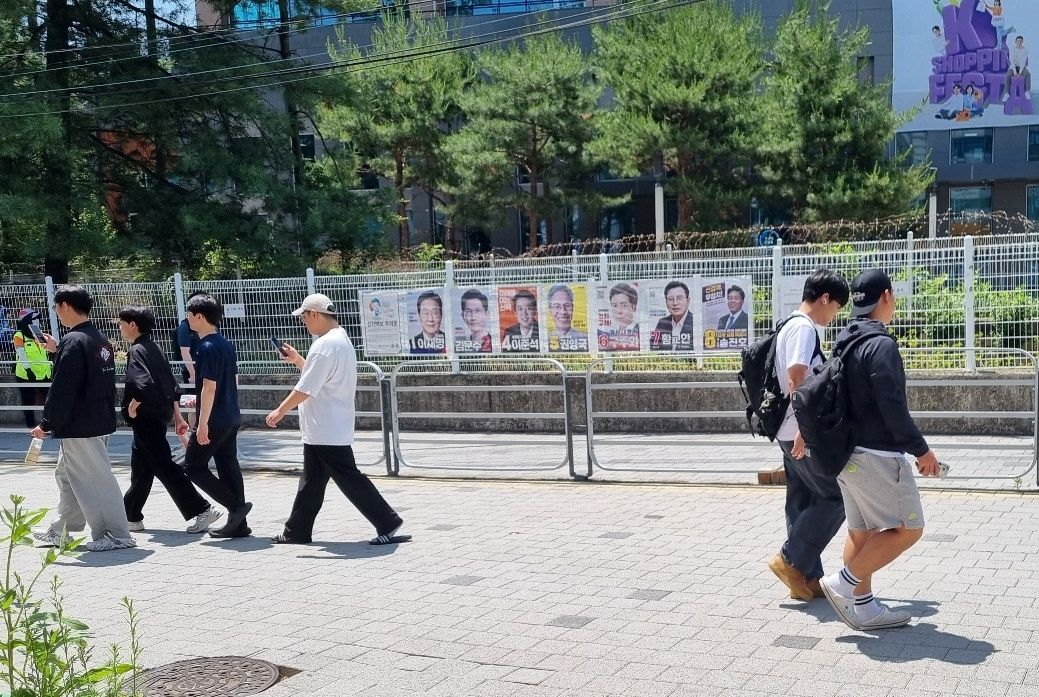
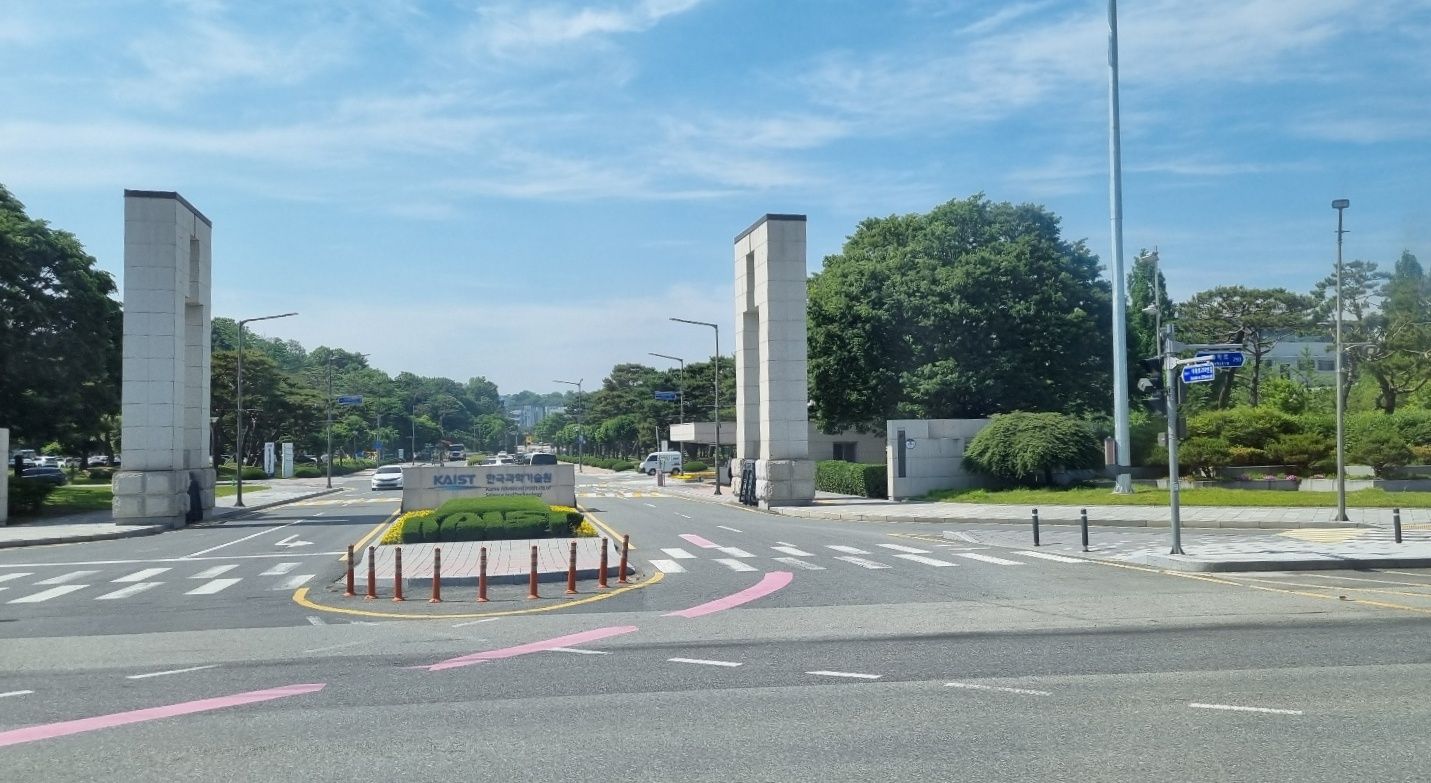
On the 26th, former President Yoon Seokyeol revisited KAIST, where he had a so-called 'trauma' after dismissing a graduate student who asked for increased research and development budget support last year, effectively silencing them. The atmosphere there was far from one that suggested an election mood.
"The election? Is it really okay to talk about that so openly? Oh, I don't really know much about those things."
This was the response I received on May 25 when I casually asked the owner of a new cafe near Doan-dong, Yuseong District, Daejeon, "What do you think will happen in this election?" Even on the weekend just a week before the 21st presidential election, Daejeon, known as the "home of scholars," maintained an air of calm amid movement. Unlike the bustling scenes in downtown Seoul, where campaign vehicles blare cheering songs and supporters in colorful T-shirts for each candidate parade through the streets, Daejeon felt far removed from the noisy "election fever."
The reactions of local residents were similar. In contrast to the heated and even overheated election fervor in the capital region, the atmosphere here was "indifferent." People passing by the small election posters stuck on city walls or the corners of metal bridges either took long detours or averted their eyes, as if they were seeing something they should not look at.
Among the younger generation, a sense of fatigue, disappointment, indifference, and avoidance toward mainstream politics was noticeable. A university student I met at Chungnam National University in Daejeon said, "I was disappointed because there were hardly any pledges for the younger generation in this presidential election," but added, "I still want to vote, at least to let politicians know they should prepare better for the next election."
On May 26, Lee Junseok, the Reform New Party candidate, campaigned with loud music from his campaign vehicle in the middle of a busy intersection in Dunsandong, Seo-gu, Daejeon. However, after observing for about an hour, it was clear that most people paid little attention to the campaign. Dunsandong is a newly emerging central area in Daejeon, where the Daejeon Government Complex, large department stores, major supermarkets, and large apartment complexes are clustered together.

Lee Junseok, the presidential candidate of the Reform New Party, is campaigning loudly with music playing from his campaign vehicle in the middle of a busy intersection in Dunsandong, Seo-gu, Daejeon on the 26th, while pedestrians pass by in front of it. Daejeon - Photo by Moon Hyewon
원본보기 아이콘Daejeon is also known as a city of education. In addition to KAIST, the city is home to many universities such as Chungnam National University, Paichai University, Woosong University, and Daejeon University, as well as numerous specialized high schools like science high schools and foreign language high schools. A local politician explained, "People in Daejeon tend not to express their true feelings openly, which is a social and cultural trait here," and added, "Even within families, there is a culture of not sharing or pressuring each other about whom to vote for."
At Yuseong Oncheon Culture Street, a group of elderly people in their seventies hesitantly began to speak. An elderly man started by saying, "I don't really know who I should vote for," while the woman next to him remarked, "Still, I think Kim Moonsoo (the People Power Party candidate) would do a good job. I just can't bring myself to trust Lee Jae Myung."
In contrast, Lee Minju (pseudonym), a woman in her fifties whom I met while she was out for a walk, introduced herself as a passionate supporter of the Democratic Party and showed off her blue nail art. She said, "Still, since Yoon Seokyeol made mistakes, I'll vote for the Democratic Party this time."
The Chungcheong region, including Daejeon, is politically centrist and often changes its voting tendencies depending on the issues at hand, so it plays the role of a "casting vote" in every major election. In this presidential election, the number of eligible voters has increased compared to the 20th presidential election, making this region an area of even greater interest for the major candidates.

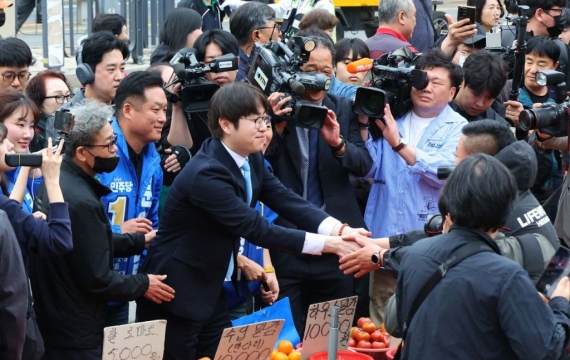
Lee Jae Myung, the presidential candidate of the Democratic Party of Korea, is greeting the citizens of Daejeon during a campaign event held on the 12th at Euneujeong Street Sky Road in Daejeon. Photo by Yonhap News
원본보기 아이콘
Lee Jae Myung, the Democratic Party presidential candidate, is campaigning on the Eunujeong Street Sky Road in Daejeon Metropolitan City on the 12th. Photo by Yonhap News
원본보기 아이콘
Kim Moonsoo, the People Power Party's presidential candidate, is campaigning around Euneungjeongi Street in Jung-gu, Daejeon on the 16th. Photo by Yonhap News
원본보기 아이콘
Kim Moonsoo, a presidential primary candidate of the People Power Party, visited Daejeon Jungang Market in Dong-gu, Daejeon on the 1st and greeted market merchants and citizens. Photo by Yonhap News
원본보기 아이콘
Lee Junseok, the presidential candidate of the Reform New Party, is taking photos with students after finishing the '2030 On-site Listening' meeting held on the afternoon of the 7th at the Korea Advanced Institute of Science and Technology (KAIST) in Yuseong-gu, Daejeon. Photo by Yonhap News
원본보기 아이콘
Lee Junseok, the presidential candidate of the Reform New Party, is greeting commuters on the morning of the 24th at the Bukdaejeon IC intersection in Yuseong District, Daejeon. Photo by Yonhap News
원본보기 아이콘-
Reporter Moon Hyewon hmoon3@asiae.co.kr
-
Edit Choo Myeonghoon chox2mh@asiae.co.kr
© The Asia Business Daily(www.asiae.co.kr). All rights reserved.