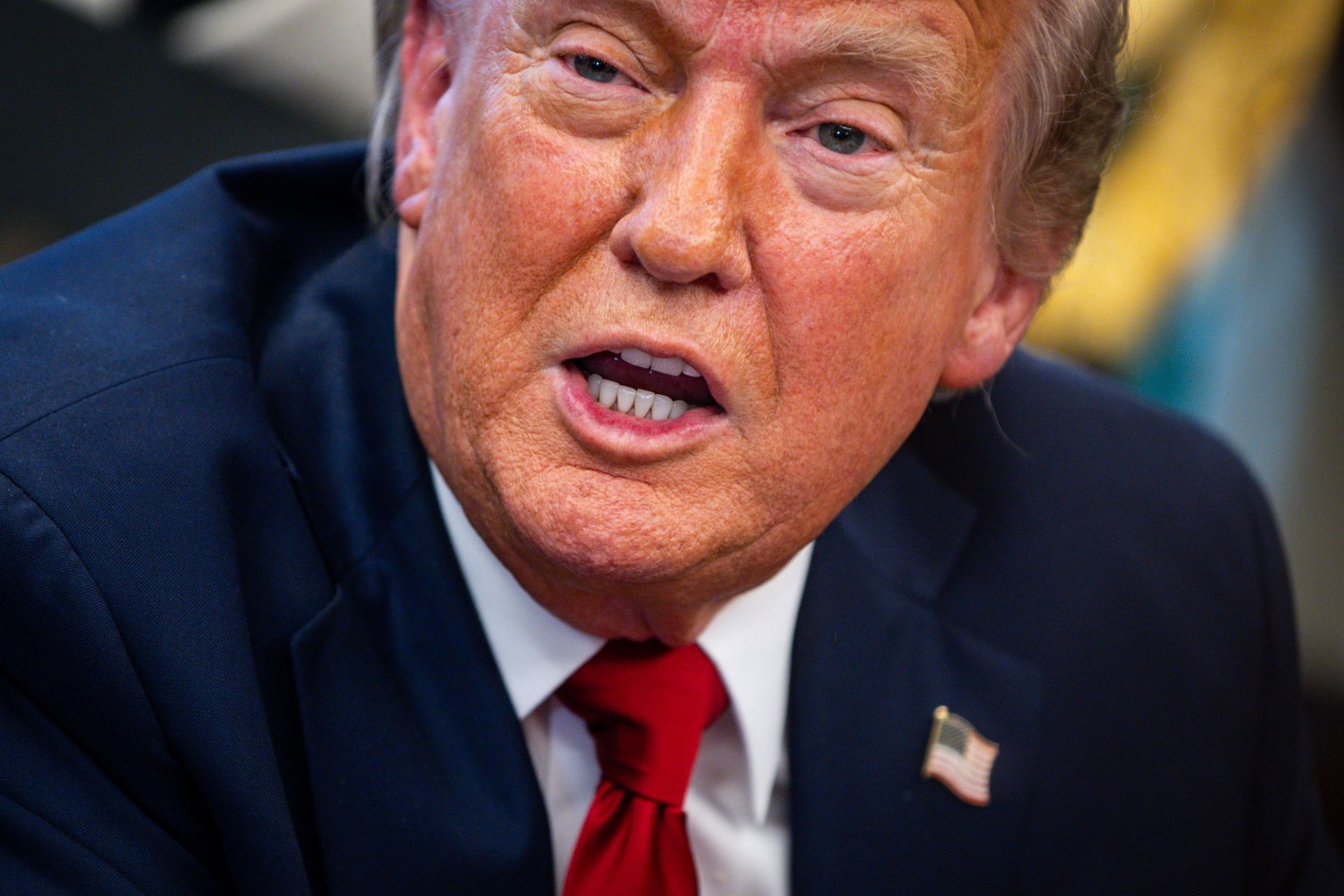
US President Donald Trump has been sending conciliatory messages to China, with which he is engaged in a tariff war, on a daily basis. Cornered by financial market turmoil triggered by tariffs, Trump indicated a possible reduction in tariffs on China. On the following day, April 23 (local time), he announced, "We will decide on the tariff rate for China within the next two to three weeks." Scott Besant, the US Treasury Secretary in charge of tariff negotiations, also mentioned the possibility of a "big deal" between the US and China, as well as the simultaneous reduction of tariffs by both countries. With President Trump repeatedly retreating from his previously hardline stance?having imposed triple-digit tariffs on China?there is growing attention on whether this could provide a breakthrough in the US-China trade war, which had been escalating toward a full-scale confrontation.
[Breakthrough in Trade Negotiations?]
One day after remarks on tariff reduction for China, a timeline has been set "The current tariff rate of 145% is too high... We will make a great deal"
WSJ reports "Considering reducing the tariff rate from 145% to 50%"
At the White House that day, when asked by reporters about the timing of a tariff reduction on China, President Trump replied, "It's up to China."
He stated that the US is currently "negotiating tariffs with 90 countries," and added, "We think we will make a great deal." He continued, "We will decide on the tariff rate within the next two to three weeks," noting that "China could be included."
After mentioning the possibility of lowering tariffs on China the previous day, Trump specified the timing of the reduction on this day. The day before, he had said that negotiations with China were "going well," and that the current tariff rate of 145% is "too high" and would be "significantly lowered."
President Trump also expressed his strong willingness to negotiate with China earlier that morning. When asked by reporters whether he was actively negotiating with China, he replied, "Everything is active." When asked if an agreement was being reached with China, he said, "It will be fair."
In this context, The Wall Street Journal (WSJ) reported that the Trump administration is considering reducing the additional tariffs imposed on China during its second term from the current 145% (20% fentanyl tariff + 125% reciprocal tariff) to between 50% and 65%, more than halving the rate. It was also reported that the administration is considering imposing different tariffs on Chinese goods depending on whether they pose a national security threat.
Treasury Secretary Besant, who oversees tariff negotiations, also mentioned the possibility of a "big deal" between the US and China, as well as the simultaneous reduction of tariffs by both countries.
Speaking at a dialogue hosted by the Institute of International Finance (IIF) in Washington, D.C., Besant said, "There is an opportunity for a big deal between the US and China," and added, "If they (China) want to rebalance trade, let's do it together." He continued, "More than 100 countries have approached us to help rebalance global trade," and said, "We are having meaningful discussions. We also look forward to discussions with China and others."
This is the second consecutive day that Besant has delivered a conciliatory message, following his remarks the previous day that the US-China tariff war is unsustainable and that "the situation will ease in the very near future." As financial markets have been shaken by the tariff war, these statements are seen as an attempt to ease tensions between the two countries, calm market unrest, and bring China to the negotiating table.
He also made it clear that before any US-China trade agreement, it is necessary to reduce tariffs on China, and that both sides should lower tariffs simultaneously.
After the IIF event, Besant told reporters that President Trump had not proposed a tariff reduction on China, saying, "Not at all." However, he added, "As I have said many times, the current tariff levels are unsustainable for both sides. So it would not be surprising if both sides reduced tariffs in a reciprocal manner." This suggests that both the US and China should lower their tariff rates at the same time.
With the Trump administration repeatedly sending moderate messages to China and effectively proposing mutual reductions of ultra-high tariffs, there is growing assessment that the US and China are laying the groundwork for a truce in the tariff war and a return to the negotiating table. Initially, the US set the reciprocal tariff on China at 50%, but after Beijing responded with retaliatory tariffs, the US raised its reciprocal tariff rate to 125% through two rounds of countermeasures. Including the 20% fentanyl tariff, the total accumulated tariff rate stands at 145%.
US Treasury Secretary Janet Yellen: "There is an opportunity for a big US-China deal" "Current tariffs cannot be sustained"... Mentioned simultaneous tariff reductions In response to the US's repeated overtures for dialogue, China also says "The door is wide open"
As the Trump administration continues to send moderate signals to China and even hints at tariff reductions, China's Ministry of Foreign Affairs also stated, "If we must fight, we will fight to the end, but the door to dialogue is wide open," indicating its willingness to engage in trade negotiations with the US.
The WSJ noted, "Chinese policymakers see President Trump's remarks on Tuesday as a signal that he is ready to abandon his (China) policy," and added, "The fact that both the US and China have expressed openness to an agreement is a significant change from last month."
However, even if the US and China lower tariffs to the minimum level of 50% reported by the WSJ, the rate would still be extremely high. Therefore, it is unlikely that the current near-complete halt in bilateral trade will be resolved easily before a big deal is reached.
![[Breakthrough in Trade Negotiations?]One day after remarks on tariff reduction for China, a timeline has been set"The current tariff rate of 145% is too high... We will make a great deal"WSJ reports "Considering reducing the tariff rate from 145% to 50%"](https://cphoto.asiae.co.kr/listimglink/9/2025042414241933841_1745472258.png)


!["Please Help Us": How Much Do Those Bowing 90 Degrees These Days Actually Earn? [Data Pick]](https://cwcontent.asiae.co.kr/asiaresize/323/2026052010120870131_1779239528.png)