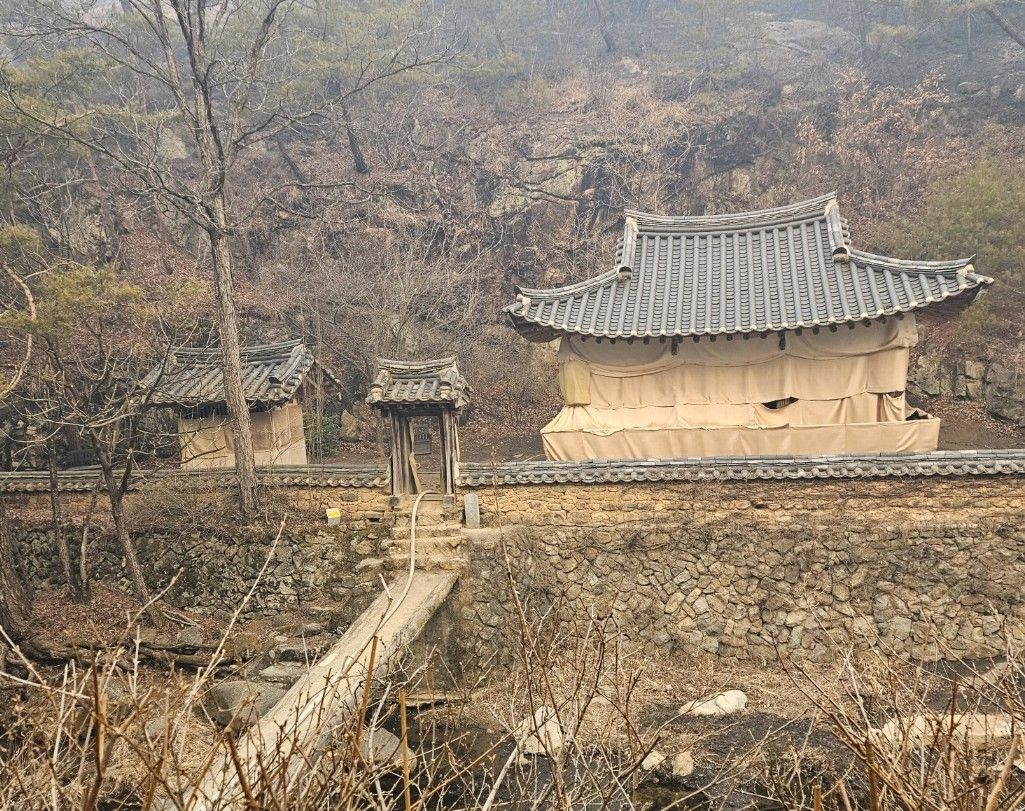
Firefighters and officials stayed at the site until the very end
Application of fire-retardant cloth to pillars and lower sections before fire spread... No damage except for some scorched pine trees
As the Andong Manhyujeong, which was once reported to have been completely destroyed by the wildfire in North Gyeongsang Province, miraculously 'survived,' attention is focusing on the fire-retardant cloth that played a decisive role in protecting it from the flames.
On the 26th, the Cultural Heritage Administration announced, "After inspecting the area around Andong Manhyujeong, which was initially reported as lost, we have confirmed that it did not suffer wildfire damage." They added, "Currently, there are traces of scorching on some pine trees, but there is no other damage."
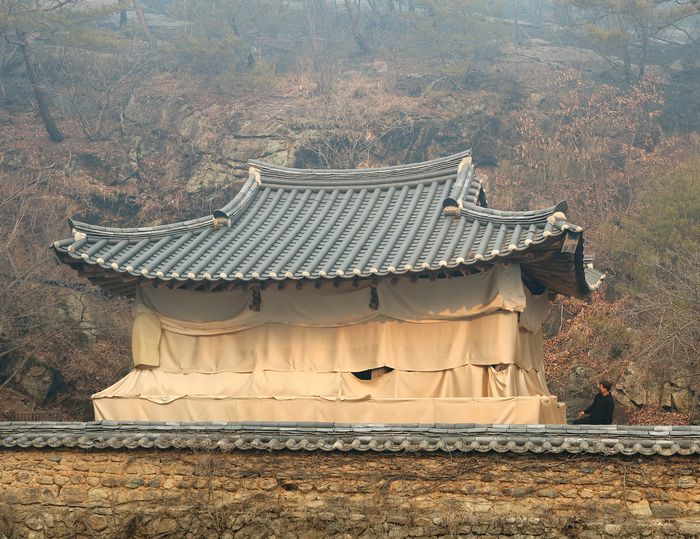
The plum tree next to Manhyujeong miraculously escaped fire damage
On the morning of the 26th, a fire-retardant sheet covers Manhyujeong in Gilan-myeon, Andong City, Gyeongbuk.
Photo by Yonhap News
The reason Manhyujeong was able to escape the flames was thanks to the fire-retardant cloth. This cloth is a fabric woven with special fire-resistant materials, designed to block flames during a fire. It is mainly kept in industrial and public facilities for safety. According to the Cultural Heritage Administration, the previous day about 40 people from Andong City, the Northern Gyeongbuk Care Center, and the fire department applied the fire-retardant cloth to the pillars and lower sections, and sprayed water in the nearby Manhyujeong garden.
Park Daejin, director of the Andong City Tourism Association, who visited the site that morning, said, "Despite the wildfire risk, firefighters and public officials covered the structure with fire-retardant cloth and stayed until the last moment, which allowed us to save Manhyujeong." Earlier, staff from the Andong City Tourism Association who had heard the news of Manhyujeong's destruction visited the site in the morning and shed tears upon seeing it unharmed. It was also reported that the plum tree blooming next to Manhyujeong miraculously escaped the fire.
'Mr. Sunshine' filming location... 'Pavilion building' designated as Gyeongbuk Cultural Heritage Material
Famous as the filming location for the drama 'Mr. Sunshine,' Manhyujeong is a pavilion building constructed in the later years of Joseon Dynasty scholar Kim Gyehaeng (1431-1517). According to the Cultural Heritage Administration's portal, Kim Gyehaeng left the teaching, "If there is a treasure in my house, it is only purity and cleanliness," and was known as an upright and incorrupt official. The pavilion building, which harmonizes with the surrounding nature, is designated as a Gyeongsangbuk-do Cultural Heritage Material. In 2011, the valley and waterfall surrounding the pavilion were also designated as the scenic site 'Andong Manhyujeong Garden.'


Meanwhile, according to the Cultural Heritage Administration's tally on the 27th, a total of 15 national heritage sites have been confirmed damaged by the wildfire, including the complete destruction of Uiseong Gounsa. This includes 11 nationally designated sites (2 Treasures, 3 Scenic Sites, 3 Natural Monuments, 3 National Folk Cultural Heritage) and 4 city/province-designated sites (1 Tangible Cultural Heritage, 1 Monument, 2 Cultural Heritage Materials). Due to concerns over fire damage to national heritage sites from simultaneous wildfires nationwide, the Cultural Heritage Administration has issued a 'serious' level disaster crisis alert for national heritage across the country.
-

Reporter Seo Jiyeong zo2zo2zo2@asiae.co.kr
-
Edit Choi Yujeong yjchoi@asiae.co.kr
© The Asia Business Daily(www.asiae.co.kr). All rights reserved.
!['WHO Declares International Public Health Emergency' Why the Untreatable 'Variant Ebola' Is More Deadly Than COVID-19 [Reading Science]](https://cwcontent.asiae.co.kr/asiaresize/323/2026052110164072055_1779326201.png)
!["Please Help Us": How Much Do Those Bowing 90 Degrees These Days Actually Earn? [Data Pick]](https://cwcontent.asiae.co.kr/asiaresize/323/2026052010120870131_1779239528.png)