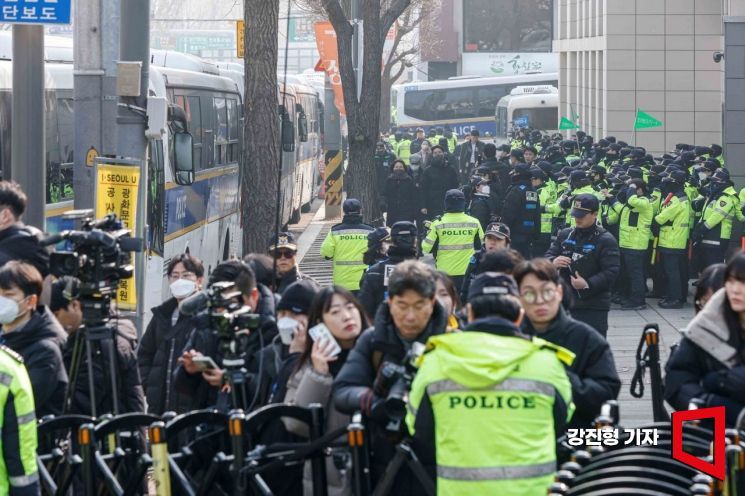
The Seoul Metropolitan Police Agency's riot squad has recently been conducting training including shield techniques, unit formation drills, and crowd safety management. It is understood that training involving capsaisin spray and 120cm police batons has also been conducted. Not long ago, through footage filmed in front of the Constitutional Court on the day of the impeachment ruling of former President Park Geunhye, they analyzed how the protesters broke through the barricades and attempted to enter the Constitutional Court building, and provided training on response methods.
As rallies both supporting and opposing the impeachment of President Yoon Suk-yeol continue day after day, the fatigue among police officers deployed to the scenes is also accumulating.
According to data submitted by the office of Democratic Party lawmaker Yang Bu-nam, based on information from the National Police Agency and Seoul Metropolitan Police Agency on the 17th, the average monthly overtime hours per officer in the Seoul Police riot squad in January was 113.7 hours, an increase of 33.7 hours compared to November of last year (80 hours), before the December 3 martial law situation. This is attributed to the surge in rallies demanding President Yoon's impeachment following the declaration of martial law, as well as the increase in rallies opposing impeachment starting from January this year.
Looking at the riot squads as a whole, from December last year to February this year, a total of 5,462 riot squad units were deployed to rallies for and against impeachment over three months. With each unit consisting of about 60 members, this means a cumulative total of 327,000 personnel were mobilized for rallies during that period. Considering that the total number of riot squad officers nationwide is about 12,000, this equates to 27 times the entire force being deployed for impeachment rally management.
As the police are putting all their efforts into maintaining public order, frontline officers are growing increasingly weary. First, the intense work schedule, now in its third consecutive month, has led to accumulated fatigue. Furthermore, as the expected verdict date of the 14th was postponed, it is unclear how long restrictions on taking leave will continue. Some have also pointed out that the level of job-related tension has increased significantly following the recent disturbance at the Seoul Western District Court.
Moreover, as the impeachment ruling for President Yoon approaches, riot squad members are being further exhausted by increased drills to prepare for emergencies on the day of the verdict.
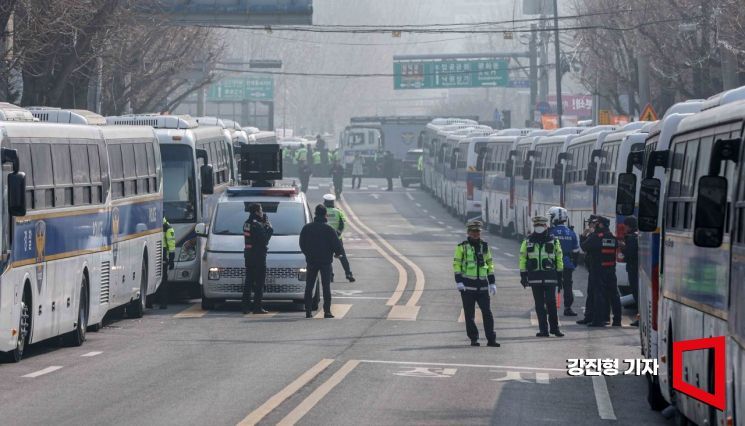
Meanwhile, on the 14th, the police announced that they would issue the highest level of emergency alert, "Gap-ho Emergency," and mobilize 100% of police forces on the day of the impeachment ruling for President Yoon. Lee Hoyoung, acting commissioner of the National Police Agency, held a "situation review meeting to prepare for the impeachment verdict day" that afternoon, stating, "We will establish a full-scale response system to minimize social unrest before and after the verdict day."
The National Police Agency plans to declare an "Eul-ho Emergency" in Seoul the day before the verdict, issuing an emergency work order nationwide, and then issue a "Gap-ho Emergency" at all police stations nationwide on the day of the verdict. When the highest level, Gap-ho Emergency, is declared, 100% of police forces can be mobilized and all annual leave for officers is suspended. Under the second-highest level, Eul-ho Emergency, commanders and staff must remain on duty and maintain emergency communication systems. The police plan to deploy 337 riot squad units and about 20,000 personnel nationwide. In addition, all available forces, including mobile patrol units and detectives, will be fully mobilized.
-

Reporter Seo Jiyeong zo2zo2zo2@asiae.co.kr
-
Edit Kim Hyunhee faith100@asiae.co.kr
© The Asia Business Daily(www.asiae.co.kr). All rights reserved.
!["Please Help Us": How Much Do Those Bowing 90 Degrees These Days Actually Earn? [Data Pick]](https://cwcontent.asiae.co.kr/asiaresize/323/2026052010120870131_1779239528.png)