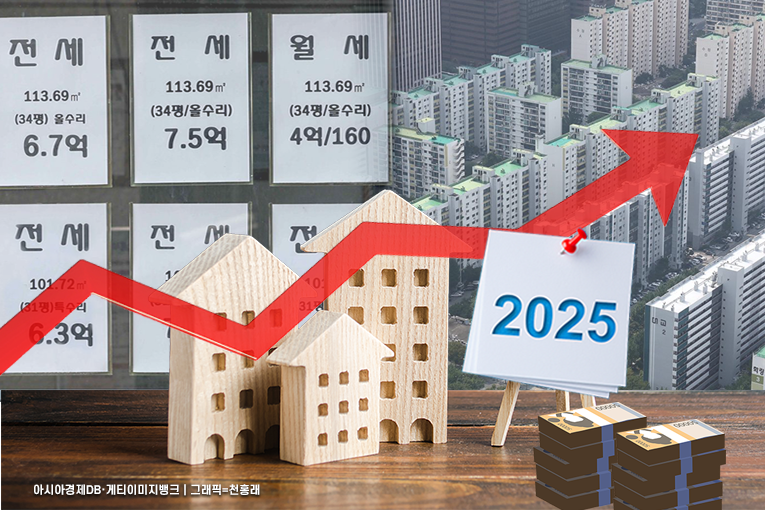
The increase in Seoul's jeonse (long-term lease) prices has slowed this month, and the number of listings has risen, especially around complexes scheduled for move-in. However, forecasts suggest that jeonse prices will rise even further next year. Despite the increase in available properties, the current supply is still below the annual average, making it unlikely for prices to drop.
Seoul Apartment Jeonse Listings Rise from 26,000 to 33,000 Units... Increase Centered on Areas with New Complexes Scheduled for Move-in
According to the real estate big data platform 'Asil' on the 23rd, as of the 20th of this month, there were 32,687 apartment jeonse listings in Seoul. This is 6,000 more than in August (26,539 units). Jeonse listings have been steadily accumulating since August.
The districts with the most listings were Dongdaemun, Seongdong, and Gangdong. In Dongdaemun-gu, the number of apartment listings reached 1,611 this month, more than triple the 465 units in August. In Seongdong-gu, listings increased from 823 to 1,609 during the same period, and in Gangdong-gu, from 3,647 to 4,132 units.
Jeonse listings surged in anticipation of new apartment move-ins. For example, the first jeonse listing for Raemian La Grande in Imun-dong, Dongdaemun-gu, which is scheduled for move-in in January next year, appeared on August 24. The number started at 74 units and has since increased to 875 units this month, accounting for 95.7% of all jeonse listings in Imun-dong, Dongdaemun-gu.

In Seongdong-gu, Seoul Forest I-Park Riverforet 1st Complex in Seongsu-dong is scheduled for move-in in January next year. The first jeonse listing was registered on September 26. The number of listings, which was 7 at that time, has grown to 321 units this month.
In Gangdong-gu, many jeonse listings were found at Olympic Park Foreon in Dunchon-dong, which is scheduled for move-in from last month through March next year. As of August, this complex had 2,268 jeonse listings, which increased to 2,780 units this month.

The rate of increase in Seoul apartment jeonse prices is also slowing. According to the Korea Real Estate Board, the jeonse price growth rate for Seoul apartments peaked at 0.86% in July and has since declined to 0.21% last month.

By district, Dongdaemun-gu's growth rate has slowed from 0.76% in August to just 0.11% last month. In Seongdong-gu, the rate dropped from 1.55% in July to 0.35% last month. In Gangdong-gu, the price increase fluctuated, and last month, jeonse prices even fell by 0.04%.
Experts: "Even if Listings Temporarily Increase, Jeonse Prices Will Rise Further"
Experts predict that although jeonse listings are accumulating in some parts of Seoul, overall jeonse prices for Seoul apartments will continue to rise. Ham Youngjin, head of the Real Estate Research Lab at Woori Bank, and Kim Hyoseon, chief real estate specialist at NH Nonghyup Bank, pointed out, "Although the number of new apartment move-ins in Seoul will increase next year compared to this year, supply remains insufficient compared to previous years, so jeonse prices are likely to rise."
Ham stated, "Jeonse listings for complexes scheduled for move-in typically appear 3 to 6 months before occupancy, and most new apartment move-ins in Seoul next year are concentrated in the first quarter. Starting from the second half of next year, supply shortages are expected to drive jeonse prices up again." He added, "The number of apartment move-ins in Gyeonggi-do also affects Seoul's jeonse prices, and next year's supply is expected to decrease by 40,000 units compared to this year, which is another factor pushing prices up."

According to real estate information provider Real Estate R114, excluding rental units, the number of new apartment move-ins in Seoul next year (as of the 20th) is 30,213 units. Of these, 32.2% (9,723 units) will move in during the first quarter. The number of new apartment move-ins in Seoul was 44,529 units in 2020, but has since decreased to the 20,000-30,000 range.
Kim noted, "There is also a possibility that demand for home purchases may shift to jeonse, further driving up jeonse prices." He explained, "With the base interest rate expected to be cut twice next year, jeonse loan rates will also be lower than this year. As the sales market remains stagnant, demand is likely to concentrate on jeonse for the time being."
-

Reporter Park SeungUk ty1615@asiae.co.kr
-
Edit Kim Hyunhee faith100@asiae.co.kr
© The Asia Business Daily(www.asiae.co.kr). All rights reserved.
!["Please Help Us": How Much Do Those Bowing 90 Degrees These Days Actually Earn? [Data Pick]](https://cwcontent.asiae.co.kr/asiaresize/323/2026052010120870131_1779239528.png)