Oldest Champion Wins Major: The Senior Open Victory
Results Achieved by Quitting Soda, Cigarettes, Alcohol and Focusing on Training
Consistently Hosting Tournaments, Aiming for 10 More Years as a Player
“I Want to Ensure Retired Players Face No Financial Hardships”
Choi Kyungju is the “big brother.” Born in 1970 in Wando, Jeonnam, he started with weightlifting in middle school and began playing golf at Wando Fisheries High School. He is a “living legend of Korean golf” with 17 wins on the Korea Professional Golfers’ Association (KPGA) Tour and 8 wins on the PGA Tour. Last May, he set the record for the oldest champion on the KPGA Tour at the SK Telecom Open, and in July, he captured the major senior event, The Senior Open. He also secured a spot in next year’s The Open. Now, with just two more PGA Tour events, he will reach the milestone of 500 career appearances.


Even with numerous records in the world of golf, Choi Kyungju still has a dream he wants to fulfill: playing a round with his second son, Kang Jun, who is currently a junior at Duke University in the United States. In an interview with Asia Economy at his foundation office in Yongsan-gu, Seoul, on the 14th, he said with a big smile, “I’ve applied to play in next month’s PNC Championship, an event tournament. I’m looking forward to enjoying a round with my son.” The PNC Championship is a tournament for players who have won majors or The Players Championship and their family members. The partner cannot be a professional. “Kang Jun has about two and a half years left before he graduates and turns pro. Until then, I’ll work hard to maintain my playing ability so I can keep competing on tour.”
The following is a Q&A with Choi Kyungju, who seems to be turning back the clock.
-You had a meaningful year. How did you spend your time after the season ended?
▲I returned from Phoenix, Arizona last Tuesday (the 12th). After coming back to Korea, I’ve been busy with foundation events. This year, I also became an ambassador for CGN (a missionary media created by Onnuri Mission Foundation). I have many overdue commitments. It looks like it will be a very busy week.
-You must be busy during the off-season in the US as well.
▲My home is in Dallas, Texas. My schedule is packed there too. Every winter, we run a junior winter training camp at my house. I also need to upgrade the facilities. Since I’m still an active player, there’s a lot to prepare. I enjoy working with the juniors. They like practicing together. When I show them how to hit shots during practice, they enjoy it. Of course, I get less practice than if I were alone, but spending time with the juniors is meaningful. Spending the whole day together even seems to improve my own health.

K.J. Choi is smiling while holding the Claret Jug immediately after winning the major tournament, The Senior Open Championship, held last July at the Carnoustie Golf Links in Scotland, UK. Carnoustie (Scotland) = AP·Yonhap News Photo
원본보기 아이콘-This year you also won The Senior Open, a major on the senior tour, and the KPGA Tour SK Telecom Open.
▲Going through tough times helped a lot. Five years ago, I had thyroid surgery. My weight dropped to 79kg. It took about four years to recover. I trained extremely hard. I haven’t touched alcohol at all. I don’t drink soda or coffee either. I tried to provide as much nutrition as possible. Now I’m back to my prime weight of 92kg. Taking care of my body makes me feel refreshed in the morning. It feels like a fallen tree standing up again. In the past, I would open my eyes in the morning but didn’t want to get up. Over the past 4-5 years, I’ve built my body through systematic training.
-How much do you train each day?
▲At least four hours a day, excluding rounds. I do squats, push-ups, grip strength training, etc. every day. Right now, I use a 140-pound grip trainer, but as I get used to it, I plan to try a 200-pound one like Major League players. On the senior tour, the short game is important. About 30% of my shot training is focused on the short game. If you lose touch in the short game, problems arise. I practice bunker shots for about two hours.
-You’re nicknamed the “Master of the Bunker.” Do you still prefer bunkers over the rough?
▲Grass can be deceiving. It’s hard to get a feel for it. But bunkers never lie. If you hit the face correctly, you can always stop the ball. Gary Player (South Africa) was a legendary golfer who practically lived in the bunker. Bunker shots made up 80% of his training. I’ve loved bunkers since I was young. I once practiced bunker shots for about five hours at Myeongsashimni in Wando. If someone had taught me the technique for bunker shots, I wouldn’t have gotten this far. I naturally learned the spacing for hitting behind the sand. When my ball lands in a bunker, I have my own set rules. I’ve used them my whole life.
-We can’t leave out the SK Telecom Open held last May.
▲Something unbelievable happened. There’s no guarantee even if you hit it a million times. In the first playoff, my second shot went into the water hazard. I hit it fat. Miraculously, the ball landed gently on a small island-like spot surrounded by rocks in the creek. There was a rock 30cm in front of the ball, so I used a 59-degree wedge instead of a 54-degree wedge and managed to get it onto the green and save par. Then, in the second playoff, I made par again and won. It’s a moment I’ll never forget. I think it’s hard to explain without calling it an act of God. Many people saw this moment. I think showing this is a kind of testimony.
-You said it was by God’s grace.
▲I’ve had moments like this before. In December 2000, I took the Q-School to challenge for the PGA Tour. The pressure was overwhelming. On the final day, on the 18th hole of the 6th round, I had a 4-meter uphill hook putt. As I looked at the line, praying, I felt peace in my heart. God showed me the line as if with white chalk. Making that putt allowed me to pass Q-School. I still can’t forget that moment. I haven’t had to go to Q-School since. The same goes for this year’s SK Telecom Open. It was an incredible event. I believe I had a positive influence through moments like this.

K.J. Choi is smiling brightly on a small island at the 18th hole after winning the SK Telecom Open, part of the Korea Professional Golfers' Association (KPGA) Tour, held last May at Pinx Golf Club in Seogwipo, Jeju Island. Photo by KPGA
원본보기 아이콘-I heard you still study hard. Is there still more to learn?
▲There’s always something to learn, even at my age. You have to study. (Bernhard) Langer (Germany), who dominates the senior tour, is truly amazing. His eyes, body, and mental strength are all excellent. He plays his own game even against younger players who hit farther. He never wavers. Langer strictly follows his routine, from eating to stretching and exercise. He never skips the basic exercises that athletes should do. He takes every step, never slacking off. He’s also very faithful and never inconveniences others. He’s a great role model for younger players.
-Any advice for younger players?
▲It’s important to stay focused during training. Once you get married and have a child, everything changes. Training time decreases. To maintain good results on tour, you have to strictly keep your training hours. I’m always grateful to my wife (Kim Hyunjung). She never calls me during training. She’s my benefactor.
-In a previous interview, you said you wanted to reach 10 wins. Does that still hold?
▲(Smiling) It seems unlikely I’ll reach 10 wins on the PGA Tour. It’s not something human strength alone can achieve. To win on the regular tour, you need to hit 300 yards. Now, I don’t even reach 270 yards. There’s a gap of over 60 yards with the younger players. The challenge is to maintain flexibility and hit accurately and long. I have to manage my body well. I need to carry 270-280 yards. If I can reach that distance, I think I have a good chance. Without preparation, you can’t compete on the field.
-I heard you walk a lot for exercise.
▲On the senior tour, you can use carts except in major events, but I never ride a cart. It’s a rule for me. Sitting for long periods causes problems with pelvic rotation. Golf is a full-body exercise. The reason Tiger Woods (USA) struggles is because of an ankle injury after a car accident. At impact, your whole body has to rotate as one, but his upper body turns first. That causes issues with the ball. Maintaining balance during the swing is important. That’s why I walk during rounds to keep my sense of balance.
-How long do you plan to keep playing, and what do you want to do after?
▲I think my physical condition is better than in my 40s. I want to play for about 10 more years. After retirement, I don’t plan to go into business. I want to nurture the next generation. I want to raise people who contribute to society and lead with good character. My motto is courtesy, self-control, and humility. I always tell young people to greet others well. I want to raise responsible, polite, talented golfers with good etiquette. I believe giving back as much as I’ve received is how I contribute to society. I want to help create good people who care for the vulnerable.

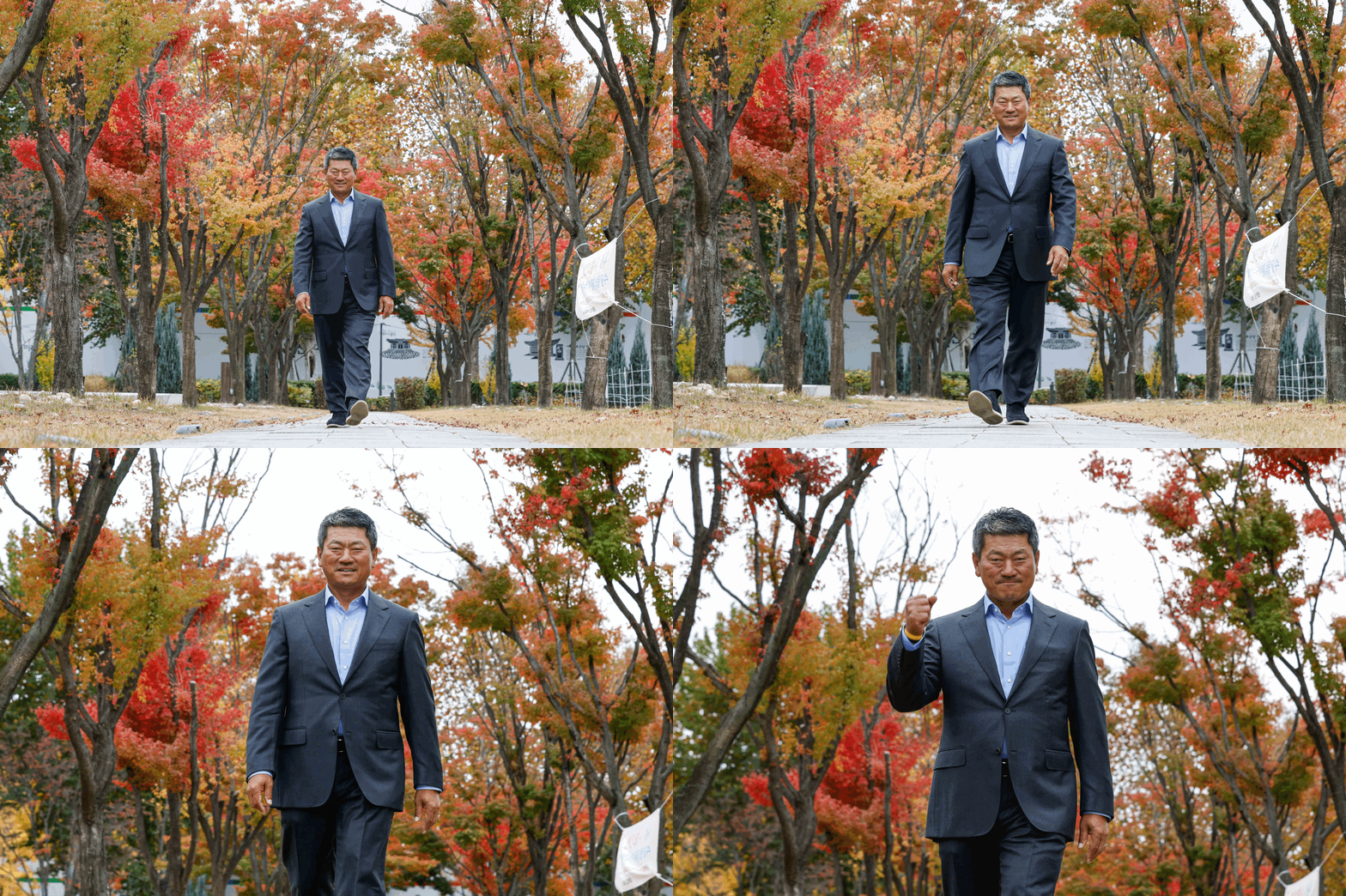
Pro Kyung-Ju Choi, who set the record for the oldest winner on the KPGA Tour this year, is being interviewed on the 14th at the Kyung-Ju Choi Foundation in Yongsan-gu, Seoul. Photo by Jin-Hyung Kang
원본보기 아이콘-You’ve led your scholarship foundation for 17 years. Is there a special reason?
▲It’s something I can do because I have many good people around me. I couldn’t do it alone. I thought about what I could do for the golf world. I became interested in the foundation, and sponsors came along. I’m especially grateful that the juniors have grown up well. This year, we’re selecting the 15th class of new students. I always emphasize certain things to young players: always greet others. Also, don’t play slowly as a player. Don’t take pleasure in your opponent’s mistakes. It’s important to make your playing partners comfortable. It’s not easy, but I tell them to give their partners a chance. In over 30 years as a player, I’ve never blamed my opponents. I teach the basics to the juniors: etiquette, how to eat, how to speak, interviews, how to grip the club, etc. If you build the basics well, everything else follows.
-You’ve consistently hosted the Choi Kyungju Invitational. Why?
▲There are no tournaments in Asia named after a golfer. In the US, there are many events hosted by Jack Nicklaus, Arnold Palmer, Woods, and others. They treat the players extremely well. I wanted to give gifts to players through a special invitational. Every time I host the tournament, I think about what more I can do for the players. I believe hosting the invitational also helps Korean professional golf. Seeing the tournament improve every year makes me proud. I want to establish it as an event that satisfies the host, the domestic men’s golf world, and the golf courses.
-What do you plan to do in the future?
▲I will continue to host tournaments where players can perform well. I want to offer events with clear distinction. Wherever I go, I want to nurture competitive players. A great era for men’s golf is coming soon. Men’s tournaments are much more dynamic. I want to contribute to the development of Korean men’s golf. In Korea, players have no money after retirement. They face financial difficulties. In the US, retired golfers are offered various jobs, such as pool manager. In Korea, it’s hard for good players to keep emerging when they have to worry about life after retirement. We need to improve the overall culture and systems related to sports.
IndexManbojeong's Counseling
- Choi Kyungju Says, "I Don't Even Use a Cart Because I Want to Play on the PGA Tour with My Son"
!['WHO Declares International Public Health Emergency' Why the Untreatable 'Variant Ebola' Is More Deadly Than COVID-19 [Reading Science]](https://cwcontent.asiae.co.kr/asiaresize/323/2026052110164072055_1779326201.png)
!["Please Help Us": How Much Do Those Bowing 90 Degrees These Days Actually Earn? [Data Pick]](https://cwcontent.asiae.co.kr/asiaresize/323/2026052010120870131_1779239528.png)