![The Joint Chiefs of Staff announced that North Korea blew up a section of the inter-Korean roads on the Gyeongui Line and Donghae Line on the 15th. The photo shows the scene of the Gyeongui Line road explosion captured by our military CCTV. [Image source=Yonhap News]](https://cphoto.asiae.co.kr/listimglink/9/2024101714295862723_1729142998.gif)
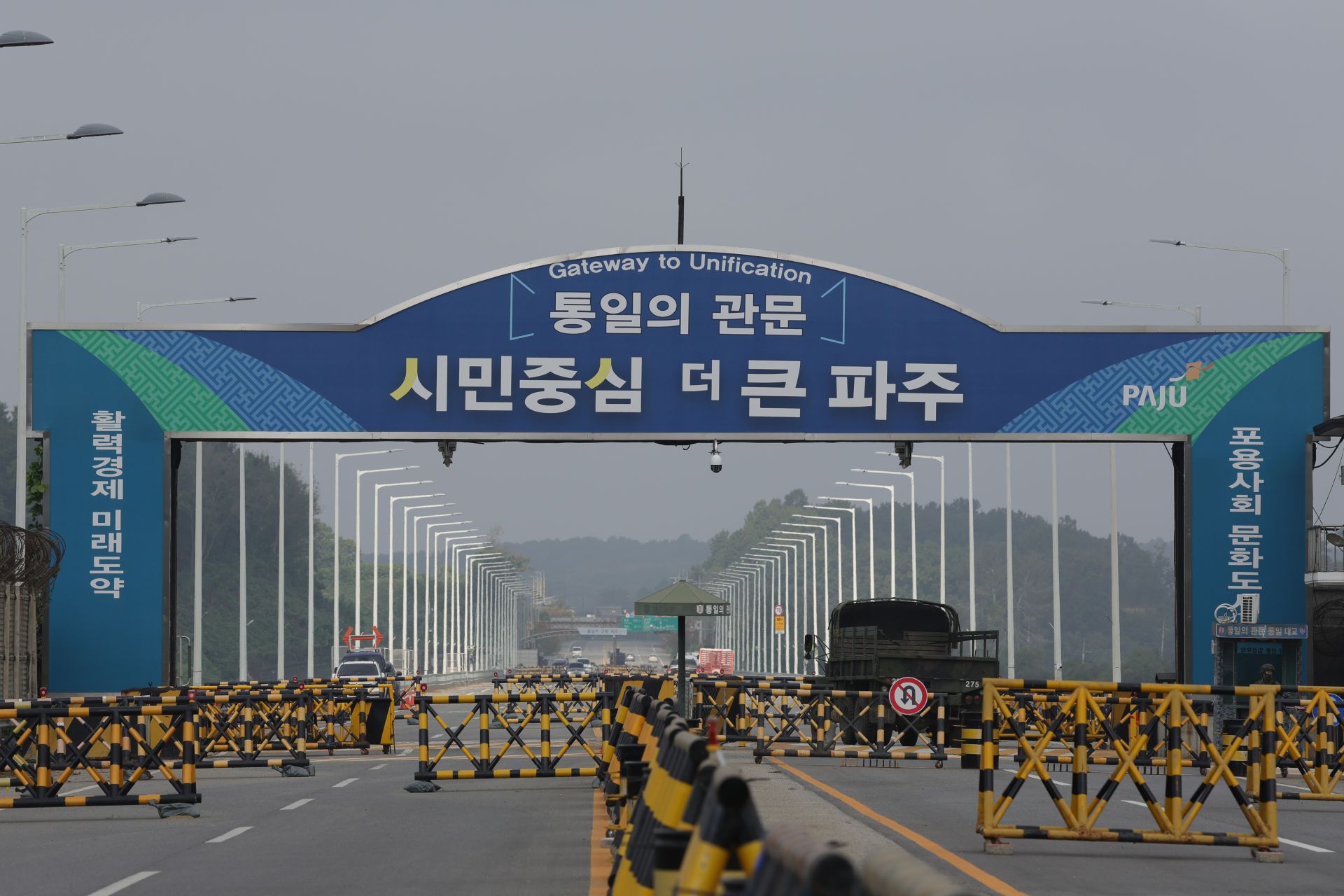
North Korea has once again chosen a "demolition show." The demolition of the Gyeongui Line and Donghae Line roads on the 15th is analyzed as a performance intended to assert its dominance over the situation on the Korean Peninsula. This marks the fifth demolition show so far.
![The Joint Chiefs of Staff announced that North Korea blew up a section of the inter-Korean connecting roads on the Gyeongui Line and Donghae Line on the 15th. <br>[Image source=Yonhap News]](http://www.asiae.co.kr/en/news/img_view.htm?img=2024101714134162690_1729142021.jpeg)
The Joint Chiefs of Staff announced that North Korea blew up a section of the inter-Korean connecting roads on the Gyeongui Line and Donghae Line on the 15th.
[Image source=Yonhap News]
North Korea's first demolition show was in 2008. Claiming to demonstrate its commitment to denuclearization, North Korea blew up the cooling tower of the Yongbyon nuclear reactor. At 5:05 p.m. on June 27, 2008, the reactor cooling tower in Yongbyon County, North Pyongan Province, was demolished in just one or two seconds, leaving no trace. The scene of the cooling tower, seen as a symbol of North Korea's nuclear tests, being destroyed was broadcast live to the world, raising hopes for the dismantlement of North Korea's nuclear program.
The United States offered to remove North Korea from its list of state sponsors of terrorism as an incentive, but when the process was delayed, North Korea responded in August 2008 by halting the disablement of its Yongbyon nuclear facilities. In October, the U.S. removed North Korea from the list, and North Korea resumed disablement work. However, the two sides soon clashed again, with the U.S. suspending heavy fuel oil aid and North Korea resuming the reprocessing of spent fuel rods.

Report on the demolition of the inter-Korean connecting road revealed at the bottom of the front page of the North Korean Rodong Sinmun on the 17th.
원본보기 아이콘After the 2008 Cooling Tower Demolition, Another Nuclear Test
The nuclear verification process was reset to square one at the end of the same year. The Six-Party Talks collapsed over the timing and methods of additional verification. In 2009, North Korea expelled International Atomic Energy Agency (IAEA) inspectors from the Yongbyon nuclear facility, reinstalled components, and pushed ahead with the reprocessing of spent fuel rods to extract plutonium, a key ingredient for nuclear weapons. Ultimately, North Korea conducted its second nuclear test in May 2009. In 2013, it announced that it would restart all nuclear facilities and reactors at Yongbyon, returning its nuclear operations to their original state.
The demolition show continued with the nuclear test site. On November 29, 2017, after launching the Hwasong-15 ICBM, North Korea declared the completion of its nuclear force and, claiming no further nuclear tests were needed, demolished the Punggye-ri nuclear test site in Kilju County, North Hamgyong Province. North Korea emphasized that this measure was part of the international community's nuclear disarmament efforts. However, North Korea did not change. There is now speculation that North Korea's seventh nuclear test could take place around the time of the U.S. presidential election. The time from decision to execution is expected to be very short. In the end, North Korea has managed to achieve what it wanted.
GP Demolished According to Military Agreement, But It Was a Deception
On November 2018, in accordance with the September 19 inter-Korean military agreement, North Korea claimed to withdraw its frontline guard posts (GPs) and demolished 10 of them. There are claims that the Moon Jae-in administration, during its on-site verification, announced that North Korea's GPs were militarily disabled without confirming whether key underground facilities were destroyed. In reality, only the above-ground posts were demolished, while underground facilities remained intact.
North Korea's demolition show to demonstrate its intention to sever inter-Korean ties also took place in 2020. It unilaterally demolished the Inter-Korean Liaison Office in the Kaesong Industrial Complex. At the time, North Korea cited the distribution of anti-North Korean leaflets by defector groups as the reason for the demolition. The day after the demolition, North Korea announced the "next phase of military action plans against the enemy." It warned of redeploying troops to the Mount Kumgang tourist area, the Kaesong Industrial Complex, and guard posts (GPs) in the Demilitarized Zone (DMZ), as well as resuming military drills in the West Sea.
![Amid North Korea's directive from the General Staff of the Korean People's Army for border artillery units to be in full firing readiness, on the afternoon of the 14th, coastal artillery gun barrels installed on the Hwanghae Province coast of North Korea, as seen from Daeyeonpyeongdo Island in Ongjin County, Incheon, were open. [Image source=Yonhap News]](http://www.asiae.co.kr/en/news/img_view.htm?img=2024101714182362702_1729142303.jpeg)
![Under the directive of the General Staff of the Korean People's Army, North Korea has ordered artillery units near the border to be in full firing readiness. On the afternoon of the 14th, coastal artillery gun barrels installed along the coast of Hwanghae Province, North Korea, as seen from Daeyeonpyeongdo Island, Ongjin County, Incheon City, were open. <br>[Image source=Yonhap News]](http://www.asiae.co.kr/en/news/img_view.htm?img=2024101714182562704_1729142305.jpeg)
Emphasizing the Border, Possibility of Maritime Provocations Following Land Actions
Given these circumstances, there is speculation that North Korea may take related measures at sea following the demolition of the Gyeongui Line and Donghae Line roads on land. Previously, North Korea declared it could not recognize the Northern Limit Line (NLL) and was expected to establish a "national border" through constitutional amendment at the Supreme People's Assembly (its parliament) on the 7th. However, contrary to expectations, North Korean media did not report on this matter. Whether or not a new border clause has been established has not yet been confirmed, but considering North Korea's recent actions, the possibility of maritime provocations remains.
Meanwhile, North Korea did not inform the public or the outside world about the demolition of the inter-Korean roads on the Gyeongui and Donghae Lines. This is a sharp contrast to June 16, 2020, when North Korea demolished the Inter-Korean Liaison Office in the Kaesong Industrial Complex and the Korean Central News Agency reported it the same day, followed by Rodong Sinmun the next day.
A government official said, "North Korea has been working to sever the Gyeongui and Donghae Lines since the end of last year, and since it had already announced earlier this month that it would cut the inter-Korean roads and railways, it may have felt there was no need to make a separate announcement about the result."
-

Reporter Yang Nakgyu if@asiae.co.kr
-
Edit Sung Kiho kihoyeyo@asiae.co.kr
© The Asia Business Daily(www.asiae.co.kr). All rights reserved.
!["Please Help Us": How Much Do Those Bowing 90 Degrees These Days Actually Earn? [Data Pick]](https://cwcontent.asiae.co.kr/asiaresize/323/2026052010120870131_1779239528.png)