"Job- and Performance-Based Compensation Systems and Flexible Work Arrangements Should Be Expanded in Technology-Driven Industries"
FKI Seminar on Labor Market Reform for Enhancing Employment Flexibility
Amidst a period of major industrial transformation, experts are highlighting the need to develop customized measures to enhance employment flexibility based on the production structure and occupational composition of each industry.

Yoon Dongyeol, Professor at Konkuk University, emphasized at the "Seminar on Labor Market Reform for Enhancing Employment Flexibility and Expanding the Employment Safety Net," hosted by the Federation of Korean Industries at the FKI Tower Conference Center in Yeouido, Seoul, on May 19, that "AI and digital technology-driven industries are highly project-oriented and rely heavily on highly skilled professionals. Therefore, it is necessary to expand job- and performance-based compensation systems instead of seniority-based pay, and to promote flexible work arrangements such as working hours accounts and discretionary working hours systems so that professionals can autonomously manage their working hours."
Professor Yoon further explained, "In the traditional manufacturing sector, to respond to changes in production processes and demand, it is necessary to improve internal flexibility by clearly stipulating the reasons and procedures for job reassignment in the law, so that existing employees can easily move to other processes or roles."
He added, "In the service industry, where labor demand is highly volatile and job roles are rapidly changing due to digital transformation, it is important to activate high-quality part-time jobs and flexible working hour options so that skilled and specialized workers can work as much as they want when needed. Additionally, there is a need to strengthen career transition and reskilling programs so that individuals can move into new roles even after taking a leave of absence or retirement."
Kim Kyupan, Senior Research Fellow at the Korea Institute for International Economic Policy (KIEP), stressed the need for tailored support for both the elderly·and youth when discussing measures to expand the employment safety net.
Research Fellow Kim stated, "For the elderly, continued employment can be constrained by wage declines and job insecurity after the retirement age." He suggested, "We should benchmark Japan's 'Elderly Employment Continuation Benefit,' which provides direct support to elderly workers whose wages fall below a certain level, to encourage continued employment among older workers."
He continued, "For the youth, Japan viewed the 'Employment Ice Age Generation' (late 2000s) not just as a youth unemployment issue, but as a structural problem of prolonged failure to enter the labor market at a certain period. It is worth noting that the central and local governments cooperated to implement measures such as job matching, vocational training, public sector hiring, and support for social participation."
He also noted, "With the expansion of spending on maternity protection benefits such as parental leave, the financial burden on the employment insurance fund is increasing." He added, "It is necessary to strengthen the soundness of the employment insurance fund, either by expanding the government's burden for maternity protection benefits or by diversifying funding sources through separate accounts and the utilization of other funds, as is done in Japan."
Kim Wonki, Professor at Sungshin Women's University, suggested that discussions on labor market flexibility should be accompanied by measures to protect the income of the unemployed and promote reemployment, using the U.S. employment safety net as an example. He said, "In the U.S., when unemployment rates rise above a certain level due to economic downturns, an extended benefits system is implemented, lengthening the period for unemployment benefits by 13 to 20 weeks." He added, "Korea should also carefully design the requirements, duration, and level of unemployment benefits, taking into account the possibility of prolonged unemployment periods and weakened incentives for reemployment."
Hot Picks Today
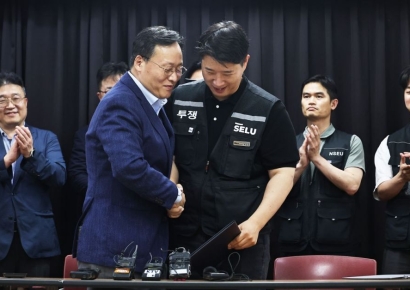 Up to 600 Million Won for Semiconductors, 160 Million Won Bonus for Loss-Making Non-Memory… Samsung Electronics Labor and Management Reach Tentative Deal on Unprecedented Performance Compensation (Comprehensive)
- "Could I Also Receive 370 Billion Won?"... No Limit on 'Stock Manipulation Whistleblower Rewards' Starting the 26th
- "From a 70 Million Won Loss to a 350 Million Won Profit with Samsung and SK hynix"... 'Stock Jackpot' Grandfather Gains Attention
- U.S. Stocks Up 1% on War Negotiation Hopes... Will Korea Recover Recent Losses? [Good Morning Market]
- "Who Is Visiting Japan These Days?" The Once-Crowded Tourist Spots Empty Out... What's Happening?
Jung Chul, Chief Research Officer at the Federation of Korean Industries and President of the Korea Economic Research Institute, emphasized, "As technological change accelerates, companies need to be able to manage their workforce more flexibly in line with changes in research and development, production, and service provision." He added, "However, to ensure that this flexibility does not lead to heightened worker anxiety, it is essential to strengthen job transition training and career support to build an employment safety net that guarantees job mobility."
© The Asia Business Daily(www.asiae.co.kr). All rights reserved.







