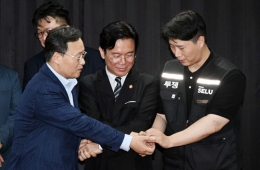
Samsung Biologics Labor and Management at a Crossroads Over Second Strike as Talks Move Behind Closed Doors
No Agreement Reached at May 8 Tripartite Meeting
Continued Attention on Ongoing Talks as Discussions Move Behind Closed Doors
The labor and management at Samsung Biologics, which have been in sharp conflict over wage negotiations and improvements to the personnel system, have shifted to closed-door talks, marking a turning point in the ongoing strike situation. As the dispute has moved toward practical negotiations with mediation from the Ministry of Employment and Labor, the previously anticipated second general strike has been put on hold for now.
According to industry sources on May 11, the labor and management at Samsung Biologics held a three-party meeting hosted by the Ministry of Employment and Labor on May 8, but failed to reach a final agreement. After the meeting, the union stated that while no concrete agenda items were produced, it decided to continue discussions in light of the ministry's mediation and the fact that Samsung Electronics has also entered the post-mediation process. Both parties accepted the ministry’s recommendation to keep the talks confidential. The management also said, "Although we did not reach an agreement at the meeting, both sides have agreed to continue discussions," adding, "All details of the negotiations will remain confidential until a tentative agreement is reached."

Originally, labor and management were scheduled to hold a one-on-one meeting between their representatives on May 6. However, the union unilaterally disclosed the details and recording of a phone conversation on May 5, which management claimed undermined trust and made further dialogue difficult. The union countered that it had only explained to its members that the company’s position had not changed, and criticized management for using this as a pretext to cancel the talks, calling it a stalling tactic.
The situation at Samsung Electronics is also a major variable in the negotiations. The labor and management at Samsung Electronics, ahead of a general strike scheduled for May 21, will return to the bargaining table with government mediation. Negotiations will resume through a post-mediation process by the Central Labor Relations Commission on May 11 and 12, as both sides attempt to reach a last-minute settlement. The Samsung Electronics union is demanding a bonus equivalent to 15% of the company’s projected operating profit of 300 trillion won this year. The union’s willingness to compromise in response to government mediation is seen as having a positive influence on the Samsung Biologics union, leading to the postponement of the second strike and continued dialogue.
Although the atmosphere has shifted somewhat, there remain many challenges for labor and management to resolve. The main issues are the scale of wage compensation and whether the union will be involved in major management decisions. The union is demanding a 14% wage increase and a bonus of 30 million won per employee. Additionally, it is proposing a collective agreement that would require management to obtain prior union consent for new hires, mergers and acquisitions, and the introduction of new equipment or technologies. The union is also calling for a fixed wage increase of 3.5 million won for all employees. For new employees, these demands would result in an actual wage increase rate of 21.3%. In contrast, management has offered a 6.2% wage increase and a lump-sum payment of 6 million won. Management also maintains that personnel and management rights are the exclusive prerogative of executives and are therefore difficult to concede.
Another unresolved issue is the criminal complaint filed by management against six union executives and one member for obstruction of work related to the strike. Earlier, the company submitted a complaint, stating that the union had pushed ahead with the strike despite a court order restricting industrial action in the finishing process to prevent deterioration and contamination. The company estimates that the work stoppage, including the suspension of some anticancer drug production, has resulted in a loss of 150 billion won. However, in the industrial and labor sectors, there is an assessment that such mass legal action is not only a means to pressure the union, but also a strategic bargaining chip to induce the union to compromise at the final negotiation stage by offering to withdraw the complaints as a condition.
Hot Picks Today
!["It Has Now Crossed Borders": No Vaccine or Treatment as Bundibugyo Ebola Variant Spreads [Reading Science]](https://cwcontent.asiae.co.kr/asiaresize/93/2026052019230771274_1779272587.jpg) "It Has Now Crossed Borders": No Vaccine or Treatment as Bundibugyo Ebola Variant Spreads [Reading Science]
"It Has Now Crossed Borders": No Vaccine or Treatment as Bundibugyo Ebola Variant Spreads [Reading Science]
- Blue House Thanks Labor and Management of Samsung Electronics for Their Magnanimous Decision
- "From a 70 Million Won Loss to a 350 Million Won Profit with Samsung and SK hynix"... 'Stock Jackpot' Grandfather Gains Attention
- "Stocks Are Not Taxed, but Annual Crypto Gains Over 2.5 Million Won to Be Taxed Next Year... Investors Push Back"
- "Who Is Visiting Japan These Days?" The Once-Crowded Tourist Spots Empty Out... What's Happening?
After completing the first general strike held from May 1 to May 5, the union has returned to work and is now conducting an indefinite work-to-rule campaign by refusing overtime and holiday shifts. Although the talks have entered a new phase with closed-door discussions, the union has left open the possibility of launching a second general strike depending on the outcome of the negotiations.
© The Asia Business Daily(www.asiae.co.kr). All rights reserved.