[Good Morning Market] Soaring Oil Prices and Hawkish Fed... KOSPI Searches for Direction
Growing Concerns Over Energy Shock
Skepticism Over AI Infrastructure Investments by Microsoft and Meta
Sector-Specific Divergence Expected in the Market
With international oil prices surging and major U.S. big tech companies releasing their earnings, the New York stock market ended mixed, and the KOSPI is also expected to search for direction.
![[Good Morning Market] Soaring Oil Prices and Hawkish Fed... KOSPI Searches for Direction](http://www.asiae.co.kr/news/img_view.htm?img=2025092407532345650_1758668003.png)
On the 27th (local time), the Dow Jones Industrial Average closed at 48,861.81, down 280.12 points (-0.57%) from the previous session. The S&P 500 index ended at 7,135.95, down 2.85 points (-0.04%), while the tech-heavy Nasdaq Composite finished at 24,673.24, up 9.44 points (0.04%) from the prior close.
Concerns have emerged that the disruption in energy supplies may last longer than expected. The Wall Street Journal reported that U.S. President Donald Trump had ordered preparations for a prolonged maritime blockade against Iran to pressure the country into abandoning its nuclear program. U.S. online media outlets such as Axios noted that President Trump had recently held a private meeting with refinery industry executives to discuss the impact of the Iran situation on energy markets and possible countermeasures. At this meeting, it was reportedly shared that the maritime blockade against Iran could continue for several more months.
Brent crude oil futures surged 6.1% to close at $118.03 per barrel on the same day. During intraday trading, prices rose as high as $119.76 per barrel, marking the highest level in about four years since June 2022. Alphabet, Amazon, Microsoft, and Meta all reported earnings that exceeded market expectations. However, both Microsoft and Meta declined in after-hours trading, as concerns grew over their investments in artificial intelligence (AI) infrastructure following the earnings releases.
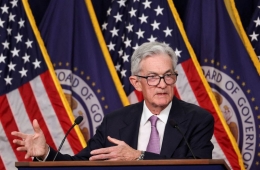
The U.S. central bank, the Federal Reserve (Fed), kept its benchmark interest rate steady at 3.50–3.75% as expected. Fed Chair Jerome Powell stated that, even after his chairmanship term ends on May 15 next month, he will remain on the Fed Board until investigations involving him are clearly concluded. In addition, three Fed members with voting rights on this year’s rate decisions—Beth Hammack, Neel Kashkari, and Lorie Logan—expressed opposition to including 'easing bias' language in the policy statement.
Market participants interpreted the Fed’s decision as hawkish (favoring monetary tightening). According to CME’s FedWatch, the interest rate futures market saw about a 12% probability that the Fed would raise the benchmark rate by at least 0.25 percentage points by December. This probability was 0% just a day earlier. The probability that the Fed will keep rates unchanged for the rest of the year rose from 80% the previous day to 85% on this day.
Bond yields climbed on concerns over prolonged high oil prices and expectations of the Fed’s hawkish policy stance (bond prices falling). According to electronic trading platform Tradeweb, the yield on 10-year U.S. Treasury notes stood at 4.42% at the close of the New York stock market, up 6 basis points (1bp=0.01 percentage point) from the previous session—the highest level in a month since the end of March. The yield on 2-year U.S. Treasury notes, which are sensitive to changes in monetary policy, rose 9 basis points from the previous close to 3.94% at the same time.
Hot Picks Today
!["What If the KOSPI Plummets?... Record Funds Flow into 'Target Maturity Funds' [Investment Trends]"](https://cwcontent.asiae.co.kr/asiaresize/93/2026043008433546440_1777506215.jpg) "What If the KOSPI Plummets?... Record Funds Fl...
"What If the KOSPI Plummets?... Record Funds Fl...
- "Parents Deposited 10 Million Won for Me"... Securities Accounts Surge 272% Amid...
- "Save 30 Million Won, Grow It to 100 Million": Dramatic Pledge Sparks "Is This a...
- "Major Crash Is Coming... Buy Even If You Have to Skip a Meal" 'Rich Dad' Shares...
- Did Her Wealthy Husband Quash the Investigation? Yang Jungwon Appears Before Pol...
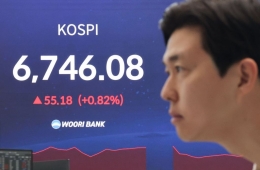
Ji Young Han, a researcher at Kiwoom Securities, said, "The domestic stock market is expected to show a differentiated trend between semiconductors and other sectors, with upward and downward factors mixed such as the burden of rising oil prices and hawkish rate holds." She added, "With the KOSPI having surged by more than 30% this month, there is a possibility that foreign investors could make mechanical adjustments to their holdings today, which is the MSCI rebalancing day."
© The Asia Business Daily(www.asiae.co.kr). All rights reserved.