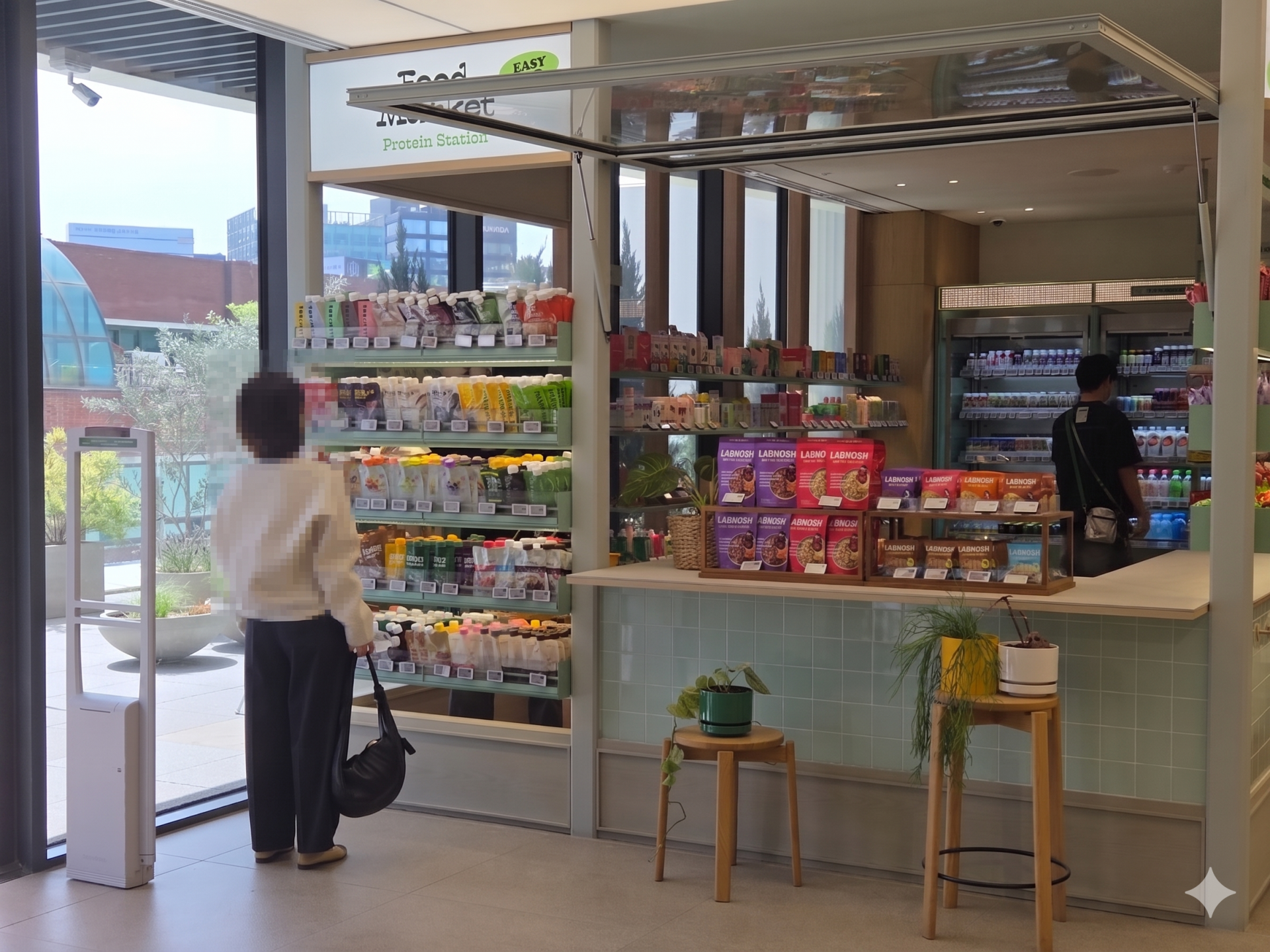
#On the morning of the 23rd, a variety of colorful pouch-type protein shakes were neatly displayed on the third floor of the Olive Young N store in Seongsu-dong, Seoul. A female customer in her 30s stood in front of the display, picked up several products, examined them closely for about five minutes, and finally walked away with a '1+1' promotional item in hand. An Olive Young store employee explained, "Quite a few office workers in the area purchase these as meal replacements, and foreign tourists are also showing interest. Products on '1+1' promotions tend to sell particularly well."

Pouch-type protein shake products displayed at Olive Young N store in Seongsu-dong, Seoul. Photo by Hyunjin Jung
원본보기 아이콘
Pouch-type protein shakes, which can be consumed simply by adding water or milk, are rapidly emerging as popular products. The market is expanding quickly, not only among men interested in fitness but also as these products appeal to Millennial & Gen Z women consumers in their 20s and 30s.
According to the retail industry on April 27, sales of pouch-type sports drinks and protein shakes at CJ Olive Young grew by 95% last year compared to the previous year. There are about 90 protein shake brands available at CJ Olive Young and its wellness platform, Olive Better. These brands collectively offer around 1,300 different products.
At Olive Better’s Gwanghwamun and Gangnam branches, as well as other stores in areas with a high concentration of younger consumers, large sections are dedicated to pouch-type protein shakes. On the Olive Young application, 9 out of the top 10 best-selling 'protein shake' menu products are pouch-type.
A representative from Olive Young stated, "As Millennials & Gen Z consumers focused on fitness and self-care increasingly seek convenient meal solutions, the popularity of protein shakes is rising. Among the wide variety of protein shake products, portable formats such as pouch-type are particularly well-received by consumers."

Pouch-type protein shakes have also established themselves as a prominent category on convenience store shelves. As a representative 'healthy pleasure' product, more Millennials & Gen Z focused on health management are choosing pouch-type protein shakes as meal replacements. Sales of Seven Eleven's 'Everyday One Meal Protein Shake' (chocolate, grain, sweet corn), launched in January and April, increased by 56% in March compared to the initial launch in January, and by 85% in April (based on April 1-22).


As consumer demand for pouch-type protein shakes rises, manufacturers are rushing to launch new pouch-type options. The share of related sales among food manufacturers has also increased. Sales of CJ CheilJedang’s pouch-type protein shakes ‘Danbaekhani’ and ‘Balance Meal’, which were launched after October last year, reached a cumulative total of 1 million units as of mid-April, just six months after launch. CJ CheilJedang currently offers three types of Danbaekhani Shakes (Signature, Chocolate, Matcha) and three types of Balance Meal Shakes (Oat, Chocolate, Nut). The proportion of pouch-type sales among all protein shake products sold by CJ CheilJedang surpassed 50% for the first time in February, and this trend has continued through March and April.
The powdered protein market, which used to be dominated by male fitness enthusiasts, is now seeing a major shift, with women in their 20s and 30s making up more than half of consumers. According to market research firm Embrain, as of December last year, women in their 20s or younger accounted for 30.7% and women in their 30s for 20.5% of all pouch-type protein shake purchasers at major distribution channels over the past year. The emergence of new terms such as 'Danshae' (short for protein shake) highlights how protein consumption is spreading as a lifestyle choice.

According to Korea Agro-Fisheries & Food Trade Corporation (aT), the domestic protein food market has grown from around 120 billion won in 2019 to 450 billion won in 2024, with projections for this year reaching 800 billion won. Embrain’s analysis estimates that pouch-type protein shake sales at major distribution channels totaled 23.2 billion won over the past year, a 112.8% increase from the previous year. This is more than a fivefold increase compared to 4.3 billion won in 2023.
An industry official commented, "As protein products shift from being function-focused to convenient everyday foods, the product format itself has become a key competitive factor. In particular, pouch-type products are driving market growth by creating new demand thanks to their portability and convenience."
-

Reporter Jeong Hyunjin jhj48@asiae.co.kr
-
Edit Kim Hyunhee faith100@asiae.co.kr
© The Asia Business Daily(www.asiae.co.kr). All rights reserved.



![[On the Road] "Ten Times Safer Than Humans"... Pony AI Robotaxi Fleet to Reach 3,000 by Year-End](https://cwcontent.asiae.co.kr/asiaresize/304/2026042713351773476A.jpg)