Gyeongju Sees Clear Increase in Foreign Tourists...On-the-Ground Impact of Tourism Market Diversification
7.8% Rise in Visitors in Q1 This Year... 20.5% Surge in February
Eastern Historic Sites and Hwangnyongsa Temple Site Draw Crowds of Foreigners
Tourism Expands to Include Middle East, Southeast Asia, and Europe
The number of foreign tourists visiting Gyeongju is on the rise, with the impact of the 2025 APEC Summit spreading throughout the tourism market.
According to an analysis of the Korea Tourism Data Lab's statistics, Gyeongju City announced on April 16 that the number of foreign visitors in the first quarter of 2026 reached 244,739, an increase of 7.8% compared to 227,108 during the same period the previous year.
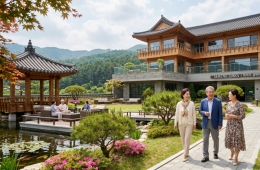
![A foreign tourist couple is touring the historic site around Hwangnyongsa Temple Site in Gyeongju. [Image provided by Gyeongju City]](http://www.asiae.co.kr/news/img_view.htm?img=2026041612492828741_1776311368.jpg)
A foreign tourist couple is touring the historic site around Hwangnyongsa Temple Site in Gyeongju. [Image provided by Gyeongju City]
View original imageBy month, 65,687 tourists visited in January 2026, a 4.3% rise from 62,968 in January 2025; in February, there were 67,822 visitors, up 20.5% from 56,284 the previous year; and in March, the figure was 111,230, a 3.1% increase from 107,856, showing an overall stable upward trend.
In particular, the increase in February, typically considered an off-season, was especially notable and drove the overall growth.
By country, Chinese tourists led the increase, accounting for approximately 46,000 people or 19% of the total. Russian and Indonesian tourists each accounted for 5.1% and 4.8%, while Americans made up 3%, reflecting diversification in the influx of tourists.
Recently, the areas around the Eastern Historic Sites and Hwangnyongsa Temple Site have seen a noticeable rise in visitors from the Middle East, Southeast Asia, and Europe, further highlighting the diversity of nationalities among foreign tourists.
Not only group tourists but also individual travelers are increasingly enjoying extended stays in the historic areas, engaging in activities such as photography and leisurely strolls.
The sight of Middle Eastern tourists wearing hijabs and individual Western travelers mingling together represents a shift from the previously Northeast Asia-centered tourist demographic.
The city believes that the rise in foreign tourists signifies not just an increase in numbers but also a transformation in the structure of the tourism market, and plans to expand tailored tourism content and convenience facilities accordingly.
Hot Picks Today
![[Exclusive] "What? I Used It for Fried Eggs and Kimchi Pancakes, but It Wasn't Edible?"... Raw Pork Lard Supplied to Department Stores, Causing Stir](https://cwcontent.asiae.co.kr/asiaresize/93/2026042216151436513_1776842114.png) [Exclusive] "What? I Used It for Fried Eggs and...
[Exclusive] "What? I Used It for Fried Eggs and...
- [Report] "Professionals in Their 30s and 40s With at Least 2 Billion Won in Cash...
- "From 8,000 Won to 730,000 Won: The Toy Everyone Wants but Can't Get"
- "375 Won Per Share" SK hynix to Pay 26.58 Billion Won Cash Dividend
- "Chairman Chey Tae-won's Warning Comes True"... Laptop Prices Already Up 1 Milli...
Choi Hyukjun, acting mayor of Gyeongju, stated, "With the growth in foreign tourists, diversification of the tourism market is accelerating. We will strengthen the foundation for extended-stay tourism by developing content tailored to each nationality and improving the tourism infrastructure."
© The Asia Business Daily(www.asiae.co.kr). All rights reserved.