Despite Ceasefire Hopes, Won-Dollar Exchange Rate Opens Up 11 Won at 1,512.2 Won (Update)
Dropped to the 1,490-won range in after-hours trading, then rebounded
As the United States and Iran remain locked in a war of nerves over ceasefire negotiations, the won-dollar exchange rate began trading on April 2 up nearly 11 won from the previous day.
On April 2, in the Seoul foreign exchange market, the won-dollar exchange rate opened at 1,512.2 won, an increase of 10.9 won compared to the previous trading day. The previous day, the exchange rate had closed at 1,501.3 won, plunging by 28.8 won on expectations of a ceasefire between the United States and Iran.
During after-hours trading, the rate dropped to the 1,490-won range, but rebounded to over 1,510 won as the United States and Iran exchanged comments on the progress of ceasefire talks.
U.S. President Donald Trump claimed on his social networking service, Truth Social, that "Iran has requested a truce with the United States." However, the Iranian Ministry of Foreign Affairs denied the claim, and the Islamic Revolutionary Guard Corps (IRGC) also stated, "The Strait of Hormuz will never be open to the enemy."
Subsequently, Iranian President Masoud Pezeshkian expressed a willingness to end the war in an open letter to the American people, stating, "Taking the path of confrontation comes with a high and meaningless price." President Trump is also scheduled to deliver a public address at 10 a.m. (local time, 9 p.m. on April 1) to update on the progress of the Middle East war and negotiations.

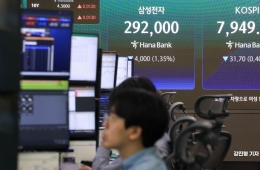
The KOSPI index surged over 5% on expectations, triggering a buy-side circuit breaker early in the session. On April 1st, the electronic board in the dealing room at the Hana Bank headquarters in Jung-gu, Seoul, displayed the status of the domestic stock market. On the same day, the won-dollar exchange rate began trading at 1508.5 won, down 21.6 won from the previous trading day. Photo by Kang Jin-hyung
View original imageWith renewed hopes for a ceasefire, the dollar is showing weakness. The dollar index, which measures the value of the dollar against the currencies of six major countries, is currently down 0.02% at 99.526. Overnight, it fell as low as 99.296, but trimmed its losses after the March U.S. manufacturing purchasing managers' index (PMI) came in above market expectations.
The New York stock market rose for a second consecutive day. The Dow Jones Industrial Average and the Standard & Poor's (S&P) 500 Index gained 0.48% and 0.72%, respectively. The Nasdaq Composite Index rose 1.16%.
Closing prices for June delivery Brent crude futures and May delivery West Texas Intermediate (WTI) futures also declined, but remained elevated at $101.16 and $100.12, respectively. The yen-dollar exchange rate fell 0.09% to 158.666 yen. The won-yen cross rate stood at 953.49 won per 100 yen, up 5.85 won from the previous day's 3:30 p.m. reference price of 947.64 won.
Hot Picks Today
 Up to 600 Million Won for Semiconductors, 160 Million Won Bonus for Loss-Making Non-Memory… Samsung Electronics Labor and Management Reach Tentative Deal on Unprecedented Performance Compensation (Comprehensive)
- "Could I Also Receive 370 Billion Won?"... No Limit on 'Stock Manipulation Whistleblower Rewards' Starting the 26th
- "From a 70 Million Won Loss to a 350 Million Won Profit with Samsung and SK hynix"... 'Stock Jackpot' Grandfather Gains Attention
- Opening a Bank Account in Korea Is Too Difficult..."It Costs 150,000 Won Just to Open a Child's Account or Check Card" [Foreigner K-Finance Status]②
- "Who Is Visiting Japan These Days?" The Once-Crowded Tourist Spots Empty Out... What's Happening?
Min Kyungwon, economist at Woori Bank, explained the reason for the decline in the value of the Korean won alone, saying, "It appears that the exchange rate was driven up overnight by offshore trading in the absence of foreign capital inflows, but there were no unusual trades. We estimate that the range-bound oil price and hedging against uncertainty may have led to demand for the won-dollar pair."
© The Asia Business Daily(www.asiae.co.kr). All rights reserved.
!["Please Help": How Much Do Those Bowing 90 Degrees Really Earn? [Data Pick]](https://cwcontent.asiae.co.kr/asiaresize/307/2026052010120870131_1779239528.png)